

The senses are so strong and impetuous that they can forcibly carry away the mind even of a man of discrimination who is endeavoring to control them.
Lord Krishna himself spoke these words 5,000 years ago during the great war of the Mahabharata, yet amid today’s worldly distractions, such as social media and entertainment, they have become more relevant than ever.
However, several people try to practice Brahmacharya in their lives but fail within a few days because of low willpower and a lack of proper understanding of the rules.
This guide will cover 25 essential Brahmacharya rules, classified into mental, physical, and speech, rooted in the Bhagavad Gita and Srila Prabhupada’s commentary. Whether you are a student, a married householder, or a spiritual seeker, these rules are perfect and applicable to everyone.
8 Mental Rules of Brahmacharya to Master Your Mind
Brahmacharya is all about controlling your senses and desire, so one can concentrate their full energy effectively and master their mind through guarding the 8 “breaks” of lust.
Below are the 8 rules Brahmacharya described perfectly:
1. Smarana (No Mental Recall)
The very first step in self-realization is knowing oneself to be distinct from the body. - Srila Prabhupada
One should not dwell upon or mentally revisit past sexual experiences. When the mind visualizes memories, immediately try to refocus on Hare Krishna Mahamantra.
2. Kirtana (No Lustful Speech)
One should speak only what is true, pleasing, beneficial, and not agitating to others. - Bhagavad Gita 17.15
Avoid discussing sexual topics or engaging in vulgar conversations and gossip. Values should guide your words and consistently focus on enhancing the subconscious mind's capacity.
3. Keli (No Flirtatious Play)
"The desire to gratify one's own senses is kāma [lust], but the desire to please the senses of Lord Kṛṣṇa is prema [love]." (Caitanya-caritamrita, Adi 4.165)
Abstain from activities like flirting or engaging in inappropriate humor with the opposite sex, because these harmless actions can lead to further temptations and can distract your mind’s focus.
4. Prekshana (No Lustful Gazing)
The eyes, if not controlled, will lead the mind toward objects of sense gratification, just as an untrained horse throws its rider, so one should not even sit on the same seat even with own mother, as the mind seeks only gratification, that's why it can get you attracted to the other sex. - Srimad Bhagavatam 9.19.17
Control your eyes from seeing unethical or provocative content, and do not look at the opposite sex with lustful intent. Try to train your mind to see nature and soul rather than focusing on the physical body.
5. Guhya - Bhashana (No Intimate Secrecy)
A brahmacārī should very strictly abstain from living with women and should not meet with gṛhasthas and those addicted to women. Nor should a brahmacārī speak in a lonely place with a woman. - Srimad Bhagavatam 7.12.9
Avoid talking in private, secretly, in an intimate way with the opposite sex. Maintain transparency and distance; keep all conversations professional to overcome attachment and vulnerability.
6. Sankalpa (No Sexual Intention)
Lord Śrī Kṛṣṇa said: O mighty-armed son of Kuntī, it is undoubtedly very difficult to curb the restless mind, but it is possible by suitable practice and by detachment. - Bhagavad Gita 6.35
Any moment lustful thoughts arise, take a deep breath and focus on higher consciousness. Do not allow the mind to think or plan how to act on the desires, make it senseless, and just focus on the Lord.
For example, even the great sage Saubari Muni fell from his austerities after being drawn by sense perception, a genuine proof that a stray thought can undo years of austerity.
7. Adhyavasaya (No Sensual Planning)
While contemplating the objects of the senses, a person develops attachment for them; and from such attachment lust develops, and from lust anger arises. - Bhagavad Gita 2.62
Do not think or visualize scenarios of sensual gratification. Mental brahmacharya is more important than physical celibacy; if you try to entertain your lustful thinking, the physical acts become much harder to refrain from.
For instance, despite thousands of years of tapasya, Rishi Vishwamitra's resolve broke when tested by Menaka, reflecting that external power alone cannot guarantee inner control.
8. Kriya - Nivritti (Complete Physical Abstinence)
One who can withdraw the senses from sense objects, as a tortoise draws its limbs within the shell, is firmly fixed in perfect consciousness. - Bhagavad Gita 2.58
Discard all the physical sexual indulgence activities from your life. By successfully winning and implementing the upper seven steps, this last physical rule becomes a natural byproduct rather than a struggle to attain this control and power.
Like, beyond the powerful demigods or great saints who were trapped in the era of lust, Haridas Thakur easily passed every test by chanting the holy name of the Lord, proving that devotion succeeds where mere austerity fails.
Speech Rules of Brahmacharya: How Your Words Break or Build Celibacy
The practice of Brahmacharya includes celibacy and control of the senses. Speech plays a vital role in directing both of these energies with an internal focus. However, the fundamentals are fully listed below:
- 01
Avoid Sexual or Intimate Speech
Restrict from talking about sex, indulging in filth, or making jokes with sexual tones. This also involves avoiding listening to or engaging in romantic gossip with the opposite sex. The Brahmacharya disciple should learn silence, study of Vedic knowledge, simplicity, celibacy, nonviolence, and equanimity in the face of material dualities such as heat and cold, happiness and distress. - Srimad Bhagavatam 11.3.24 - 02
Practice Truthfulness (Satya)
Your tongue or speech should always say the truth; speak purely, grounded with ethical words. Avoid unnecessary talk or manipulative language. Life is ruined due to irreligion manifesting in the forms of arrogance, lust for women, and intoxication. - Srimad Bhagavatam 1.17.24 - 03
Observe Moderate Speech (Vak-Nigraha)
Limit your tongue; speaking too much dissipates mental energy and distracts you from your spiritual and ethical discipline in living. And satisfaction, simplicity, gravity, self-control and purification of one’s existence are the austerities of the mind. - Srila Prabhupada, Bhagavad Gita 17.16 Purport - 04
Avoid Harsh or Angry Words
Do not use bad language with the intention of hurting others. Aggression without any reason decreases mental clarity and weakens self-control over one's thoughts and tongue. Nonviolence, truthfulness, freedom from anger, renunciation, tranquility... These are the divine qualities. - Bhagavad Gita 16.2 - 05
Control Hidden Desires
Make sure your speech or communication doesn't intend to attract anyone. The true focus of your words should always remain in spreading the holy name and spiritually uplifting knowledge. One who has not listened to the messages about the prowess and marvelous acts of the Personality of Godhead and has not sung or chanted loudly the worthy songs about the Lord is to be considered to possess earholes like the holes of snakes and a tongue like the tongue of a frog. - Srila Prabhupada, Srimad Bhagavatam 2.3.20 Purport
Brahmacharya Physical Rules: 7 Body Disciplines You Must Follow
According to yogic and Ayurvedic scriptures, Brahmacharya is a lifestyle that aims to preserve or redirect the vital forces of life to enhance mental clarity and physical energy. Let’s take a look at what physical rules can help us be holistic and well.
- 01
Mitahara (Sattvic Diet)
Eat only fresh, pure vegetarian food. Discard all spicy, oily, and stimulating foods containing onion and garlic, as these can interfere with your Brahmacharya practice. Foods in the mode of goodness increase the duration of life, purify one's existence, and give strength, health, happiness, and satisfaction. - Bhagavad Gita 17.8 - 02
Virya Raksha (Energy Preservation)
The most effective way to preserve your energy is to conserve your reproductive fluid. This results in a drastic decrease in energy associated with excessive physical indulgence. By practicing celibacy and developing renunciation, one's life of austerity is solidified, and the spiritual fire becomes brighter. - Srimad Bhagavatam 11.17.36 - 03
Indriya Nigraha (Control Over Senses)
Practice over and over, and try to train your senses and limit the body stimulation. Avoid viewing provocative visual content or indulging in romantic conversations, as they can trigger your latent desires. One who is unable to control his mind lives always with the greatest enemy, and thus his life and its purpose are spoiled. - Bhagavad Gita 6.6 - 04
Asana (Daily Yoga and Exercise)
Maintain a fit body and physical strength by working out daily, practicing yoga asanas, and practicing various breathing exercises. Regular movement helps in keeping the nervous system balanced. Performing one's prescribed duties is necessary to keep the body and soul together. - Bhagavad Gita 3.8 - 05
Brahma Muhurat Niyama (Regulated Sleep Cycle)
Wake up early in Brahma Muhurat and ensure to get 6-8 hours of proper rest. Avoid staying up late at night, as it can mess with the mind and make the body more prone to unusual thoughts and cravings for unhealthy foods. - 06
Saucha (Purification of the Body)
Bathe with moderately cool or cold water. Cold water helps regulate body temperature and stimulates the nervous system, so your body can respond with an immediate boost without causing restlessness. Cleanliness is essential for making advancement in spiritual life... external cleanliness means taking a bath daily. - Srila Prabhupada, Srimad Bhagavatam Purport - 07
Upavasa (Fasting for Self-Control)
Try occasional fasting to maintain your physical austerity and purify the digestive system, helping control overnight desires and vague thinking.
Ahara Niyama: 5 Dietary Rules of Brahmacharya for a Sattvic Life
Ahara Niyama are perfect Brahmacharya rules by utilizing a sattvic diet to stabilize hormones, calm the mind, and decrease sexual impulses. Below are some core principles of this discipline to follow:
- 01
Choose Sattvic, Stay Pure
Develop a diet rich in fresh fruits, seeds, and light dairy products such as fresh milk and ghee. These food items provide physical energy without taxing the nervous system, allowing you to focus on your mental state. Sattvic foods increase life, purify the mind, and grant strength and happiness - Bhagavad Gita 17.8 - 02
Reduce Tamasic and Rajasic Influence
Certain food products like onion, garlic, meat, alcohol, and caffeine consist of high sexual impulses and passions, which can affect mental thinking and disrupt your focus on the good path. Rajasic and tamasic foods cause distress, disease, and dullness of mind - Bhagavad Gita 17.9-10 - 03
Moderation in Eating
Excessive eating leads to laziness and a desire for fulfilling thinking. Follow the yogic principle that says one’s stomach should be filled only half, and that with healthy, good food items, fill one-quarter with water, and leave the other one empty for better circulation. Yoga is not for one who eats too much or too little - Bhagavad Gita 6.16 - 04
Follow Proper Meal Timings
Avoid eating at irrelevant times, such as in the middle of the night or when you are close to sleep, as a heavy meal before sleep can cause restlessness and psychological pollution. Have your primary meal at noon when your digestive fire is strongest. Regulated habits in eating and sleeping lead to the perfection of yoga - Bhagavad Gita 6.17 - 05
Practice Mindful Eating Habits
Food is the purest thing on which a human body survives, so prepare and eat in a calm and silent environment. Chew food thoroughly and avoid mixing incompatible elements, such as milk and sour fruits, to promote smooth digestion and mental relaxation. Even a simple offering of food made with love and devotion is accepted by the Lord - Bhagavad Gita 9.26
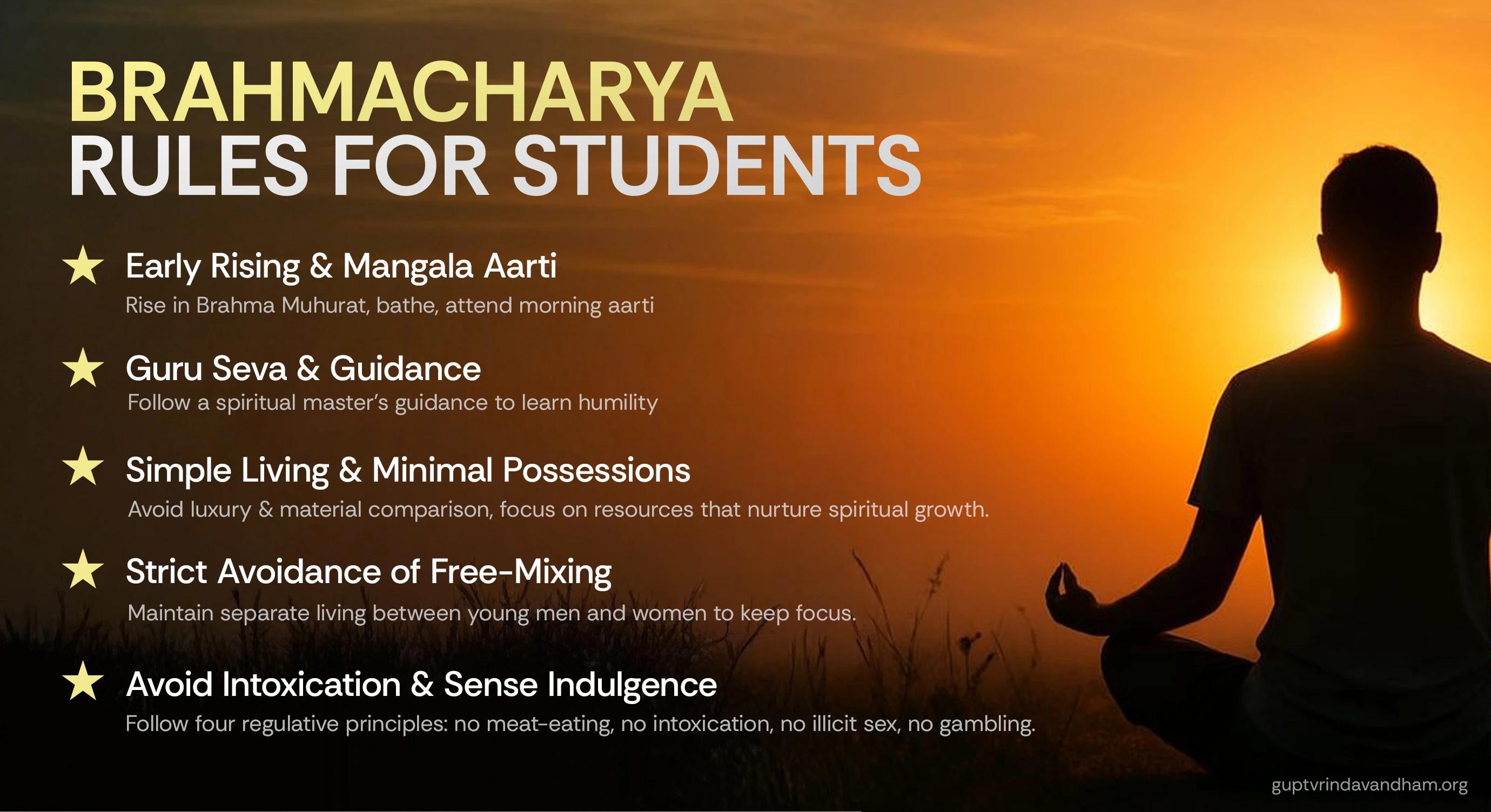
Brahmacharya Rules for Students
According to Gaudiya Vaishnava philosophy, student life is the starting stage for building character, spiritual strength, and discipline before entering Grihastha life or full-time devotional service.
- 01
Early Rising and Mangala Aarti
Students should wake during Brahma Muhurat, take a holy bath, attend the morning temple aarti, chant Hare Krishna Mahamantra, and start the day in a spiritually uplifting environment rather than engaging in useless and mundane activities. - 02
Guru Seva and Guidance
Seek the guidance of a spiritual master, so that you can learn humility, compassion, and discipline. With the help of Guru, you can properly conduct your service rather than experimenting with things on your own. - 03
Simple Living and Minimal Possessions
Students who are encouraged to attain inner peace should avoid luxury and focus on resources that foster a spiritual realm rather than on material accumulation or in comparison with people of their age. - 04
Strict Avoidance of Free-Mixing
Unlike regular educational institutions, gurukuls and ashrams promote separate living and minimal interaction between young men and women, so that they can focus purely on devotion to the Lord from an early age. - 05
Avoid Intoxication and Sense Indulgence
Following the four regulative principles described by His Divine Grace A.C. Bhaktivedanta Swami Srila Prabhupada (no meat-eating, no intoxication, no illicit sex, and no gambling), in brahmacharya, these activities are strictly prohibited because they lead to distractions and reduce focus.
प्रशान्तात्मा विगतभीर्ब्रह्मचारिव्रते स्थितः ।
मनः संयम्य मच्चित्तो युक्त आसीत मत्परः ॥
"With a serene mind, completely devoid of fear, firmly established in the vow of celibacy, and having fully controlled the mind, a yogi should sit in meditation, keeping Me as their supreme goal." - Bhagavad-gītā 6.14
Brahmacharya Rules for Married Householders (Grihastha)
The core rules of Brahmacharya for married couples help in living a good married life, regulated through certain principles listed below:
- 01
The Principle of Marital Fidelity
The Brahmacharya rule for a married person is to follow no sex outside of marriage strictly. According to Vedic scriptures, intimacy should be used for pro-creational purposes, rather than for personal gratification. - 02
Forbidden Days of Intimacy
To uphold the sanctity of Grihastha Brahmacharya, couples should refrain from physical relations on specific holy days such as Ekadashi, Amavasya, and Purnima. - 03
Mental and Sensory Restraint
Married Brahmacharya signifies that all women should be viewed with respect, and one should refrain from reading, watching, or engaging in lustful media programs. - 04
Lifestyle and Sadhana
Regular chanting of the Hare Krishna Mahamantra is essential for protecting and purifying the mind from material attachments. Honor prasadam and avoid all intoxicants, meat, alcohol, fish, and eggs by following the four regulative principles taught by Srila Prabhupada. - 05
Consciousness of the Home
Married devotees' central point should be Lord Krishna, and they should donate and engage in devotional service, such as deity worship, associating with Vaishnava devotees, and giving a portion of their income to devotional services.
What Breaks Brahmacharya and How to Recover
| Watching explicit or provocative content | Replace screen time with Japa or Bhagavatam reading |
| Indulging in lustful thoughts or fantasies | Redirect attention to the Hare Krishna Maha Mantra immediately |
| Casual or flirtatious talk with the opposite sex | Keep interactions formal, purposeful, and limited |
| Late nights and irregular sleep | Return to Brahma Muhurat, waking and fixed sleep schedule |
| Overeating or eating tamasic/rajasic food | Shift to sattvic, moderate meals (Mitahara) |
| Excessive socializing or idle gossip | Engage in service (seva) or productive activity |
Conclusion
It is concluded that Brahmacharya is not just about practicing physical celibacy, but rather a holistic discipline of energy submission. It includes guarding one’s senses, actions, and energy towards higher consciousness, helping oneself achieve focused intention rather than approaching worldly desires.
“Following Brahmacharya with strict rules is like living a life dedicated to realizing one's true spiritual identity and devotion.”
Let’s pledge to make our minds purer and create a world that thinks beyond pleasure.