
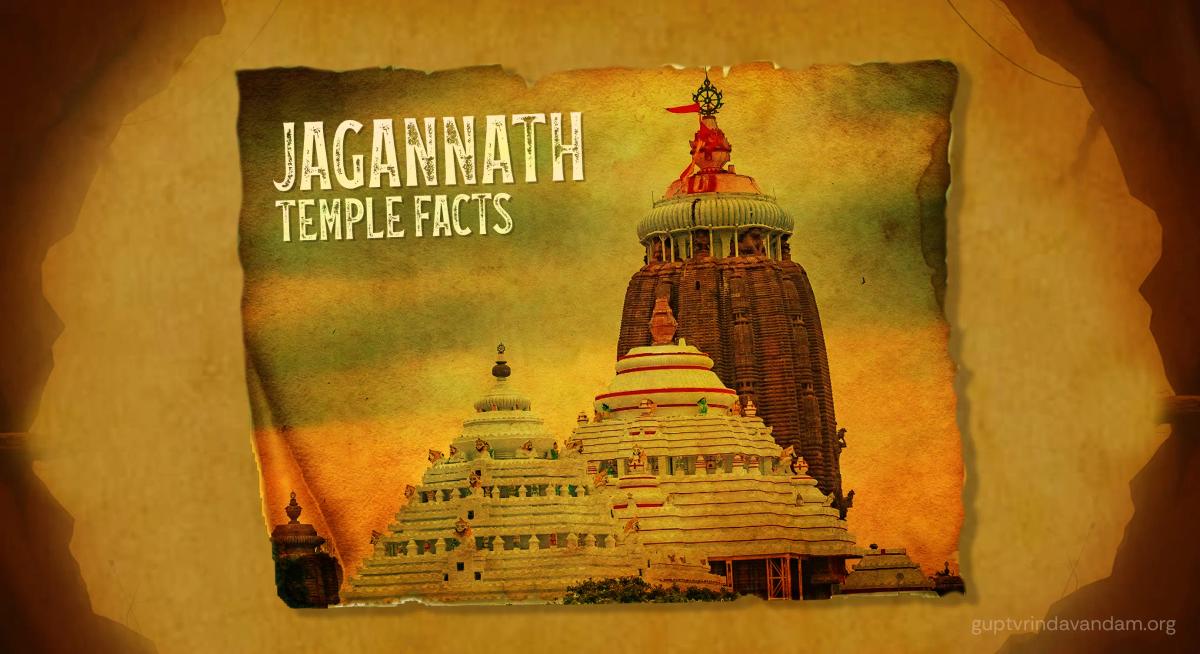
Facts about the Jagannath temple reveal that its deities are made of sacred wood and are ceremonially renewed every 12 to 19 years during the Nabakalebara ritual. The temple's massive Rath Yatra chariots also gave rise to a new English word, “Juggernaut”.
Did you know the flag at the top of the Jagannath Temple is said to fly in the opposite direction of the wind every time? This is just one of the many Jagannath Puri temple facts that make the 12th-century shrine in Puri one of the most mysterious places of worship of Lord Krishna.
From deities carved entirely from sacred wood to thousands of people having Mahaprasadam daily for centuries, prepared without any modern equipment, the facts about the Jagannath temple are far beyond what most of you know.
This guide covers the most-searched Jagannath Temple Facts, from ancient rituals to modern mysteries still unfolding today.
15 Interesting Jagannath Temple Facts You Should Know
The specialty of the Puri Jagannath Temple is connected to several mysteries, or we can say various miracles of Lord Jagannath, which leave human thought behind. Let’s look at each fact and the associated stories behind them:
1. Salabega’s Miracle Chariot Stop:
Salabega's story remains one of the most emotional Jagannath Temple Facts ever recorded. He was a significant historical figure as a devotee because he was born to a Muslim father and had a Brahmin mother.
Unable to reach Puri during the Rath Yatra due to illness, he prayed to the Lord to wait for him. Miraculously, the massive Nandighosha chariot stopped moving until Salabega arrived for the darshan. Even today, his Samadhi stands on Puri’s Grand Road in Balagandi, where the chariot pauses every year in his honor.
Though deeply moved by this miracle, the temple priests still refused him entry into the temple due to his Muslim identity. Salabega spent the rest of his life on the streets of Puri, composing over 150 devotional bhajans for the Lord, including Ahe Nila Saila, until he passed away.
2. The Hidden Brahma Padartha:
The Brahma Padartha (Neela Mani) is a very sacred, imperishable item, believed to be Lord Krishna’s heart. Its true form is heavily guarded and remains highly private, though several ancient scriptures and traditional lore suggest its story and true essence.
During the rare Nabakalebara ceremony, this Brahma Padartha is transferred into the new vigrah carved from the sacred woods. Selected Daitapati priests perform this ritual while remaining completely blindfolded. According to ancient traditions, the energy of the Brahma Padartha is so divine that anyone who looks at or touches it will be instantly incinerated.
Since the temple's establishment, this has remained one of the most curious Jagannath Puri temple facts that every devotee seeks an answer to.
3. A Deity Gave English a New Word:
The Jagannath temple has an unexpected link to the English language. The word “juggernaut,” now used worldwide to denote an unstoppable force, originated from the massive chariots used during the Puri Rath Yatra festival.
During British rule, English colonists witnessed the towering chariots of Lord Jagannath being pulled by thousands of devotees. Their sheer scale and momentum so struck them that the term entered the English vocabulary, eventually coming to symbolize any powerful or unstoppable entity.
“Juggernaut” now appears in dictionaries worldwide, all because British travelers were amazed by the large size of Lord Jagannath’s chariot during the Rath Yatra centuries ago.
4. The Flag That Defies the Wind:
One of the most interesting facts about the Jagannath Puri temple is that the temple’s flag, known as Patita Pavana Bana, is always seen to flow in the opposite direction to the wind, defying the natural laws of science.
Despite the normal wind flow, the bright triangular flag often appears to ripple backward. While several devotees see this as the Lord’s energy, others attribute it to the temple's unique architecture, which creates aerodynamic effects around the towers.
However, as per the temple's daily ritual, the Chunara sevayats (serving from 800 to 100 years) perform the daring task of changing the flag every evening by climbing the 214-foot temple without any safety gear, a tradition followed for centuries and with zero injuries recorded to date.
The flag is usually red, yellow, or white in color and is chosen by lottery rather than by specific selection. The temple authorities also observed that when the white flag is hoisted, it means the Lord is signaling bad weather, a belief that has been held on several occasions, such as Cyclone Yaas in 2021.
5. 18 Invasions, 1 Undying Temple
The Sri Jagannath temple in Puri, Odisha, was invaded and damaged 18 times between the 15th and 18th centuries. Despite these loots and invasions, dedicated devotees and priests did their best to protect the Lord's deities and the temple, ensuring its survival and restoration.
Despite several attacks by the Bengali Sultans and the Mughals, it is widely believed that the Jagannath temple was protected and preserved by the Lord’s mercy.
During these 18 attacks, the primary deities left the temple altar around 21 times, and even if the wooden vigraha were to be burnt or destroyed, the Brahma Padartha was never compromised.
Lastly, the era of invasions finally ended in the mid-18th century when the Marathas took control of Odisha, bringing peace and rejuvenation after a long period of struggle.
6. The Top Pot That Cooks First:
According to old records of the Sri Jagannath Puri temple, earthen pots are stacked vertically to cook the Mahaprasadam. However, it is a fact of Jagannath Puri that the topmost pot always gets cooked first, but logically, the bottom should be cooked first. This reverse-cooking phenomenon is believed to be the Lord's miracle and a marvel of ancient engineering.
Moreover, as per the setup, seven or nine clay pots are stacked on top of one another on a single wood-fired stove.
Devotees widely believe that Goddess Mahalaxmi herself cooks the Mahaprasadam in disguise, which is why the cooking process is flawless and goes beyond the normal process. This remains one of the most surprising facts about the Jagannath temple kitchen.
7. The Rule Even Kings Can't Break:
The Jagannath temple in Puri follows a strict permit system: only traditional Hindus, Buddhists, Jains, and Sikhs are allowed inside its sacred sanctum. For centuries, non-Hindu foreign nationals, and even non-Hindus married to Hindus, have been banned from entering.
Historians believe that this rule was established during the Mughal invasions and in response to several temple lootings by non-Hindu communities. However, non-Hindu people can have darshan of the Lord in His form of Patiapaban, which is located right at the entrance for public viewing.
Also, during the Rath Yatra festival, Lord Jagannath Himself comes out of His temple to offer darshan to all His devotees, irrespective of their caste, religion, or color.
8. Priests Who Aren't Brahmins:
One specialty of the Puri Jagannath temple is that the Daitapatis, a vital tribal non-Brahmin community, are the servitors of Lord Jagannath. They serve as the living bridge between the temple's classic Hindu traditions and its ancient tribal roots.
According to temple lore, the Daitapatis are the direct descendants of Vishwabasu, the chief of the Savara tribe, who worshipped Lord Neela Madhava before Lord Jagannath appeared.
Because of their tribal legacy, the Daitapatis hold exclusive rights to perform sacred duties that traditional Brahmin priests cannot.
9. A Kitchen That Never Runs Out:
The Jagannath temple is home to Rosagara, the world's largest open-air kitchen, capable of feeding up to 100,000 devotees daily with Mahaprasadam using traditional clay pots, firewood, and ancient cooking methods.
The kitchen spans more than an acre and includes 32 rooms, with about 240 to 752 earthen chulhas. Around 500 to 600 temple cooks (Suaras) and 300 to 400 assistant workers work daily to prepare the sacred Mahaprasadam.
Modern kitchen equipment is strictly forbidden in this process, and every meal is cooked using ancient methods. It is a widely believed fact that at the Jagannath Puri temple, no matter how many devotees come, there is never a shortage of Mahaprasadam.
10. One of Only 4 Sacred Dhams in India
The Jagannath Puri temple in Odisha is a supreme Hindu pilgrimage site and is one of the most sacred Char Dhams. Among the most significant facts about Jagannath Puri is that the temple represents the seed of pure devotion (Bhakti) and is dedicated to Lord Krishna, who is believed to guide humanity toward salvation in the Kali Yuga.
The Char Dham circuit was established by the philosopher Adi Shankaracharya, who founded the four primary shrines (Mathas) in the four cardinal directions of India. Puri was chosen as the eastern dham.
According to Vedic traditions, the four pilgrimage sites offer a complete spiritual cycle: Badrinath represents knowledge, Rameswaram stands for action, Dwarka for detachment, and Puri for true devotion.
Jagannath Temple in Puri is the only one of the sacred Char Dhams where people of non-Hindu religions are not allowed.
11. Two Temples Older Than Jagannath Itself:
Before the current Jagannath deities were installed, two older shrines already stood within the temple complex - the Vimala Temple and the Narasimha Temple, both historically predating the main Jagannath shrine.
Before the Jagannath deities were installed in this temple, several older shrines stood within it. Two notable examples of this are the Vimala Temple and the Narasimha Temple, which are also present in the Jagannath Temple complex and are historically known to be older than the Jagannath shrine.
12. The Ocean Goes Silent at the Gate:
At the Jagannath temple in Puri, the roar of the ocean fades away and goes into absolute silence at the right moment when you walk through the temple gates.
It is seen that outside the temple’s boundary walls, especially near the Singhdwara (the main Lion’s Gate) and the Western Gate, the sound is easily and loudly audible. But as you step in through these gates, the sound of the ocean goes silent entirely. Not a single decibel of the waves can be heard inside.
According to traditional stories, Lord Jagannath was once disturbed by the loud sound of the waves while sleeping. So Lord Hanuman was called by Him to keep the ocean silent. From that day, Lord Hanuman remains at the western gate, blocking the sound waves permanently so that Lord Jagannath could rest peacefully.
13. No Bird Flies Over the Dome:
No birds, airplanes, or helicopters are ever seen flying over the Jagannath temple's dome - a mystery devoted to the Sudarshan Chakra's protective energy.
However, according to scientific studies, this occurs due to fluid dynamics, as strong coastal winds and air eddies can make the area challenging for birds.
Another interesting fact about the Jagannath temple is that the massive Sudarshan Chakra is said to look the same from every direction or corner of the city, and modern engineers remain puzzled about how this happens without any modern machinery.
14. Five Waters, One Cleansing Ritual:
The temple complex offers a complete Pancha Tirtha - ritual bathing across five sacred ponds, believed to cleanse pilgrims of negativity and karmic debt before darshan. However, the four tanks are scattered in all directions from the holy city; one is located at the center of the massive temple complex.
Rohini Kundam, Indradyumna Tank, Markandeya Tank, Swetaganga Tank, and Mahodadhi (the sea) offer ritualistic cleansing believed to remove all your negativity and bad karmic debts.
15. The Ratna Bhandar: 46 Years of Sealed Secrets:
The Ratna Bhandar, the temple's treasury holding centuries of gold, silver, and gem offerings, remained sealed for 46 years, from 1978 to 2024, after its keys went missing.
Only then did the court order it to be opened in 2024 for repairs and inventory checks. The investigation is still ongoing in 2026; every day, around 20 precious ornaments are checked, and the history is gradually coming to light.
Conclusion
From Salabega’s true devotion to the unfolding secrets of Ratna Bhandar, the Jagannath temple facts reveal the shrine's history, faith, and the mystery of the Lord. Every ritual, from reverse pot cooking to the Nabakalebara ceremony, carries centuries-old beliefs that are still hard to grasp or fully explain. Even the unsolved Jagannath Puri flag mystery continues to amaze devotees, showing that some truths are meant to be felt, not to be proven.
So, the next time you visit the Jagannath Puri temple, remember several secrets that keep the shrine one of the most prominent pilgrimage places in India, where the Lord of the Universe resides.