
Lord Jagannath is a form of Lord Krishna worshipped as the Lord of the Universe in Puri, Odisha. His sacred origin story began with the king’s devotion, a vanishing deity, and a divine wooden form whose mystery continues to attract millions of devotees today.
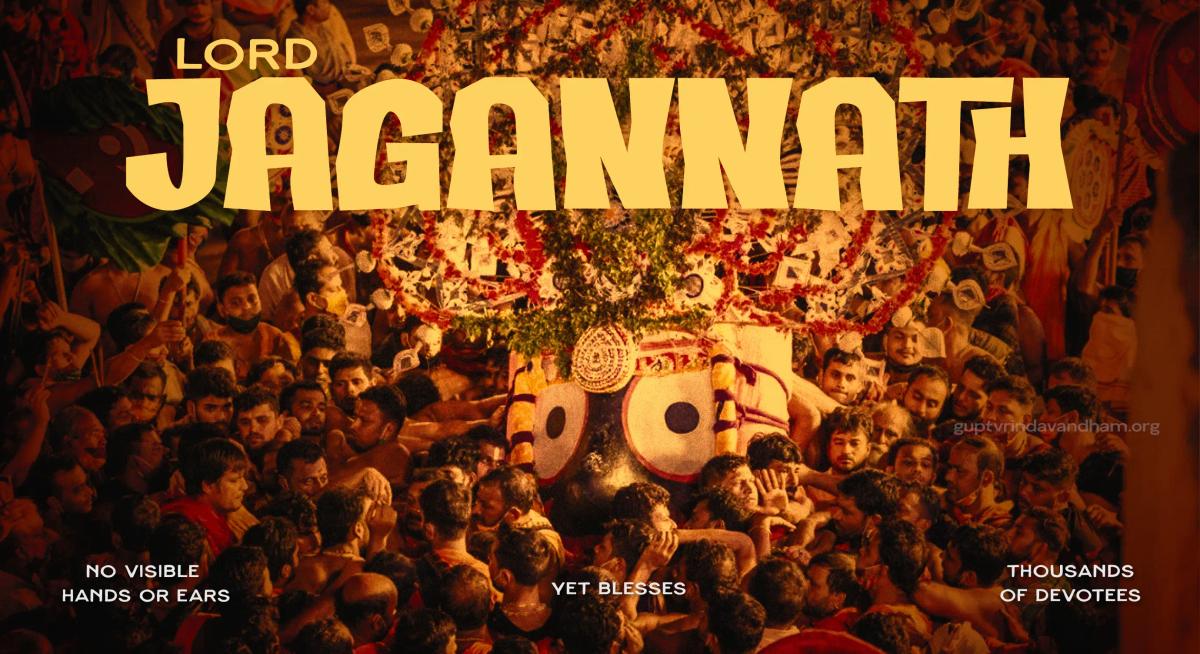
Have you ever seen a deity with no visible hands or ears, yet blesses thousands of devotees every day, being the Lord of the Universe in the age of Kaliyuga?
That deity is Lord Jagannath - and his story begins long before the grand temple of Puri ever existed. Lord Jagannath, formerly known as Bhagwan Neela Madhava, was historically worshipped by the Savara/Saura community in Odisha as the sacred Lord who had Lord Krishna’s heart (Brahma Pardartha).
Today, Lord Jagannath resides in a large temple built by King Indradyumna of Avanti. The Lord stays with his siblings, where the true story of Lord Jagannath, Balabhadra and Subhadra starts.
The divine forms of the Lordships are carved from sacred wood and depicted with large, round eyes and an intentionally unfinished form. So, there is a lot to know about Lord Jagannath's story to grasp the full mystery of the God who chose to appear in an incomplete form, just to show his mercy.
Who is Lord Jagannath?
The Jagannath story begins with understanding him as the Lord, worshipped as the master of the entire universe. The word Jagannath means “Jagat - Universe and Nath - Lord”. In the form of the Supreme Lord (Krishna), Lord Jagannath stays with his sister and brother in the temple. Together, this divine trio represents the complete family of God.
Unlike traditional Hindu deities sculpted from stone and metal, Lord Jagannath and his siblings are carved entirely from sacred wood (Daru Brahma logs). One of the prominent places of Chardham, Jagannath Puri, holds a vital position in the Vaishnava community.
The Lord’s dark-complexioned idol reflects the cosmic mystery that goes beyond human existence. It signifies the true nature and the divine power that spread throughout the universe, far from all material realms. The temple is famous worldwide for its sacred Jagannath Mahaprasad, considered one of the largest temple food offerings.
The Story Begins: King Indradyumna's Search
According to the “Skanda Purana’s Utkal Khanda”, long ago in Satya Yuga, King Indradyumna, a devout ruler of the Avanti Kingdom, was an exemplary man and a great devotee of Vishnu, the Supreme Lord. He was from the same lineage as Lord Brahma and was revered as his twenty-fifth descendant.
Once, the king was seeking an answer to how he could serve and witness the Lord in his original form. At that time, unknowingly, a traveller came into his court and changed everything, revealing to King Indradyumna that Lord Vishnu was being worshipped as Lord Neela Madhav in the dense forests of Puri. This chance encounter became the first thread in the Jagannath story.
After receiving this information, the King directed his head priest, Vidyapati, to enquire about this place and learn where Lord Neel Madhav is worshipped. After this, the Neela Madhava story and the entire history of Lord Jagannath truly began. The priest met Vishwabasu, a tribal chieftain who was the caretaker and priest of Lord Neel Madhav.
Vidyapati asked the tribal chief Vishwabasu to take him to the place where he worships Lord Neel Madhav. Vishwabasu refused and told Vidyapati not to ask this question again. Vidyapati got scared, as he needed to follow his King's words and had to identify the location, but he had no way left. He stayed at Neelachal Parvat for a time and fell in love with Vishwabasu's daughter.
Through this marriage, Vidyapati finally found a way in. After some time in their marriage, Vidyapati asked his wife for a favour: to ask her father if he could show him to Lord Neel Madhav.
This time, Vishwabasu was unable to deny her daughter's request and agreed, but told her that he would take Vidyapati blindfolded. Vidyapati was happy and agreed to be blindfolded, but he outsmarted his father-in-law and scattered mustard seeds along the way to the Lord so he could trace the route again.This entire episode remains one of the most retold parts of the Jagannath story even today.
The Disappearance of Neela Madhava
After learning the location, the Neela Madhava Story took a turn. Vidyapati rushed back to the kingdom and told King Indradyumna, but when the King reached it, he found it empty. Seeing this, the king was devastated and asked the tribal chief, Vishwabasu, but he did not know either.
Some time later, the Lord appeared in the dream of both King Indradyumna and Vishwabasu. The Lord assured both of them that he had not gone or left the tribal chief, but was taking a new universal form as a wooden log that would be at the shores of the Puri coast. This moment, the divine dream and the sacred log, marks the true beginning of Jagannath's origin story as the Lord of the Universe.
The Divine Log and Vishwakarma
On the shores of Puri, exactly as the Lord reveals in his dream, King Indradyumna found a sacred, glowing log, known as Daru Brahma, that no human strength could move. This part of the Jagannath story revealed how divine will took form in his newest avatar.
With the log, he planned to carve a deity form, for which he had asked several carpenters. Vishwakarma, the Lord’s craftsman, came and told him that he would create the idol, but he had to seal him in and not open the door until he said so.
For 14 days, the creation remained still, but on the 15th day, the King became impatient, opened the door, and, as the carpenter said, he created an incomplete idol.
This is the heart of the Jagannath wooden idol story: a form not carved by human hands alone but completed by divine will. Seeing this, the King became very upset, but the Lord again appeared and told him that this was the only true form that had self-manifested. But the King’s devotion was so true that Lord Brahma himself summoned him to Satya-loka to oversee the sacred installation, and the current Jagannath Puri temple stands as the eternal result of that divine grace. Finally, this Jagannath Puri story concluded with the King building the great temple for the Lord in Purushottam Kshetra (modern-day Puri), dedicating his entire Kingdom’s resources to its construction.
Why Lord Jagannath Has No Hands or Feet - The Spiritual Meaning
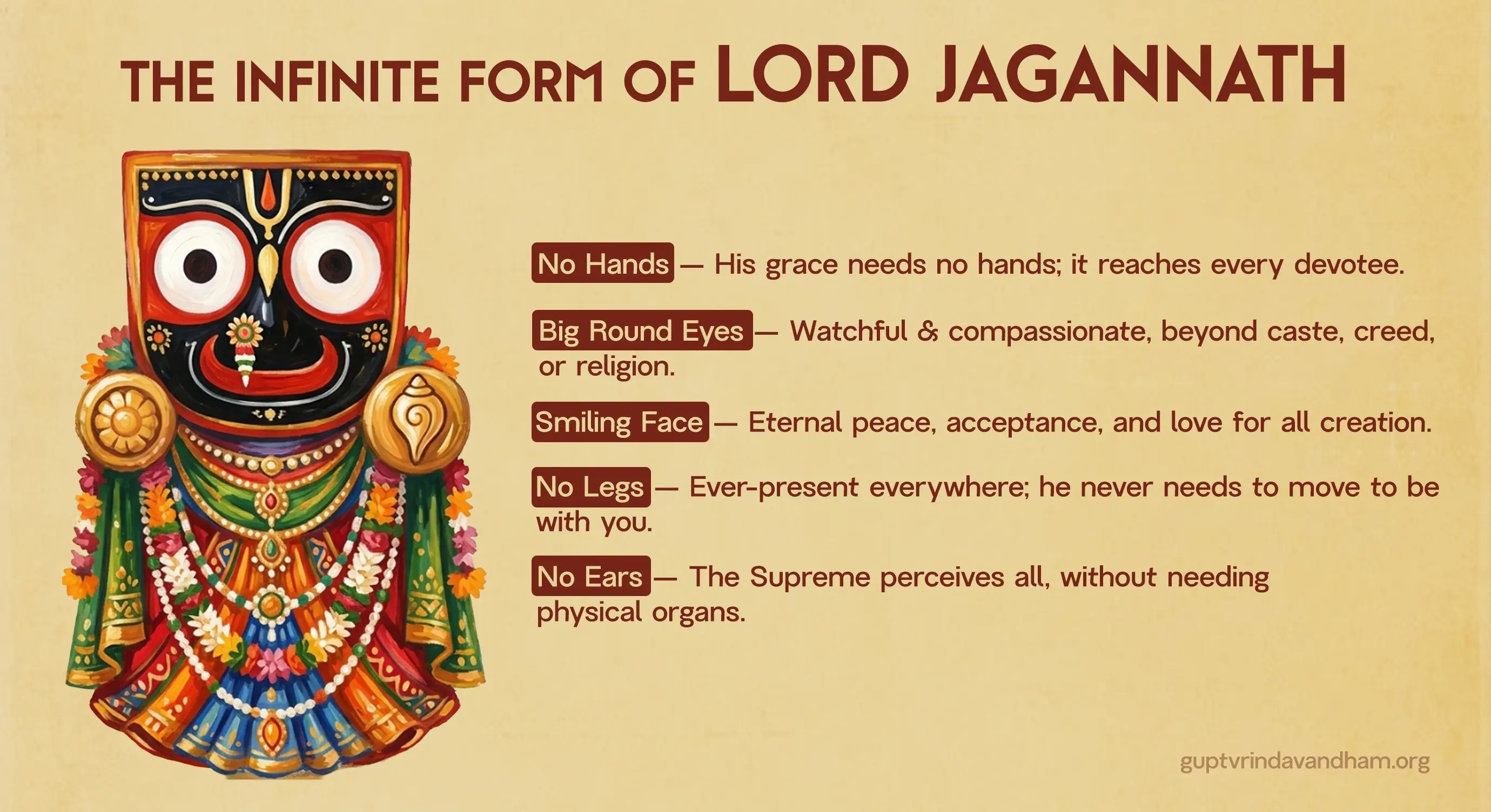
The Jagannath story behind his iconic incomplete form carries deep spiritual significance, reminding devotees that the Supreme divinity cannot be confined to any human form.
No Hands: Signifies that the Lord does not need hands to protect or to bless his devotees. His grace reaches all.
Big Round eyes: Lord Jagannath has big eyes that showcase the Supreme’s watchfulness and compassion towards all beings, regardless of caste, creed, or religion.
Smiling Face: It represents the Lord's acceptance, peace, and universal love towards all creation.
No Legs: Denotes that the Lord is present everywhere; he does not need to move anywhere to be with his devotees; he is eternal.
No Ears: Symbolises the profound concept of being the Supreme personality, so it does not require any physical organs to perceive the universe.
Krishna's Heart Inside Jagannath: The Mystery of the Nila Mani
The mystery of the Brahma Padartha is believed to be the soul or heart of Lord Krishna, kept inside the wooden idol of Lord Jagannath at the Jagannath temple in Puri. Let’s take a look at Lord Jagannath’s story of Neela Mani.
The Origin:
According to ancient texts, Lord Jagannath's origin story begins in Satya Yuga as a shining blue jewel known as Indranila Mani. After Lord Krishna’s disappearance in Dwapara Yuga from the earth, the log containing his divine heart (Brahma Padartha) floated from Dwarka city to the shores of Puri.
The local King, Indradyumna, found the log and placed it in the sacred idol of Lord Jagannath, combining the divine energy of Lord Krishna’s soul and the essence of Neela Madhava.
Beyond this, ritual practices occur every 12 or 19 years; the Nabakalebara festival occurs, during which new idols of the Lord are carved and the Brahma Padartha is transferred into them by designated priests (the Daitapatis). The priests completely transfer it blindfolded and with their hands covered, as it is believed that viewing and touching it can be very impure and would be wrong.
This sacred transfer often takes place before the grand Jagannath Rath Yatra, when the Lord travels through the streets of Puri to bless his devotees.
Lord Jagannath and Chaitanya Mahaprabhu's Spiritual Bond
A significant chapter in Lord Jagannath's history is the sacred bond between Lord Jagannath and Chaitanya Mahaprabhu, which was the foundation of today's Gaudiya Vaishnava tradition, characterised by deep and ecstatic love. Jagannath Puri's story revealed that he spent his last 24 years in Puri, preaching Lord Jagannath as Krishna himself with the longing emotion of Srimati Radha Rani.
Chaitanya Mahaprabhu did not view Lord Jagannath just as an idol, but as Lord Krishna, who reunited with his devotees. He frequently fell into a state of spiritual ecstasy, weeping and dancing before the altar of Lord Jagannath.
Upon taking sannyasa in 1510, he relocated to Puri upon his mother’s request. He made Gambira (a small room) his residence, where he chanted and spread awareness of Krishna consciousness and the Hare Krishna Mahamantra. This same teaching later became the spiritual centre and modern-day foundation for the Jagannath ISKCON movement, which continues to spread Krishna consciousness worldwide.
After about 24 years, in 1534, he disappeared by submerging himself in the sacred deities, as devotees believed. Stories and historical evidence revealed that he merged into the knee of the Tota Gopinath deity.
Conclusion
The Lord Jagannath story is far more than just an ancient legend; it is a reminder of the Supreme's divine love and compassion towards his devotees. From the mysterious Neela Mani holding Lord Krishna’s heart to the Lord’s unique incomplete form with no hands, no ears and no legs, every detail of Lord Jagannath carries a profound spiritual meaning.
It is pure ecstasy to preach to him, as Lord Jagannath never ignores his devotees and is available for every bhakt who is preaching about him out there.