
 Donate Now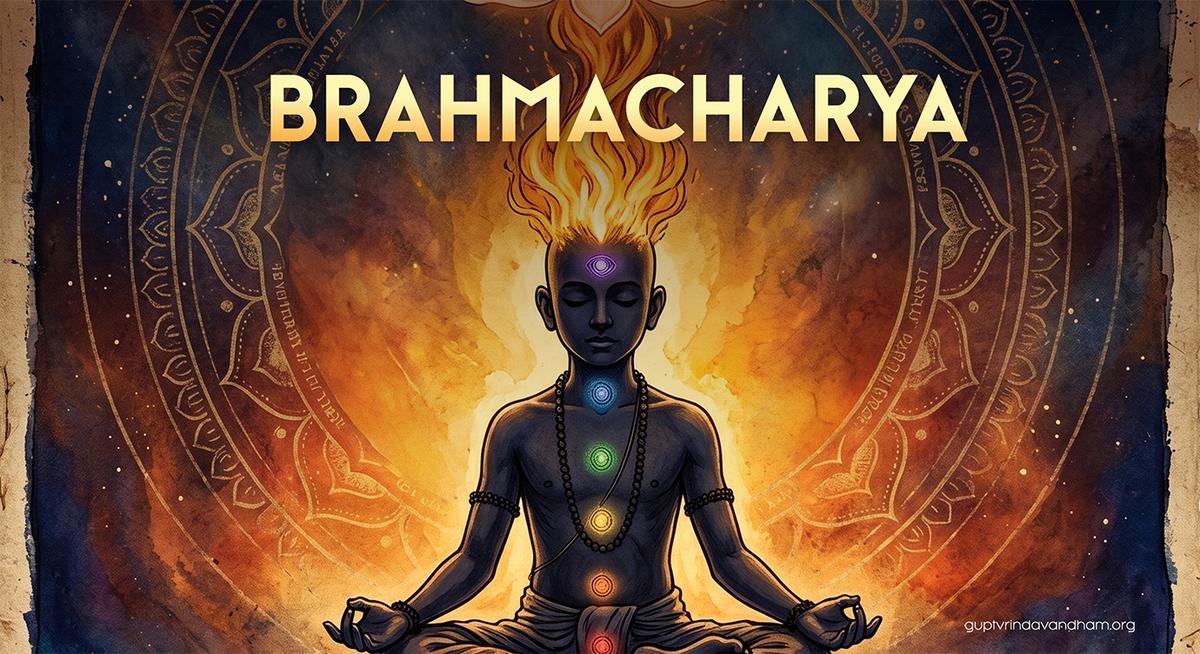
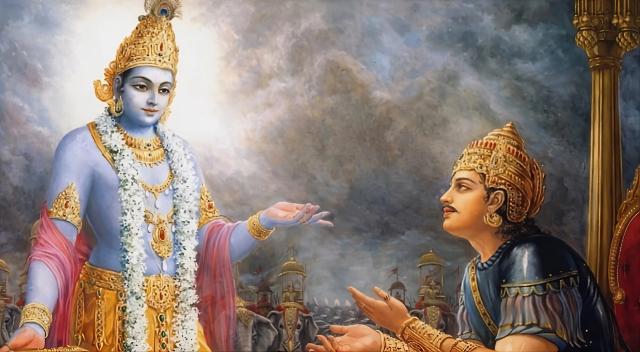
"deva-dvija-guru-prājña-pūjanaṁ śaucam ārjavam brahmacaryam ahiṁsā ca śārīraṁ tapa ucyate" - Bhagvat Gita 17.14
Translation: “Worship of the Supreme Lord, the twice-born (the wise), the spiritual master, and the elders; cleanliness, straightforwardness, celibacy, and non-violence- these are declared as the austerity of the body.”
As Srila Prabhupada explains - Brahmacharya means directing all bodily energy toward Krishna consciousness by controlling the senses.
What is Brahmacharya?
Brahmacharya is a means of achieving the highest possible purification of the human body, enabling one to recognize the true meaning and purpose of life. It also means walking on the path of Krishna-Consciousness, moving towards infinity (Shri Krishna). As described by His Divine Grace A.C. Bhaktivedanta Swami Srila Prabhupada, it literally means “acting on the spiritual platform”. He emphasized that engaging in Brahmacharya serves the Supreme Lord, and that rather than merely seeking an artificial suppression of worldly, materialistic desires, one who observes Brahmacharya with true devotion surely attains the mercy of the Lord.
The Word Brahmacharya comes from two Sanskrit roots:
- Brahma: The Absolute Truth of Life, The Infinite and Supreme Consciousness
- Charya: To Walk, To Move, Way To Conduct Oneself
“brahmacharati iti brahmachari, tasya bhāvaḥ karma vā Brahmacharya” - (Chandogya Upanishad 8.5.1)
Translation - “Brahmacharya means to move and live entirely within Brahman - the Supreme Consciousness.”
In essence, Brahmacharya is not a restriction; it is a divine directive through which one can transform one's life and achieve moksha by fulfilling one's duties.
Types of Brahmacharya
According to various Vedic philosophies and spiritual traditions, Brahmacharya is understood as the practice of directing one’s life and energy toward the service of the Lord. In traditional scriptures and different religious faiths, there are distinct types of brahmacaris, classified by their vows and the duration of celibacy.
1. As of Smritis (Hindu Scriptures)
1. Savita Brahmacharya
"The first is called sāvitra, which refers to a brahmacārī who, after initiation and the sacred thread ceremony, must observe at least three days of celibacy."
Savita is a short-term, initial vow to follow strict celibacy after a student’s sacred thread (upanayana) ceremony. For example, a young Brahmin student may control his senses, mind, and speech for at least three consecutive days, helping him transition to a dedicated life guided by the Guru's teachings.
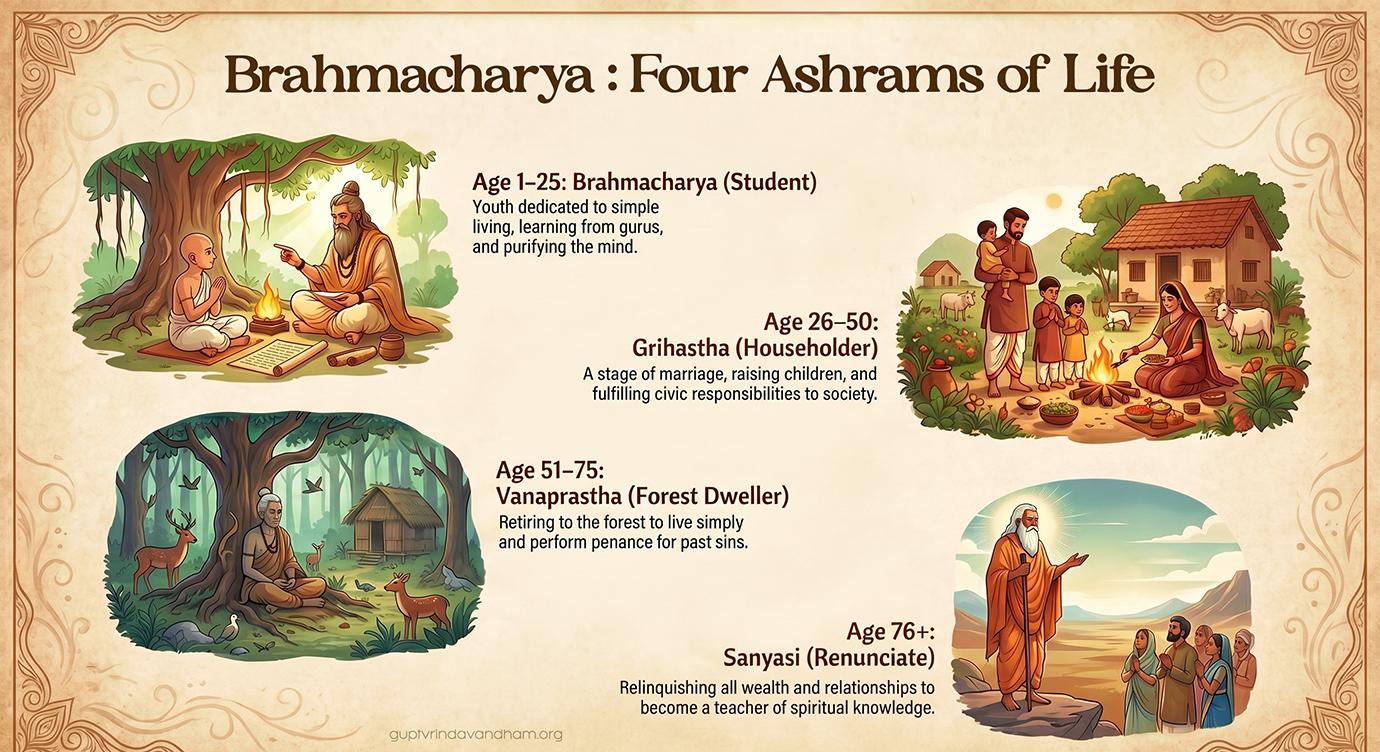
Brahmacharya in the Four Ashrams of Life
- 01
1. Brahmacharya (1-25 years)
This stage begins in youth, when strict guidelines and guidance help purify the mind; during this time, adolescents and spiritual students are called Brahmacharis. During this time, young minds live with and learn from their gurus, leading simple lives and fully dedicated to the worship of the Lord. This stage lasts up to 12 years, but if someone wants to attain a higher realm, they can practice until age 31. After this ashram, the student offers guru dakshina to their spiritual masters and enters the next stage, i.e., Grihastha ashram. - 02
2. Grihastha Ashram (26-50 years)
This ashram stage begins after getting married. This civic responsibility includes raising children, caring for their families by making sacrifices, and being responsible citizens. This stage continues for at least 25 years, from the children’s birth until they reach maturity. This age is mainly for having children, growing a family, and performing duties that are meant to be done. "A Krishna Conscious marriage is not based on sense gratification but rather mutual cooperation between husband and wife for making advancement in spiritual life and also for raising Krishna Conscious children." - Srila Prabhupada, Letter to Babrubahun, 4 July 1971 - 03
3. Vanaprastha Ashram (51-75 years)
At this stage of life, you need to return to your spiritual phase by guiding society away from the material world. Vanaprastha means “forest dweller,” so at this stage, one needs to live in the forest, away from society, to perform sacrifices and lead a proper, simple life. These austerities are seen as penance for sins committed knowingly or unknowingly during the Grihastha Ashram. In Krishna Consciousness, this stage is the time to deepen chanting, hearing, and association with devotees. - 04
4. Sannyasa Ashram (76+ years)
After gaining knowledge, fulfilling opportunities, and performing acts to atone for sinful activities committed during one's lifetime, the last ashram stage is becoming a teacher of spiritual knowledge beyond the social and political realms. During this stage, a person leaves behind all wealth and relationships and becomes a sanyasi. A sannyasi practices and dedicates the rest of life in the service of the Supreme Lord Krishna and guiding liberation to all other distracted souls.
Why Should We Practice Brahmacharya?
Brahmacharya is the practice that helps us realize the true aim of our birth in this material world. Like, if one is seeking to know the true meaning of one's life, brahmacharya helps attain the highest state of consciousness, offering vital nourishment and vigor to the brain.
Each person is potentially divine, with the manifestation of the Supreme Lord. In addition, by practicing the Brahmacharya principle, one can balance all aspects of life through speech, action, and desires.
"brahmacārī carati veviṣad viṣaḥ sa devānām bhavaty ekam aṅgam" - Rigveda (10.109.5)
Translation: "He who leads the life of a Brahmachari, adoring all the Gods, becomes one limb of the Gods themselves."
Benefits of Brahmacharya
- 01
1. Spiritual Awakening and “Higher Taste”
By refraining and controlling their senses, devotees can develop a “higher taste” for spiritual happiness. "viṣayā vinivartante nirāhārasya dehinaḥ rasa-varjaṁ raso 'py asya paraṁ dṛṣṭvā nivartate" "One naturally withdraws from sense objects upon experiencing a higher taste. - (Bhagavad Gita 2.59) Translation: This transmission of energy discards all distraction and offers deep satisfaction in hearing, serving, and chanting for the Lord. - 02
2. Unparalleled Memory and Intellect
As per Vaishnav teachings, celibacy is strictly observed, and energy is refined, thereby redirecting the mind. This process helps attain intelligence, sharpen the mind, and enhance exceptional retention. - 03
3. Control of the Mind and Senses
Material attachments lead to endless anxiety and pressure, which force a soul to perform sinful activities unknowingly. Brahmacharya helps the practitioner strengthen his/her willpower, easily control anger, and remain fearless and steady by overcoming life obstacles. - 04
4. Protection from “Fall - Down”
Strict observance of celibacy consists of not looking, touching, or thinking lustfully about the opposite sex, which helps the mind think beyond the desires. Through this, one can perfectly fulfill the spiritual vows and can achieve moksha. - 05
5. Readiness for the Moment of Death
The ultimate goal of living a Brahmacharya life is to dedicate one's life to the Lord and remember Him at the time of death. A perfect and balanced mind without any bodily attachments naturally sharpens one’s mind, helps in focusing on the Lord, and offers freedom from the cycle of birth and death. "anta-kāle ca mām eva smaran muktvā kalevaram yaḥ prayāti sa mad-bhāvaṃ yāti" - (Bhagavad Gita 8.5) Translation: The Lord himself stated that "Whoever remembers Me alone at the time of death attains My nature - of this there is no doubt."
Brahmacharya Yoga
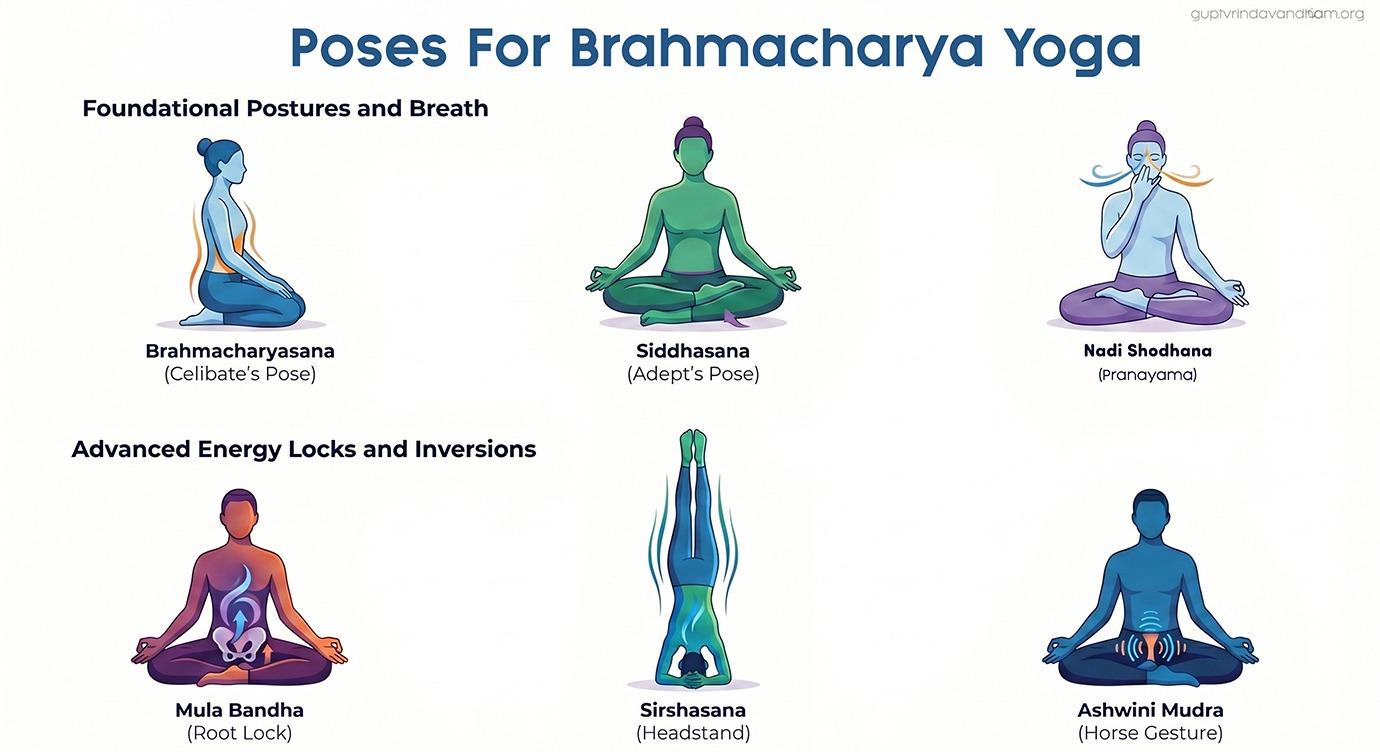
Brahmacharya is seen as the fourth Yama (ethical restraint) in classical yoga philosophy. According to various yogic texts, Brahmacharya is not forced celibacy but rather a practice of energy conservation.
Different Yoga Practices for Brahmacharya
| Yoga Practice | Description |
|---|---|
| Brahmacharyasana (Celibate's Pose) | Sit between your heels. Calms the mind and reduces sexual urges. |
| Siddhasana (Adept's Pose) | Best meditation posture for celibates. Pushes energy upward naturally. |
| Mula Bandha (Root Lock) | Tighten the pelvic floor. Stops energy from flowing downward and wasting. |
| Pranayama (Nadi Shodhana) | Alternate nostril breathing. Steadies the mind and reduces sensory cravings. |
| Sirshasana (Headstand) | Flips the body to send energy to the brain. Builds mental clarity and ojas. |
| Ashwini Mudra (Horse Gesture) | Contract and release the root muscles. Strengthens the base and lifts energy upward. |
Famous Brahmacharya Practitioners
- 01
1. Lord Hanuman
Lord Hanuman is seen as a prominent figure, a Naisthika Brahmachari who practiced celibacy throughout his life and attained immense power and devotion. His entire strength and ability to cross the ocean, lifting mountains, and defeating mighty warriors with the vow of unbroken Brahmacharya. Through his unsurpassable valor and strength, Lord Hanuman is the living example of a perfect brahmachari who surrendered himself unto the Lotus feet of the Lord and became unconquerable. - 02
2. Bhishma Pitamah
Bhishma Pitamah is the ultimate embodiment of Akhanda Brahmacharya in the Vedic scriptures. To fulfill his father's desires, he took “Bhishma Pratigya,” a vow never to marry or claim any throne. However, his unmatched physical powers and spiritual strength were exceptional, and due to this dedication, he received a boon of Iccha Mrityu (the power to choose the time of his own death). He performed all his duties without distraction, and that is why he is a prominent figure in Hinduism. - 03
3. Saubhari Muni
Saubhari Rishi, mentioned in Srimad Bhagavatam 9th Canto Chapter 6, was a legendary sage who engaged in deep austerities while submerging in the River Yamuna. However, after some time, his mind got distracted because of the rise of sexual desires. He emerged from the river and asked King Mandhata for one of his daughters as his wife. Despite his deep reverence, Saubhari Muni engaged in family responsibilities, yet was unsatisfied. His story is a great example: despite all his extraordinary power, he lost everything because of a single distraction. - 04
4. Vishwamitra Rishi
Vishwamitra was also a great sage with extraordinary powers. He was so powerful that Indradev himself grew insecure and sent apsara Menaka to distract him. She succeeded, and after 10 years, Vishwamitra finally realized his mistake and abandoned her to regain his brahmacharya life. Srila Prabhupada himself cited Vishwamitra as proof that mystic yoga alone is not enough to control the senses; one also needs to surrender to the Lord, the Supreme Being. Vishwamirta became a perfect example of being Rajarishi to Supreme Brahmarishi, as he did not give up the path. At one time, he lost his consciousness, but after some time, he regained his true path.
Brahmacharya vs Celibacy: Key Differences
| Feature | Brahmacharya | Celibacy |
|---|---|---|
| Primary meaning | The Path of the Lord | Discarding particular activities like (sexual, lustful thinking) |
| Core Focus | Controlling all senses (mind, speech, and actions) | Refraining from sexual intercourse and physical intimacy. |
| Goal | Spiritual awakening, energy conservation, and self-realization | Can be practiced for various reasons (personal, religious, and practical) |
| Application | Can be practiced in different stages | Generally binary; either practicing or not. |
| Origin | Ancient Vedic texts and Yogic philosophies | Appears from different religions and secular frameworks |
Common Misconceptions About Brahmacharya
Brahmacharya is seen as a way or a rigid vow of reducing physical celibacy, but it is totally wrong and incorrect. Its origin and reverence are evident in Yogic and Ayurvedic texts, making it a philosophy that helps bring life to the end goal in every human form. Below are some of the most common myths:
- It’s not about physical celibacy
- It is not necessary to forbid marriage and family life
- Suppression of the desired goal is not the main aim
- It is a punishment with a joyless existence
FAQs
Conclusion
Lastly, today’s generation needs to understand the true meaning of Brahmacharya, as several misconceptions obscure its benefits. It is beyond physical celibacy and enhances the focus of the mind, vitality, by redirecting the sexual energy mainly for the procreational process only.
Living a life of Brahmacharya is not bad; it is the most powerful gift of the Lord through which humans can attain the highest form of consciousness.