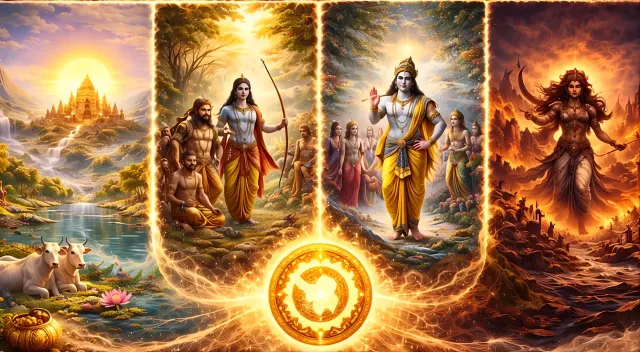

Srimad Bhagavatam briefly describes the appearance, glories, pastimes, and qualities of Lord Ramachandra. It is a complete literature which not only includes the topics of Lord Krishna or Lord Vishnu, but also the incarnations of Supreme Lord and his devotees. The Bhagavatam beautifully demonstrates the character of Lord Rama as an ideal son, brother, husband, kshatriya and a king.
In this section, we will explore how the Srimad Bhagavatam reveals the divine character and transcendental pastimes of Lord Ramachandra. Hearing these narrations one purifies the heart and gradually awakens attraction for His devotional service.
Where Is Lord Rama Mentioned?
The main narration of Lord Rama is mentioned in 9th canto of Srimad Bhagavatam, but He is briefly described in several places.
Srimad Bhagavatam 1.3.22
This verse describes Lord Rama as the eighteenth incarnation of the Supreme Lord. He appeared for the purpose of doing some pleasing work for the demigods to maintain the order of the universe and to chastise the atheist Ravana. Since, Lord Rama was the Personality of Godhead, He exhibited superhuman activities which no human being, including the materially advanced Ravana, could perform.
Srimad Bhagavatam 2.7.23–25
These verses reveals us that Lord Rama is the Supreme Personality of Godhead, and His brothers, namely Bharata, Lakshmana and Shatrughna, are His plenary expansions. Mother Sita is the Goddess of fortune Herself (Laxmi ji), the internal potency of the Lord. Ravana, the greatest demon of that yuga, committed a great offense by kidnapping the Lord’s wife, Sita and was eventually killed by the Lord.
Srimad Bhagavatam 5.19.1–8
These verses glorifies Lord Rama as the supreme person, the king of kings and a touchstone that can verify all good qualities. Also describes that the host of Gandharvas is always engaged in chanting the glories of Lord Ramachandra. Hanuman ji and the chief person in Kimpurusha-varsha, constantly hear those glories with complete attention.
Srimad Bhagavatam canto 9, chapter 10
This chapter briefly narrates the Lord’s key pastimes; protecting Vishvamitra’s sacrifice, breaking Lord Shiva’s bow and marrying Sita Devi, exile to the forest with His wife and younger brother, and killing Ravana. It also highlights His divine character and extraordinary power, while presenting Him as an exemplary king and ideal kshatriya.
Srimad Bhagavatam canto 9, chapter 11
This chapter describes Lord Rama’s reign over the entire planet and concluding His earthly pastimes. It also glorifies His name, fame and greatness, which is far beyond extraordinary acts such as building the bridge to Lanka and killing Ravana. Describes how His devotees attained the spiritual abode by His mercy.
Why Is His Story Told Briefly?
This question has been answered by Srila Shukadeva Goswami in the 9.10.3 verse of Srimad Bhagavatam. Shukadeva Goswami told Maharaj Parikshit that the transcendental activities of Lord Ramachandra have been described by great saintly persons who have seen the truth. And because you have heard again and again about Lord Rama, I shall describe these activities only in brief.
This verse explains that the great personalities who know the truth, who are not in illusion but are the liberated souls have described the activities of Lord Rama. These narrations of Lord Rama’s transcendental activities have been repeatedly heard by King Parikshit, therefore Shukadeva Goswami described the story of Lord Ramachandra briefly.
Lord Rama’s Divine Identity
Lord Ramachandra, who is the Supreme Personality of Godhead, appeared with His expansions as the four sons of King Dasharatha. Lord Ramachandra is the incarnation of Vasudeva, Lakshmana is the incarnation of Sankarshana, Bharata is the incarnation of Pradyumna and Shatrughna is the incarnation of Aniruddha. Sita Devi is Lakshmi ji, the internal potency of the Lord.
Great ocean identifies Him as the master of the entire universe, the unchanging and original Personality of Godhead, who is the master of all qualities. Great saintly persons like Markandeya Rishi glorify His characteristics in the assemblies of great emperors like Maharaja Yudhishthira. Similarly Lord Shiva and Lord Brahma worships the Lord by bowing down before Him.
Key Pastimes in Canto 9
Breaking the bow of Lord Shiva and marrying Sita Devi
There was a svayamvar ceremony held in Mithila, the kingdom of Maharaja Janaka. In the assembly, Sita Devi was to choose her husband and the condition to marry her was to strung the bow which belonged to Lord Shiva. This was not an ordinary bow, it was so heavy that three hundred men were required to lift it.
All the kings assembled there, one by one tried to strung the but no one was successful in his attempt. Finally Lord Ramachandra attempted to strung it, just like a baby elephant breaks a stick of sugarcane, He bent, strung it and broke the middle of the bow. Thus the Lord married to Devi Sita who was the goddess of fortune Herself and rests on the chest of the Lord.
Ravana Kidnapping Mother Sita in the absence of Rama & Lakshmana
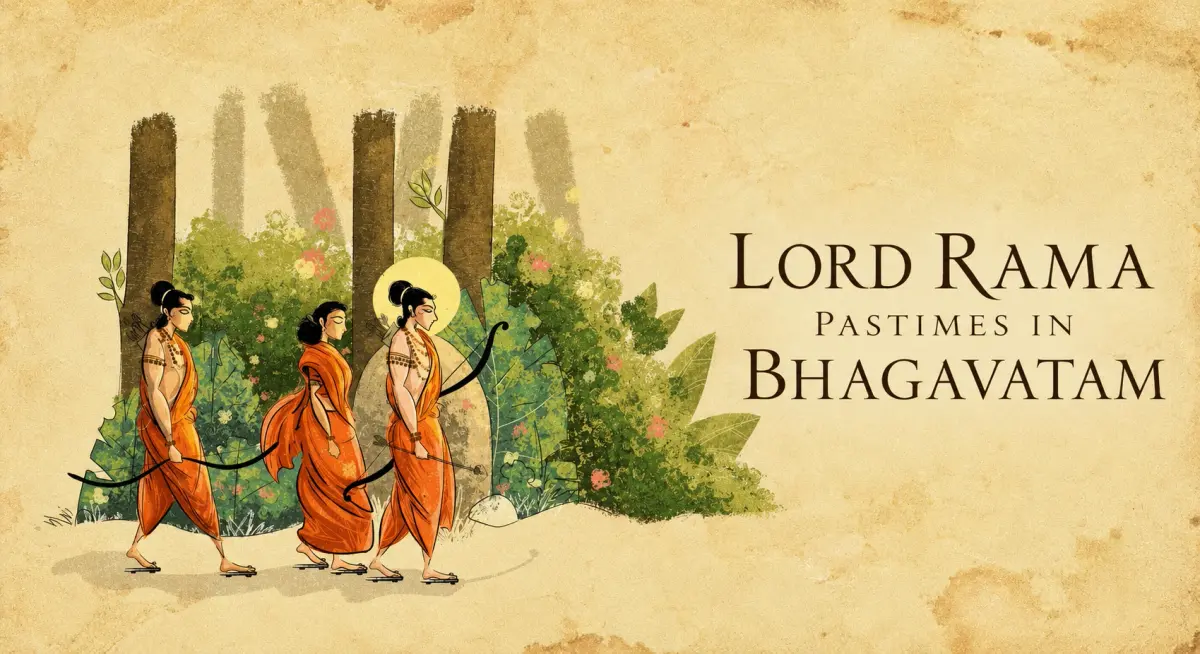
Bound by a promise to his wife, King Dasharatha enthroned Bharata as king and sent Lord Ramachandra into exile in the forest. Carrying out the order of His father, Lord Rama left everything and went to forest with His wife Sita and younger brother Lakshmana.
When Ravana, a great demon who was falsely puffed up of his power, heard about Sita his mind was agitated by lusty desires. He planned to kidnap Sita by sending Maricha in the form of a golden deer to distract Lord Rama from his ashrama. When Lord Rama saw the golden deer, He followed it and killed it after realizing that it was actually a demon.
Before returning of Lord Rama from forest to the ashrama, Ravana came in a diguise of a Brahmana, who was by his character and actions a demon. In Lakshmana’s absence, Ravana deceitfully kidnapped Mother Sita.
Lord Rama killing Ravana
Lord Ramachandra constructecd a bridge to Lanka with the help of mighty vanaras and crossed the great ocean. Devotee Hanuman found the location of mother Sita and partly burned Lanka. A fierce battle took place between Rama and Ravana, the warriors from the Lord’s side fought courageously and killed many prominent Rakshasas.
Ravana himself came forward to fight with the Lord. The ten headed Ravana was killed by the powerful arrow of Lord Ramachandra that pierced his heart. After the death of her husband, Mandodari lamented over the fallen king, Ravana. Her lamentation reveals that Ravana’s uncontrolled desire and a great offense against mother Sita had caused his death.
The Importance of Hearing Rama Katha
The pastimes of the Supreme Lord are as good as the Lord Himself. Hearing the narrations of His activities vanquish all sinful reactions which we have committed. These pastimes are the way of associating with the Lord, great devotees Hanuman always hear and chant the glories of Lord Rama and takes transcendental pleasure in it.
Hearing about the Lord is the begining of devotional service, by hearing about Lord Ramachandra we becomes purified. Without becoming purified one cannot approach god and this hearing is the best and the only way to begin our devotional life and make our life successful.
Conclusion
Although the narrations of Lord Ramachandra in the Srimad Bhagavatam is brief but it gives a clear understanding of His character. He showed an ideal conduct through his dealings and divine postion through his extraordinary powers. Great devotees always drink the nector by chanting and hearing His glories and also guides us to do the same to experience the actual eternal happiness.