
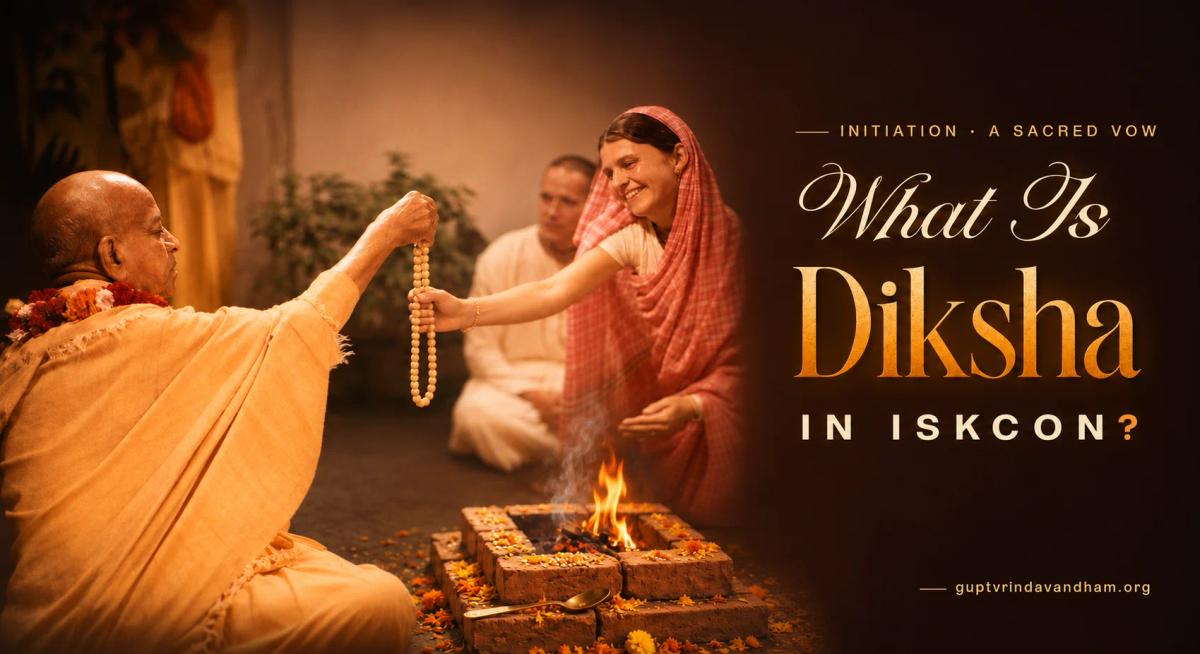
Many devotees wish to receive diksha but may not fully understand what happens during initiation and what a bona fide spiritual master actually does in the life of a disciple.
A Diksha is not limited to a one-day ceremony but is a commitment to accept a spiritual master and follow bhakti under his guidance. From that day onwards, the disciple promises the spiritual master to follow his instructions, and the spiritual master takes the responsibility of delivering the disciple
Let us understand the meaning of diksha, its importance, the role of a spiritual master, and the process of initiation in ISKCON through Srila Prabhupada's teachings.
Quick Summary: Diksha in ISKCON
Diksha means spiritual initiation: accepting a bona fide spiritual master and committing to Krishna consciousness. As explained by Srila Jiva Goswami, it awakens divya-jnana (transcendental knowledge) and brings papa-sankshaya (removal of sinful reactions). Bhagavad-gita 4.34 teaches us to receive this knowledge through submission, inquiry and service, and initiated devotees in ISKCON vow to chant at least 16 rounds of the Hare Krishna maha-mantra daily.
What Is the Meaning of Diksha?
Diksha means spiritual initiation. In the Gaudiya Vaishnava tradition followed by ISKCON, it involves accepting the guidance of a bona fide spiritual master and committing oneself to the practice of Krishna consciousness.
The deeper meaning of diksha is explained by Śrīla Jīva Gosvāmī in Bhakti-sandarbha (283), as quoted in Caitanya-caritamrta, Madhya-lila 15.108.
दिव्यं ज्ञानं यतो दद्यात् कुर्यात् पापस्य सङ्क्षयम्।
तस्माद् दीक्षेति सा प्रोक्ता देशिकैस्तत्त्वकोविदैः॥
divyaṁ jñānaṁ yato dadyāt
kuryāt pāpasya saṅkṣayam
tasmād dīkṣeti sā proktā
deśikais tattva-kovidaiḥ
Meaning: Diksha is the process through which transcendental knowledge is awakened, and the reactions of sinful activities are destroyed.
The verse explains two important aspects of initiation.
Divya-jnana (Transcendental Knowledge): Spiritual knowledge helps us understand that we are not the material body but eternal souls whose natural position is to serve Lord Krishna.
Papa-sankshaya (Removal of Sinful Reactions): Through bona fide spiritual initiation and devotional practice, a devotee becomes purified of sinful reactions and gradually loses the desire to engage in sinful activities.
Therefore, receiving diksha is not simply about becoming an initiated devotee. Its purpose is to bring genuine spiritual change into one's life.
Why Is Diksha Important in ISKCON?
Diksha is important because spiritual life requires proper knowledge, guidance, and a sincere commitment to devotional service. Lord Krishna also teaches us to receive transcendental knowledge from a qualified spiritual master Bhagavad-gita 4.34.
तद्विद्धि प्रणिपातेन परिप्रश्नेन सेवया।
उपदेक्ष्यन्ति ते ज्ञानं ज्ञानिनस्तत्त्वदर्शिनः॥
tad viddhi praṇipātena
paripraśnena sevayā
upadekṣyanti te jñānaṁ
jñāninas tattva-darśinaḥ
Meaning: One should approach a spiritual master, inquire submissively, and render service. A self-realised spiritual master can impart knowledge because he has seen the truth.
Thus, diksha establishes a serious commitment to learning and practising Krishna consciousness under proper spiritual guidance.
What Is the Role of a Spiritual Master in Diksha?
The role of a spiritual master is much greater than giving a spiritual name or conducting an initiation ceremony. The responsibilities of a spiritual master include imparting transcendental knowledge, providing spiritual guidance, teaching devotional practices, and helping the disciple develop sincere faith in Lord Krishna.
Accepting disciples brings a serious spiritual responsibility. Srila Prabhupada explains that the guru may have to bear consequences connected with the disciple's past sinful activities.
Therefore, initiation is not a casual relationship. The spiritual master accepts responsibility for guiding the disciple, while the disciple sincerely follows the guru's instructions.
FAQs
Conclusion
Diksha in ISKCON is much more than receiving a spiritual name or taking part in a ceremony. It is a serious commitment to learn about Krishna, follow the spiritual master's instructions, and make progress in devotional life.