
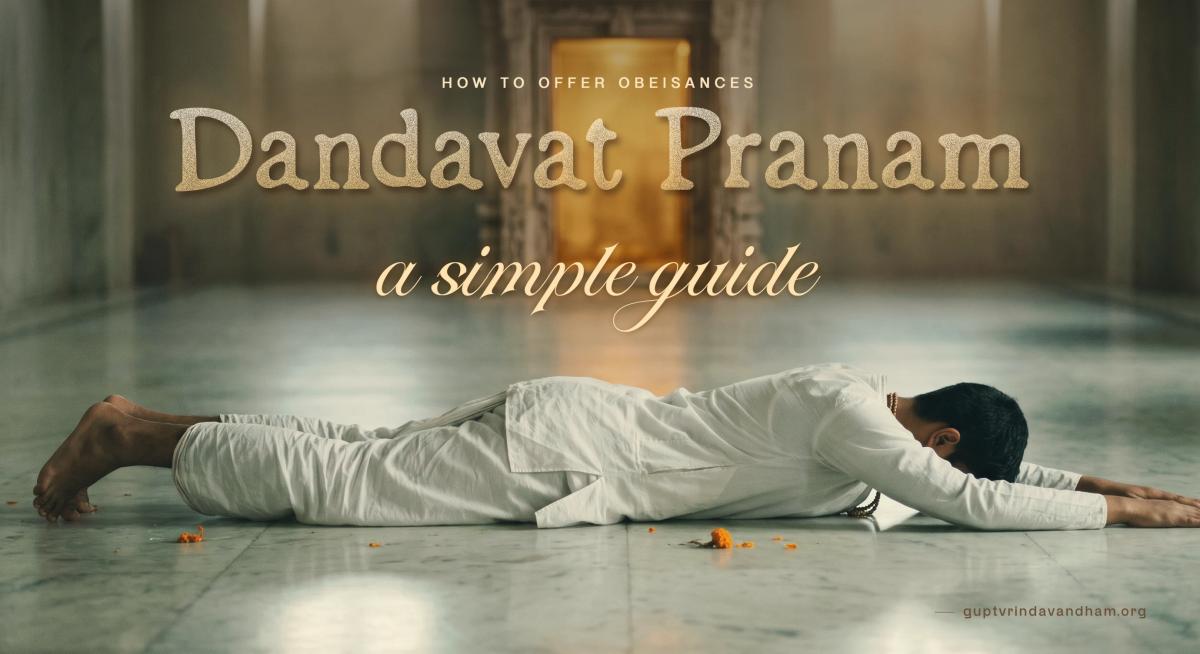
Dandavat pranam means offering full-body obeisances by lying straight on the ground like a stick. Devotees offer it to the Lord, the spiritual master, and Vaishnavas with humility and a desire to serve.
The Sanskrit word danda means “stick” or “rod,” describing the straight posture of the body. The words “dandavat pranam” are also used as a respectful greeting among devotees, expressing reverence even when a full bow is not possible.
Quick Summary
- Meaning: Dandavat pranam is a full-body obeisance, lying straight on the ground like a stick (danda).
- To whom: It is offered to the Lord, the spiritual master and Vaishnavas with humility.
- Two types: Ashtanga (full prostration with eight aspects) and Panchanga (kneeling bow with five aspects).
- ISKCON etiquette: Men traditionally offer Ashtanga pranam and women offer Panchanga pranam.
- Correct way: Remove your shoes, keep your left side toward the Deities, lie straight with your hands beyond your head, and recite the pranama prayers.
Types of Pranam
Two principal forms of prostrated obeisances are:
1. Ashtanga or Sashtanga Pranam
This full-body prostration is also called dandavat pranam. It involves eight aspects: feet, knees, chest, hands, head, sight, mind, and speech. The body lies extended, while the mind remains attentive and the voice offers prayers. Thus, the name ashtanga refers to these eight aspects coming together in one act of respect.
2. Panchanga Pranam
This is a kneeling bow involving the knees, arms, head, intelligence, and speech. The head and hands lower to the ground while the chest remains raised. In ISKCON etiquette, women traditionally offer Panchanga Pranam and men follow Ashtanga Pranam. When paying obeisances to Tulasi Maharani or Vaishnavas, Panchanga Pranama is offered.
How to Offer Dandavat Pranam Correctly
- Remove your shoes and choose a clean space without obstructing others.
- Keep your left side toward the Deities, following the temple’s arrangement.
- Kneel, place both hands down, and extend your body straight.
- Keep your hands beyond your head, with your head, chest, knees, and feet touching the ground.
- Recite the appropriate pranama prayers, remembering the Lord’s lotus feet. Follow the established order for prayers to your spiritual master and the Deities.