
 Donate Now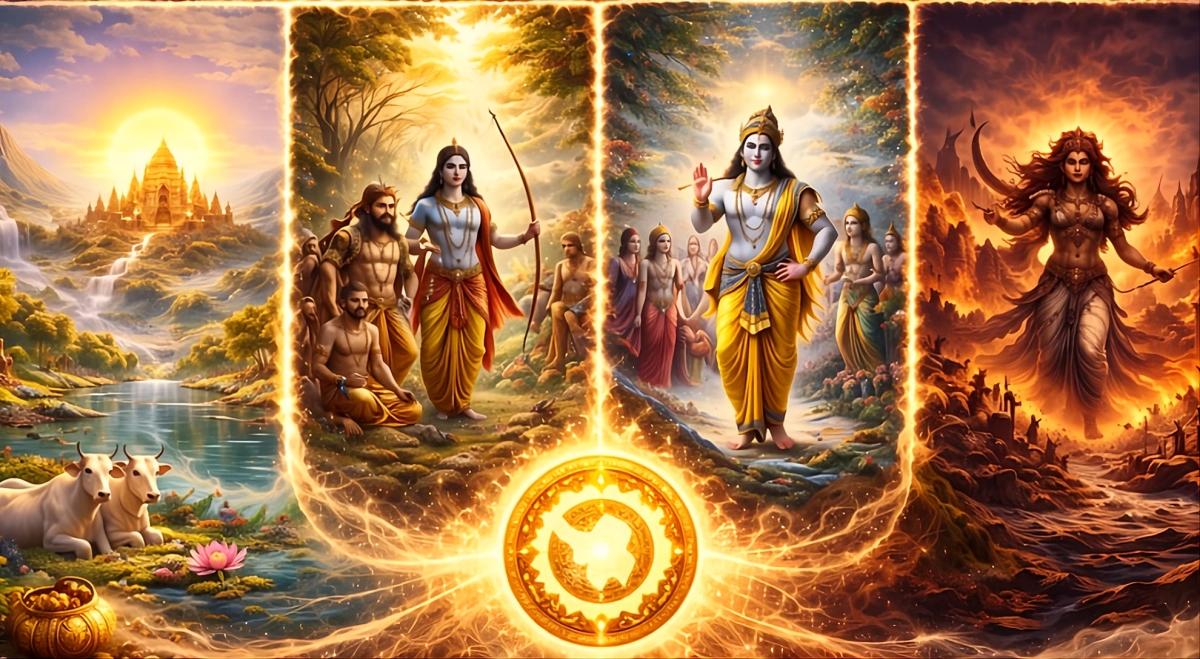
Do you want to learn about the 4 yugas and how they explain the way time moves in a giant circle? In many ancient traditions, especially in Hindu teachings, time is not a straight line that goes from a beginning to a final end.
Instead, time is a repeating cycle of four different ages. These ages show how the world, the people in it, and the level of goodness change over millions of years.
In this guide, we will look at the names of these ages, how many years they last, and what each one means for us. We will also talk about the different forms the Lord took to help the world during these times.
You will see how the world moves from a time of perfect peace to a time of trouble, and then resets to start all over again.
Understanding the 4 yugas helps us see the bigger picture of the world we live in today. It explains why things are the way they are and gives us a simple map of human history from the very beginning of a cycle to the very end. By the end of this article, you will know the math, the stories, and the meaning behind this ancient view of time.
What are the 4 yugas?
The 4 yugas are four distinct ages or time periods that describe the state of the world and the people living in it. You can think of them as the four seasons of a very long year, or like the phases of the moon.
Just as the moon grows bright and then fades away in a repeating pattern, the goodness and truth in the world also grow and fade over time.
The basic idea is that the world starts in a state of perfect goodness, health, and wisdom. As time moves forward through the four ages, these good qualities slowly start to disappear. People become less focused on spiritual things and more focused on money, power, and fighting.
By the time we reach the final age, the world is at its lowest point. However, this is not the end of the story. Once the last age finishes, the world goes through a reset, and the cycle of the 4 yugas begins again with a new age of purity.
Names of the 4 yugas
Each of the 4 yugas has a name that tells us something about the quality of that time. These ages are also often given nicknames based on metals, similar to how some history books talk about the Stone Age or the Bronze Age. These nicknames show the "value" of the age, with the first being the most valuable.
- Satya Yuga: This is the first age, often called the "Golden Age."
- Treta Yuga: This is the second age, known as the "Silver Age."
- Dvapara Yuga: This is the third age, known as the "Bronze Age."
- Kali Yuga: This is the fourth and final age, known as the "Iron Age."
In the Satya Yuga, or Golden Age, everything is at its best. As the cycle moves through the Silver and Bronze ages, things get a little worse in each step. Finally, in the Iron Age (Kali Yuga), the world is in its most difficult state.
Duration of the 4 Yugas
| Name of the Age | Length in Divine Years | Length in Human Years |
|---|---|---|
| Satya Yuga | 4,800 divine years | 1,728,000 human years |
| Treta Yuga | 3,600 divine years | 1,296,000 human years |
| Dvapara Yuga | 2,400 divine years | 864,000 human years |
| Kali Yuga | 1,200 divine years | 432,000 human years |
| Full Cycle | 12,000 divine years | 4,320,000 human years |
Timeline of the 4 yugas
The ages always happen in a fixed order. You cannot skip from the first age to the third, and you cannot go backward. The timeline always moves from the top down. As the world moves along this timeline, there is a gradual decline in four major areas of life:
- Wisdom: The ability to understand deep truths and the laws of the world gets weaker.
- Truth: People start to lie more and value honesty less.
- Intellect: The power of the human mind to focus on good and helpful things decreases.
- Goodness: General kindness, moral behavior, and spiritual practice fade away.
In the first age, these qualities are at 100%. In the second, they drop to 75%. In the third, they are at 50%, and by the final age, only 25% of these qualities remain. This steady decline is what defines the transition through the timeline of the 4 yugas.
Satya Yuga (The Golden Age)
Satya Yuga is the age of truth and purity. It is the longest of all the ages, lasting over 1.7 million years. During this time, the human race is at its highest level of spiritual strength. People in this age are naturally healthy, live for thousands of years, and spend their time in deep meditation. There is no such thing as war, hunger, or poverty in the Satya Yuga. Everyone lives in perfect harmony with nature and each other. There are no different cultures fighting for land because everyone follows the laws of the world naturally. People do good things simply because it is right, and there is complete peace on earth. However, as the millions of years pass, people slowly begin to lose their focus on the spirit, and a small sense of competition starts to grow.
The Avatars of Satya Yuga
To keep the world in balance, Lord Vishnu appeared in several forms during this age. Each form, or avatar, had a specific job to do to protect truth.
Matsya (The Fish)
The first form was a fish named Matsya. A demon named Hayagriva had stolen the sacred books of wisdom, known as the Vedas, while the creator, Brahma, was sleeping. Without this wisdom, the human race would have no guide. Lord Vishnu became a tiny fish and appeared to a king named Satyavrata while he was washing his hands in a river. The king put the fish in a small jar, but the fish grew so fast it had to be moved to a well, then a lake, and finally the ocean. The fish warned the king that a giant flood was coming to clean the world. He told the king to build a large boat and fill it with seeds and the seven great sages. When the flood came, Matsya tied the boat to his horn using a giant snake as a rope and pulled them to safety. He also killed the demon and gave the Vedas back to Brahma.
Kurma (The Tortoise)
The second form was a giant tortoise named Kurma. At one point, the good beings (demigods) were losing their strength and needed a special drink called the nectar of immortality. To get it, they had to churn a giant ocean of milk. They used a mountain called Mandara as a stirring rod and a giant snake named Vasuki as a rope. However, the mountain was so heavy it began to sink into the mud at the bottom of the ocean. Lord Vishnu took the form of Kurma and swam under the mountain, letting it rest on his giant shell. This allowed the churning to continue. Many wonderful things came out of the ocean, including the nectar that gave the good beings their strength back.
Varaha (The Boar)
The third form was a boar named Varaha. A powerful demon named Hiranyaksha had taken the earth and hidden it at the bottom of the universal ocean. This caused great trouble for everyone. Varaha dived deep into the water, fought the demon for a long time, and finally won. He then used his tusks to lift the earth back up and place it in its proper spot in the sky.
Narasimha (The Half-Lion)
The final form in this age was Narasimha, who was half-man and half-lion. He came to save a young boy named Prahlada from his father, a demon king named Hiranyakasipu. The king was very mean and had a special protection that meant he could not be killed by a man or an animal, nor inside or outside, nor during the day or night, and not by any weapon. Lord Vishnu took a form that was neither man nor animal (Narasimha). He appeared at twilight, which is neither day nor night. He sat on the doorstep of the palace, which is neither inside nor outside. He used his claws instead of a weapon. Because he followed all the rules of the demon's protection while still being able to stop him, he was able to destroy the evil king and bring peace back.
Treta Yuga (The Silver Age)
Treta Yuga is the second age. It is shorter than the first, but people were still mostly good and dutiful. In this age, people were very moral and followed the right path, but they weren't as naturally perfect as those in the Golden Age. To help society stay organized and peaceful, a system called Varnasrama was created. This divided people into four groups based on their roles:
- Brahmanas (Teachers and Priests): Their job was to study wisdom and lead people in spiritual ways.
- Kshatriyas (Leaders and Warriors): They were the kings and soldiers who protected the weak and kept order.
- Vaishyas (Merchants and Farmers): They handled trade, money, and growing food to make the world wealthy.
- Shudras (Workers): They helped the other groups with their daily tasks so everything ran smoothly.
The Avatars of Treta Yuga
Three main forms appeared in this age to teach people about duty and balance.
Vamana Avatar
He appeared as a small person (a dwarf) to a king named Bali. Even though Bali was a good king, he had become too powerful and proud. Vamana asked for just three steps of land. The king laughed and said yes. Suddenly, Vamana grew to a giant size. With his first step, he covered the whole earth. With the second, he covered the heavens. For the third step, the king realized his mistake and offered his own head. This taught everyone about the importance of being humble.
Parashurama Avatar
He appeared as a warrior with a powerful axe. During his time, some of the kings and leaders had become very mean and were hurting the people they were supposed to protect. Parashurama traveled the world to stop these unfair leaders and remind them that power must be used for good, not for bullying others.
Rama Avatar
The most famous form is Lord Rama. He lived his life as a prince and king to show everyone what a perfect person looks like. Even when he was sent away to live in the forest for 14 years, he never got angry or broke his word. His story teaches us that doing our duty (Dharma) is more important than our own comfort. He fought a giant battle to save his wife and restore justice to the world.
Dvapara Yuga (The Bronze Age)
Dvapara Yuga is the third age, and this is where the decline of the world becomes more obvious. People started to become greedy and began to fight over land and money. The natural health of humans started to fade, and life became more of a struggle. However, this was also a time of great beauty. Many of the most famous and wonderful temples were built during this age. Because people were losing their natural connection to the spirit, they needed places like temples to help them remember to be good. The sacred wisdom of the Vedas was also divided into four parts during this time to make it easier for people with weaker minds to study.
Lord Krishna and the Bhagavad Gita
The most important event of this age was the life of Lord Krishna. He appeared to destroy evil kings who were treating their people like slaves. During a massive war between two groups of cousins, Krishna served as a driver for a great warrior named Arjuna. When Arjuna felt sad and didn't want to fight, Krishna gave him a famous talk called the "Bhagavad Gita." He explained that the world is a place where we must do our duty without worrying only about what we get in return. He taught that even in a world of fighting, a person can find peace by focusing on the right things. Dvapara Yuga ended the moment Lord Krishna left the earth to return to his heavenly home.
Kali Yuga (The Current Age)
Kali Yuga is the age we are living in right now. It is the shortest of the 4 yugas, but it is also the most difficult. It is called the age of darkness or the age of machines and money. In this time, goodness is at its lowest point. You can see the signs of Kali Yuga all around us. Ancient texts say that in this age, people will lie often, and many leaders will act like criminals instead of helping others. People often pretend to be spiritual or good just to get money or fame. This is called hypocrisy. Because of greed, the environment is hurt, and there is a lot of fighting and lack of peace.
The End of Kali Yuga and the Return of Satyug
The Kali Yuga will end with the arrival of the final form, the Kalki avatar. He is predicted to be born in a family of teachers and will become a great king. He will ride a white horse and carry a sword to destroy the evil that has taken over the world. The ancient books say that a special sign will mark the return of the Golden Age: Jupiter, the Sun, and the Moon will all enter a specific star sign called Pushya Nakshatra. When this happens, the world will go through a giant change, the greed will be washed away, and a new Satya Yuga will begin. Peace and happiness will return, and the cycle will start all over again.
Yuga Cycle (Mahayuga Explained)
As we have seen, the 4 yugas make up one full cycle called a Mahayuga, which is over 4 million years long. The very end of this cycle involves a "reset" called Pralaya. This is a time when the world dissolves or is cleaned so it can be fresh for the next cycle.
The ancient texts describe four different ways the world resets:
Occasional Reset (Naimittika)
This happens when the creator is resting at the end of his "day." The lower parts of the world are cleared away while he sleeps.
Elemental Reset (Prakritik)
This is a much larger event where the very building blocks of the world (like earth, water, and air) dissolve back into nature.
Absolute Reset (Atyantika)
This isn't a reset of the world, but a reset for a person. It happens when someone becomes so wise and good that they leave the cycle of ages forever and find total peace.
Perpetual Reset (Nitya)
This is the constant reset we see every day, like when something dies so new life can grow, or even when we go to sleep and wake up fresh.
This cycle is like a farmer who harvests his crops, clears the field, and then plants new seeds for the next year. The Pralaya clears away the greed and mess of the Kali Yuga so the world can be a Golden Age once more.
Which yuga are we in now?
We are currently in the Kali Yuga. Ancient records suggest that this age began about 5,000 years ago, shortly after Lord Krishna left the earth. Since the Kali Yuga lasts for 432,000 years, we are still in the very early part of it.
Because we live in this time, we see a lot of the problems mentioned before, like people being focused on money and a lack of honesty. But the cycle of the 4 yugas reminds us that this is just a phase. Just as winter always leads to spring, the difficulties of our current age will eventually lead back to a time of peace and truth.
FAQs
Conclusion
The 4 yugas offer a simple and fascinating way to look at history and the future. They teach us that the world moves through stages of goodness and decline, much like the seasons of the year. From the perfect peace of the Satya Yuga to the struggles of our current Kali Yuga, every age has its own story and its own purpose.
Even though we live in an age that can feel full of greed and trouble, the lesson of the 4 yugas is one of hope. It reminds us that darkness is temporary and that truth always returns. By understanding these cycles, we can see that we are part of a much bigger story—one that always moves toward a fresh start and a return to peace.