
 Donate Now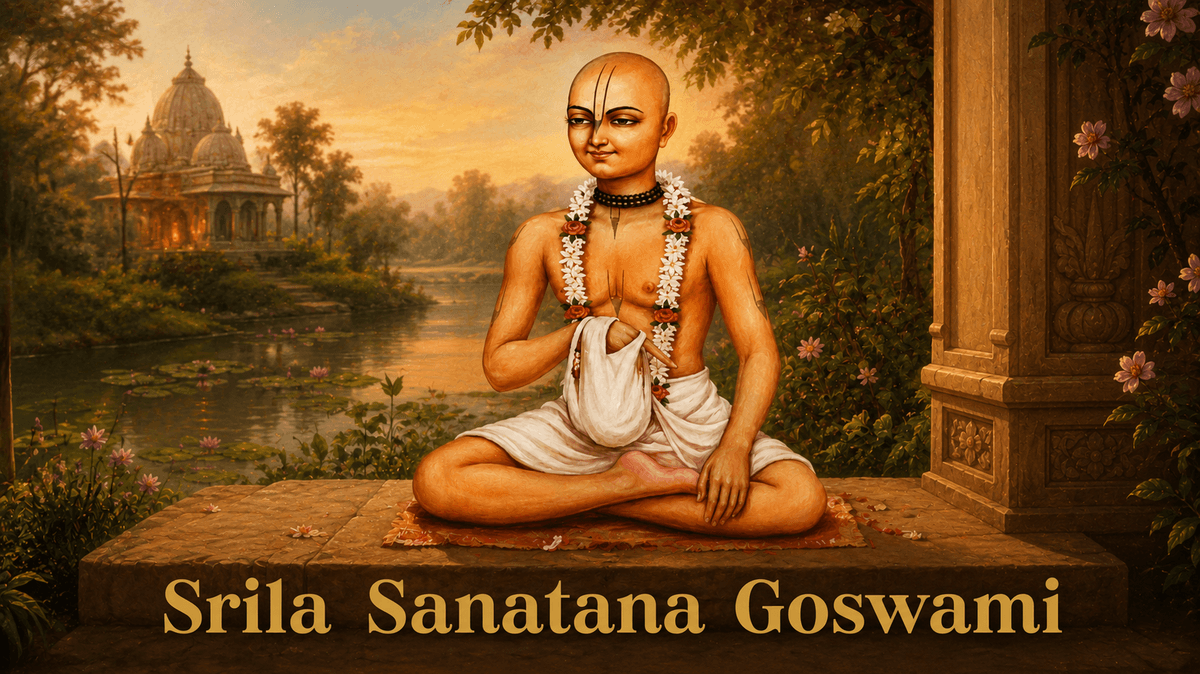
Srila Sanatana Goswami stands as the senior-most of the six Goswamis of Vrindavan and a foremost disciple of Lord Chaitanya Mahaprabhu. He is revered as the Acharya of Sambandha-jñāna (knowledge of our relationship with Lord Krishna). Leaving his position as a minister, he renounced everything and devoted his life to spreading the teachings of Lord Chaitanya.
After being instructed by Mahaprabhu, he rediscovered the holy places of Vrindavan, wrote devotional scriptures, and established Vaishnava practices that continue to guide devotees today.
Birth and Early Life
Srila Sanatana Goswami was born in 1488 AD (Sakabda 1410) in the village of Bakla Candradvip. He belonged to a prestigious line of Karnataka Brahmanas of the Bharadvaja-gotra. His father was Kumaradeva, a well-behaved and pious Brahmana, and his mother was Revati Devi. Sanatana was the eldest of many sons, with his most prominent brothers being Rupa Goswami and Anupama (Vallabha).
He received his formal education in the village of Sakurma, near the capital of Gaura-desa. He studied Nyaya under Madhusudana Vachaspati, the brother of Sarvabhauma Bhattacharya, and Vedic literature under Vidyavachaspati. Sanatana knew many languages and became proficient in Sanskrit, Arabic, and Persian.
Devotees of the Gaudiya Vaishnava tradition and ISKCON celebrate Sanatana Goswami’s Appearance Day every year. They pray for his mercy and guidance on the path of devotional service.
Meeting with Chaitanya Mahaprabhu
The meeting between Srila Sanatana Goswami and Lord Chaitanya Mahaprabhu took place in two distinct phases: their first secret meeting in Ramakeli and their profound reunion in Varanasi.
The First Meeting at Ramakeli (1514 AD)
Sanatana Goswami served as the Prime Minister (Sakara Mallik) to Nawab Hussein Shah. He and Rupa Goswami (Dabir Khas) corresponded with Mahaprabhu through letters, expressing their desire to renounce their worldly positions. To avoid detection by the Nawab, the brothers met the Lord in the dead of night. They approached Mahaprabhu with blades of grass between their teeth, a sign of humility, and fell before Him “like rods.”
They considered themselves even more fallen than Jagai and Madhai because they served in the administration of Muslim rulers, who were regarded as “meat-eaters” and “enemies of cows and Brahmanas.” Moved by their humility, Mahaprabhu embraced the two brothers, declared them His eternal servants, and gave them the names Sanatana and Rupa.
The Reunion at Varanasi
Following this meeting, Sanatana Goswami was eventually imprisoned by the Nawab for refusing to assist in military campaigns. After escaping by bribing a jailer with 7,000 gold coins, he travelled in disguise to reach Mahaprabhu in Varanasi.
On arriving in Varanasi, looking like a beggar, he sat outside the house of Chandra Shekhar. Mahaprabhu told His host to bring in the great devotee who had arrived. Chandra Shekhar reported to Mahaprabhu that he had found no Vaishnava outside, but only a Muslim mendicant. Mahaprabhu told him, “Please bring him here.”
The Transcendental Embrace
As Sanatana Goswami entered, Mahaprabhu rushed to embrace him in ecstasy. Feeling himself contaminated, Sanatana said in a faltering voice, “O my Lord, do not touch me.” The Lord insisted on embracing him, stating that He was touching Sanatana only to purify Himself because Sanatana’s devotional service could purify the whole universe.
The Lesson of the Woolen Blanket
During his stay, Sanatana Goswami wore a valuable woolen blanket gifted by his brother-in-law. Mahaprabhu repeatedly glanced at it with disapproval, indicating that such an opulent item was contradictory to the life of a mendicant. Understanding the hint, Sanatana Goswami immediately exchanged the expensive shawl with a beggar for a torn, old quilt, which greatly pleased the Lord.
Teachings of Lord Chaitanya to Sanatana Goswami
Sri Caitanya Mahaprabhu’s teachings to Srila Sanatana Goswami, primarily delivered over two months in Varanasi, constitute the foundational philosophical framework of Gaudiya Vaishnavism. Sanatana Goswami approached the Lord with extreme humility and asked three essential questions that every beginner on the spiritual path eventually asks:
- “Who am I?”
- “Why do the miseries of material existence permeate my life?”
- “What is the ultimate goal?”
Mahaprabhu answered all three questions one by one. He taught that the living entity’s true identity is that of an eternal servant of Lord Krishna. Every soul is an infinitesimal part and parcel of the Lord, existing in a relationship of “simultaneously one and different.”
The Lord explained that miseries arise when the soul forgets its original relationship with Krishna and becomes controlled by the external, illusory energy known as maya. When the soul identifies with the material body, it becomes encased in matter and subjected to the ignorance and suffering inherent in the cycle of birth and death.
Chaitanya Mahaprabhu identified the ultimate goal of life as unalloyed love of God (prema) and the re-establishment of the soul’s eternal, direct service to Krishna. This perfection, known as prayojana, is realized when the devotee transitions from following rules and regulations (vaidhi-bhakti) to experiencing spontaneous, ecstatic love (raganuga-bhakti) for the Lord in the spiritual realm of Goloka Vrindavan.
After empowering him with the complete science of devotional service, Mahaprabhu gave him final instructions.
- Excavate and restore the lost holy places and pastime sites of Lord Krishna.
- Discover ancient deities and establish their worship in the temples.
- Compile authoritative scriptures (Bhakti-shastras) to scientifically define Vaishnava philosophy.
- Establish Vaishnava principles by writing a directory (smriti) on Vaishnava practices and etiquette.
Why Sanatana Goswami Wanted to End His Life?
After Sanatana Goswami’s initial pilgrimage to Vrindavan, he journeyed to Jagannath Puri with a desire to meet Lord Chaitanya Mahaprabhu. He passed through the dense Jharikhanda forest, where he was afflicted with a severe skin disease characterized by oozing sores and blood after drinking stagnant, unclean water. Overwhelmed by humility, Sanatana Goswami felt his diseased body was unfit to enter the Jagannath Temple or receive the Lord's touch.
Sanatana Goswami resolved to commit suicide by throwing himself under the wheels of the Ratha Yatra cart during the annual festival. When he reached Puri, he avoided the temple and stayed with Haridasa Thakura at his humble hut. During their first meeting in Puri, the Lord rushed to embrace Sanatana Goswami in ecstasy. Sanatana tried to pull away, crying, “Please do not touch me!” However, the Lord forcefully held him, declaring that He was touching Sanatana to purify Himself.
The Lord, sensing Sanatana’s secret plan for suicide, strictly forbade it. He delivered a profound teaching on surrender. He told Sanatana Goswami, “Your body is My property; you have no right to destroy it.” Mahaprabhu explained to him that He had much work to do through Sanatana’s body and mind.
Through these transcendental and repeated embraces, Sanatana’s disease was miraculously cured, proving that true surrender means maintaining one’s life entirely for the Lord’s pleasure.
Finding the Deities of Madana Mohana
Sri Madan Mohan Ji was discovered by Advaita Acharya under a Vatavriksha (banyan tree) in Vrindavan. When it became time for Advaita Acharya to return to Bengal, he entrusted the deity to a Brahmana in Mathura named Purushottam Choube. In Choube’s home, the deity was treated with immense motherly affection and the children used to play with the deity.
Sanatana Goswami visited the house while begging for alms and was disturbed to see the children playing casually with the deity. He instructed the family that the Supreme Lord must be treated with great reverence and formal rituals. The family members started following the instructions given by him, worshiping the deity with respect in a service attitude.
However, that night, the deity appeared in dreams to both Sanatana Goswami and the Brahmana. The Lord explained that He missed the motherly love and the companionship of the children, and requested Sanatana Goswami to stay with Him. The Lord then asked the Brahmana to “sacrifice” Him as a gift to Sanatana Goswami.
Sanatana Goswami, being a sannyasi, was initially hesitant, worried that he could not provide opulent offerings. He told Madan Mohan that he could offer only simple food obtained by begging, such as dry chapatis, and would accept Him only if He was satisfied with that. The deity agreed and moved to a small hut on Dwadasha Aditya Tila in Vrindavan.
Key Contributions
Srila Sanatana Goswami is renowned as a great acharya in Gaudiya Vaishnavism for his contributions and an exemplary life of surrender. His major contributions are outlined below.
Revival of Vrindavan and Deity Worship
Sanatana Goswami played a central role in transforming Vrindavan from an obscured forest into a global center of pilgrimage. He rediscovered and identified many of Lord Krishna's lost pastime places that had been forgotten for centuries. He rediscovered the ancient Madana Mohana deity and inspired the construction of the magnificent Madana-mohana temple and worship.
Literary Works
He authored foundational scriptures that established the philosophy and practices of Gaudiya Vaishnavism.
- Brihad-bhagavatamrita: An analytical study detailing the gradations of devotees through various planetary systems to the highest abode, Goloka Vrindavan.
- Hari-bhakti-vilasa: A massive directory of Vaishnava behavior and etiquette (smriti). It covers everything from the guru-disciple relationship and initiation to daily rituals and the observation of festivals. This work was a collaboration, based on notes from Gopal Bhatta Goswami.
- Vaishnava-tosani (Dashama-tipanni): An extensive commentary on the Tenth Canto of the Srimad-Bhagavatam, detailing Lord Krishna's intimate pastimes.
- Krishna-lila-stava (Dashama-charita): A poetic work summarizing Lord Krishna's pastimes in Vrindavan and Mathura.
Establishing Sambandha-tattva
He established the primary knowledge of the living entity's eternal relationship with the Supreme Personality of Godhead, Lord Krishna. His deity, Madana Mohana, represents this first stage of spiritual development: re-establishing our forgotten relationship with God to overcome material attraction.
Srila Sanatana Goswami’s Disappearance
Srila Sanatana Goswami disappeared from this material world in 1558 on the full moon day of the month of Ashadha. His disappearance was so profoundly felt by the residents of Vraja that they established his disappearance day as Guru Purnima. His samadhi mandir is located in Vrindavan at the site of the Madana Mohana temple on Aditya Tila. Devotees remember him on this occasion by discussing his pastimes and teachings and praying for his mercy.
Conclusion
Every contribution of Sanatana Goswami played an important role in the establishment of Lord Chaitanya’s teachings. As the Sambandha Acharya, he taught the science of the soul's eternal relationship with the Supreme Personality of Godhead, Lord Krishna. By sincerely following in his footsteps, one can awaken devotion to Lord Krishna and attain His eternal abode.