
 Donate Now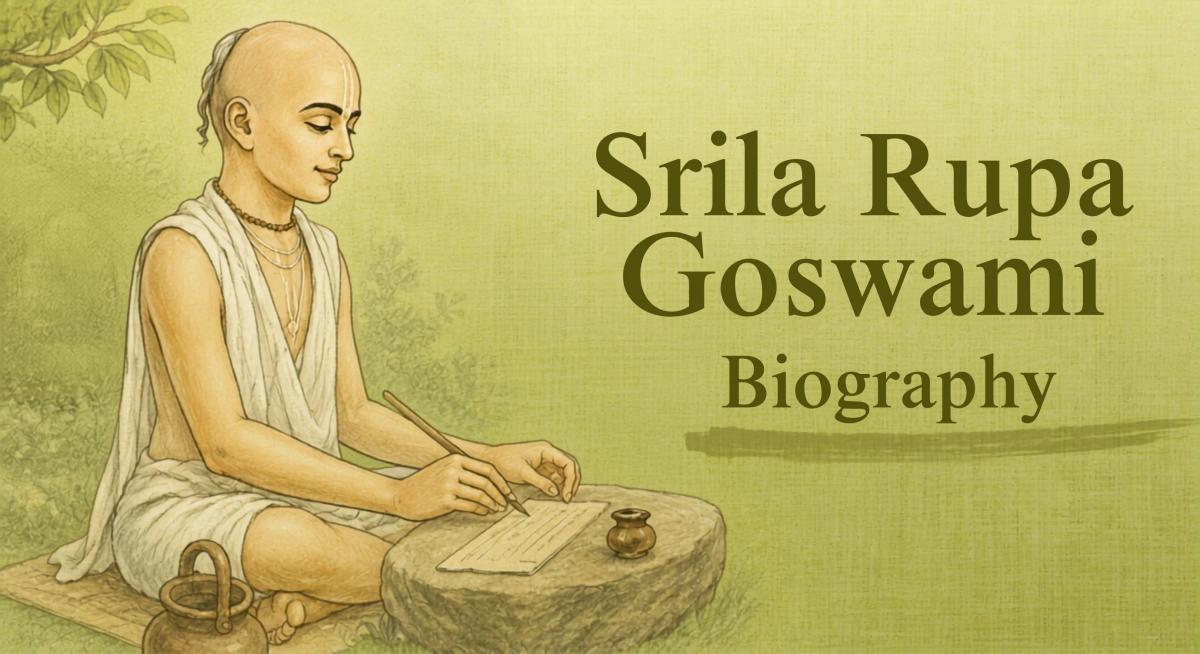
Srila Rupa Goswami is one of the most prominent acharyas of the Gaudiya Vaishnava tradition and one of the principal disciples of Shri Chaitanya Mahaprabhu. He is revered as the Rasa-acharya for systematically presenting pure devotional service and explaining the stages and transcendental rasas of devotion to Lord Krishna.
At a young age, he left his position as minister and renounced everything to devote his life to propagating Lord Chaitanya’s mission. Following his spiritual master's instructions, he went to Vrindavan, where he discovered the Deity of Govindadeva, rediscovered the lost sacred places of Krishna’s pastimes, and wrote books on devotional service.
Srila Rupa Goswami’s Appearance, Family and Education
Srila Rupa Goswami was born in 1493 in Fateyabad, Bengal, to Kumaradeva and Revati Devi. His childhood name was Santosh Dev. He was the younger brother of Srila Sanatana Goswami, whose earlier name was Amar Dev, and the elder brother of Anupama, whose earlier name was Vallabha. The family belonged to the Sarasvat Brahmana community of the Bharadvaja gotra and had its ancestral roots in Karnataka, South India.
In their childhood, the three brothers would play in local forests and name them after the forests of Vrindavan, designating their favorite bathing ponds as Radha-kunda and Shyama-kunda. Rupa Goswami received his earliest education from Ramabhadra Vani Vilas. Later, he went to Navadvipa for advanced studies, learning Nyaya (logic) from the famous Sarvabhauma Bhattacharya and his brother Madhusudana, and obtaining complete scriptural education under Vidyavachaspati.
He knew many languages, mastering Sanskrit, Arabic, Persian, Urdu, and Bengali. To learn Arabic and Persian, his grandfather Mukunda Dev sent him to Saptagram to study under a Mullah appointed by their family friend, Fakhruddin.
Forced Ministership under Nawab Hussein Shah
Recognizing the brothers' extraordinary genius and status as "kings of learning," the Muslim ruler of Bengal, Nawab Hussein Shah, demanded that they join his administration. The Nawab blackmailed them, threatening to destroy temples and persecute the local Vaishnavas and Brahmins if they refused.
To safeguard the devotee community, the brothers accepted the posts. Rupa Goswami was given the title Dabir Khas and appointed as the Nawab's Private Secretary and Finance Minister, while Sanatan became Sakar Malik, the Prime Minister. Despite their heavy political duties, they spent their private evenings studying the Srimad-Bhagavatam and longing for spiritual freedom.
Meeting with Shri Chaitanya Mahaprabhu
First Meeting: Midnight at Ramakeli (Humility)
Shri Chaitanya Mahaprabhu traveled to Ramakeli on His way to Vrindavan. At the time, Rupa Goswami and his brother Sanatana were living in the wealthy, royal capital of Ramakeli, serving as elite ministers under the Muslim ruler, Nawab Hussein Shah. Desperate to escape their government bondage, the brothers went in disguise under the cover of night to meet Lord Chaitanya, who was staying nearby under a local Tamal tree.
As they approached, they threw themselves flat on the ground to offer their dandavat obeisances. In a profound gesture of ultimate humility, they placed bunches of straw between their teeth and wept, pleading for the Lord's mercy.
Lord Chaitanya’s heart melted. He lifted them, embraced them, and assured them that Krishna would soon deliver them from their royal service. It was during this historic meeting that He renamed them Rupa and Sanatana.
Second Meeting: Ten Days at Prayag (Empowerment)
After resigning from royal service, Rupa Goswami distributed his wealth among his family, devotees, and charitable causes before traveling to Prayag with his younger brother Anupama. There, they first saw Sri Chaitanya Mahaprabhu performing ecstatic kirtan at Bindu Madhava Temple and later met Him privately at the home of a South Indian Brahmana.
Lord Chaitanya sat with Rupa Goswami for ten consecutive days on the banks of the Triveni at Dasasvamedha Ghat. There, the Lord systematically explained the entire science of devotional service (bhakti-yoga). Mapping out the progressive stages of faith from initial seed (sraddha) up to the highest ecstatic love of God (prema).
Lord Chaitanya compared the ocean of bhakti to a limitless expanse and told Rupa Goswami that He was injecting just "one drop" of this nectar into his heart. By this divine empowerment, Rupa Goswami understood and realized the entire theology of devotional mellows (bhakti-rasa), preparing him to write foundational textbooks for future generations. Lord Chaitanya then ordered him to proceed to Vrindavan to begin his mission
Third Meeting: The Secret Palm Leaf at Jagannatha Puri (Revelation)
After visiting Vrindavan, Rupa Goswami traveled to Jagannatha Puri to reunite with the Lord. Feeling extremely fallen, he did not enter the main temple but stayed at Siddha Bakula with Haridasa Thakur. Chaitanya Mahaprabhu visited him daily with Jagannatha prasadam.
During the annual Ratha-yatra festival, Lord Chaitanya danced before the chariot of Lord Jagannatha. He was chanting a seemingly mundane, external love song about a girl pining to return to the riverbanks and forests of her youth. While the crowds could not understand the deeper meaning, Rupa Goswami immediately decoded the Lord's internal heart. He recognized Srimati Radharani longing to bring Krishna back from the opulence of Kurukshetra to the sweet, simple pastimes of Vrindavan.
Inspired by Mahaprabhu’s mood, Rupa Goswami composed a Sanskrit verse on a palm leaf and placed it in his hut before going to bathe. During his absence, Sri Chaitanya Mahaprabhu found the verse, admired Rupa’s handwriting, which He compared to “strings of pearls,” and was deeply moved by its meaning.
When Rupa Goswami returned and offered his obeisances, Sri Chaitanya Mahaprabhu playfully tapped him on the back and asked how he had understood His innermost heart. He then told Svarupa Damodara that He had fully bestowed His mercy and potency upon Rupa Goswami, making him an authorized representative of His mission, sri-caitanya-mano-'bhistam.
Finding the Deities of Govindadeva
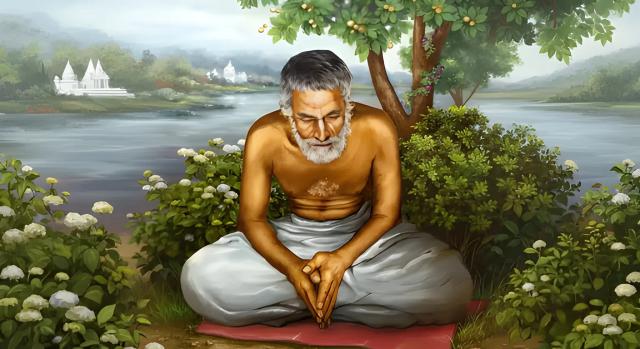
Srila Rupa Goswami had been tasked by Lord Chaitanya Mahaprabhu to reclaim Vrindavan and locate its ancient, lost Deities. He was particularly desperate to find the original Deity of Govindadev, which had been carved 5,000 years prior by Sri Krishna’s great-grandson, Vajranabha. Deeply saddened and weeping because his search was yielding no results, Rupa Goswami sat in deep prayer under a tree near the Yamuna River (near the Keshi Ghat area)
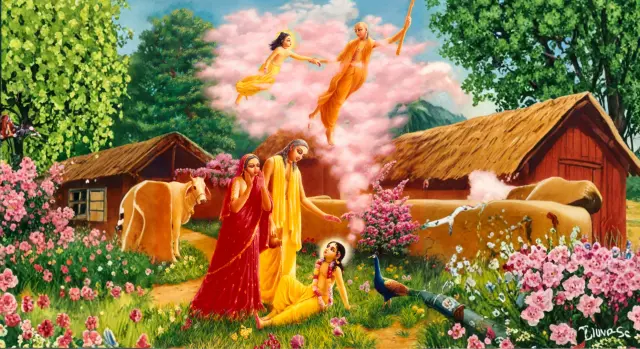
A beautiful local cowherd boy approached him and told him not to lament. The boy shared that on a nearby hill called Gomatila, a cow went daily and spontaneously shed her milk into a hole in the ground. The boy led Rupa Goswami to the exact spot and suddenly disappeared. Rupa Goswami immediately realized the boy was none other than Lord Krishna Himself.
Rupa Goswami gathered the local villagers to dig into the wet earth where the cow had poured her milk. Through their collective efforts, they unearthed the exquisite Deity of Govindadev.
Upon unearthing Govindadev, Rupa Goswami was completely overwhelmed by ecstatic love. He composed his famous and sweet prayer of glorification, "Jay Jay Sundara Nanda-kumara". He performed a grand four-hour abhisheka of the deity with sacred Yamuna water mixed with cow’s milk.
Radharani’s Sweet Rice Pastime
While residing at Ter Kadamba, Srila Rupa Goswami deeply desired to prepare a sweet rice feast to honor his older brother, Srila Sanatana Goswami, on his appearance day. However, living as a penniless mendicant, Rupa had no ingredients and sat weeping.
Srimati Radharani saw Her devotee's sorrow and personally approached him disguised as a young, beautiful local village girl. She handed him a pot containing rich ingredients—including milk, rice, sugar, and saffron. She told him that her mother had sent them from a local wedding so the sadhu could have a cooked meal.
Rupa joyfully cooked the opulent sweet rice. When Sanatana Goswami arrived and tasted it, he was instantly overwhelmed, and all eight ecstatic symptoms of love for Krishna (asta-sattvika-bhava) quivered throughout his body. Sanatana realized the mysterious girl was Srimati Radharani Herself.
Sanatana Goswami wept and gently chastised Rupa Goswami, explaining that they should never accept service from their worshipable Goddess. Overwhelmed with intense love, both brothers wept and honored the divine sweet rice remnants together.
Srila Rupa Goswami’s Disappearance Day
Srila Rupa Goswami’s disappearance was marked by a profound mood of spiritual separation and deep absorption in the holy name. Following the departure of his beloved elder brother and guide, Sri Sanatana Goswami, on Guru Purnima, Rupa Goswami was overcome with grief. After performing Sanatana Goswami’s final rites and placing him in a samadhi, he arranged a grand feast for the local Vraja community.
Deeply affected by his brother’s departure, Rupa Goswami then retired to his bhajan kutir at Sri Radha-Damodara Temple. There he remained absorbed in meditation and chanting for 27 continuous days without stepping outside. On the 28th day, the auspicious Shravan Shukla Dvadashi, he departed to rejoin the eternal pastimes of Radha and Krishna in Goloka Vrindavan as Rupa Manjari.
Samadhi And Bhajan Kutir
Srila Rupa Goswami’s sacred Samadhi Mandir and principal Bhajan Kutir are located in the courtyard of the historic Sri Sri Radha-Damodar Temple in the Seva Kunj area of Vrindavan. The bhajan-kutir marks the sacred place where he performed his devotional practices, while his samadhi is revered as his memorial shrine.
Key Contributions
The key contributions of Srila Rupa Goswami include:
Systematizing the Science of Bhakti (Rasa-Acharya)
At Prayaga, Sri Chaitanya Mahaprabhu personally instructed Srila Rupa Goswami for ten days and empowered him to understand the science of bhakti. Rupa Goswami later systematically presented the stages of devotional advancement, from faith (shraddha) and devotional practice to bhava and prema. Because of his profound exposition of bhakti-rasa, he is revered in the Gaudiya Vaishnava tradition as the Rasa-acharya, the foremost teacher of devotional mellows.
Established a Literary Foundation for Bhakti
Srila Rupa Goswami authored numerous foundational works that have become highly influential texts in the Gaudiya Vaishnava tradition. His major works include Bhakti-rasamrta-sindhu, Upadesamrta, Ujjvala-nilamani, Vidagdha-madhava, Lalita-madhava, Dan-keli-kaumudi, and Other Notable Texts. Through these writings, he systematically presented the principles of bhakti and provided guidance for devotees.
Unearthing and Establishing the deity of Shri Govindadev
With the help of a cowherd boy, who was Lord Krishna Himself, Rupa Goswami was able to find the deity of Govindadev. He gathered local villagers to dig into the wet earth and successfully unearthed the exquisite Deity. Rupa Goswami then established His worship, arranging regular seva with food offerings, arati, prayers, and other devotional services.
Rediscovered Lost Places of Vrindavan
Rupa Goswami traversed the wilderness of Vraja, mapping out the 12 sacred forests and uncovering the exact locations where Krishna performed His pastimes 5,000 years prior, transforming Vrindavan from an unmapped jungle into a prominent place of pilgrimage.
FAQ
Conclusion
Srila Rupa Goswami devoted his entire life to fulfilling the mission of his spiritual master, Lord Chaitanya. His exemplary life teaches us the attitude of selfless service, renunciation for the Lord’s mission, and humility. Anyone who sincerely desires to take shelter of the Lord’s lotus feet should follow in his footsteps and strictly follow the teachings given by him.