
 Donate Now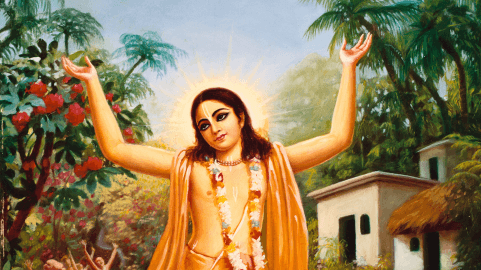
In the scriptural history, there are many chapters where the Supreme Lord, Lord Krishna, has taken divine forms to save humanity or His dear devotees.
Among that, there is one golden chapter of the 15th century, where the Supreme Lord has taken form to give the ultimate nectar of bhakti and the gate of freedom from all the sufferings of the soul.
This is the story of chaitanya mahaprabhu, the ultimate guru for the Kali Yuga,How Ram Navami is Celebrated
who has given the mercy of Harinam Sankirtan, the nectar of true and pure devotion towards the Supreme Personality.
Birth of Chaitanya Mahaprabhu in Mayapur
Sri Chaitanaya Mahaprabhu is the divine form of Lord Sri Krishna, with the mood of Srimati Radha Rani, the purest devotee of the Lord.
He appeared in the year 1486 CE in Mayapur, a town near the Ganga River, in Navadvipa. His period of birth was the Phalguna month, a very auspicious time for devotional practices.
Parents: Jagannath Mishra and Sachi Devi
His father was a great man named Jagannath Mishra, and his mother, Sachi Devi, was also devout by heart and practice. They both were Vaishnavas and worship Lord Vishnu, the preserver and protector of the universe.
Sachi Devi's father was an intelligent astrologer, Pandit Nilambar Chakravarti. When Mahaprabhu was born, her father was invited to perform the nama-karan ritual.
Names and Meanings: Nimai, Vishwambar, Gauranga
After Mahaprabhu's divine birth, he was named 'Vishwambar' by the Gauranga Mahaprabhu Vedic scholars, who were invited to give Him a name. This name signifies the one who maintains the universe.
Later, when people witnessed His divine chantings and the devotional mood, they renamed Him as
i) Nimai: It symbolizes the one who was born under the neem tree; there was one in His house. The full name was Nimai Pandit.
This was His nickname, which was used by the family members and the neighbors during His childhood and adulthood years, before His sanyasa.
ii) Gauranga: Gauranga refers to 'Gaura,' which means golden, and 'anga,' which means body.
It symbolizes his golden complexion, reflecting the glow of bhakti, similar to Srimati Radha Rani.
This was named by the followers, who once came in contact with Him and started following His instructions.
iii) Gaura Hari: 'Gaura' refers to the golden, and 'Hari' refers to the Supreme Lord.
The sincere followers of Sri Chaitanaya Mahaprabhu used to address Him by this name, after they had realized that He was none other than the Supreme Personality Himself.
Early Life and Scholarly Brilliance
Mastery in Sanskrit and Nyaya
Nimai Pandit was an extraordinary child compared to all the other children of his age. He has accomplished mastery of the Sanskrit language at a very young age.
In ancient times, the master of Sanskrit was considered to be an expert in the following branches of the language.
i) Vyakarana (Grammar)
ii) Nyaya (logic and debate)
iii) Alankara (Poetics)
iv) Vedas/Puranas (Scriptures)
Defeat of Keshav Kashmiri
Keshav Kashmiri was a Gauda Brahmana and a scholar expert in the Sanskrit language. His debating skills were so unmatchable at that time that he once achieved the title of Jagadvijayi.
The word 'Jagadvijayī' refers to 'Jagat' = world and 'Vijayi' = defeat. It means the one who defeated the world.
He achieved this title after defeating so many Sanskrit scholars. He used to travel a lot; wherever he went, he defeated the scholars of that area.
He once visited Navadvipa and challenged all the scholars to debate him and defeat him if they could. Nimai Pandit stepped forward and accepted the challenge.
The challenge was 'Glorifying Mother Ganga in Sanskrit verses.'
At that time, Mahaprabhu was living His household life and preaching Sanskrit subjects: logic, debate, and grammar.
The challenge was started by Keshav Kashmiri, and when he stopped, Nimai Pandit praised his intelligence and humbly pointed out a single mistake.
This has broken the pride of Keshav Kashmiri, and he accepted his defeat.
After this, he simply bowed before Nimai Pandit and appreciated His intelligence. This has also developed a humble attitude inside Keshav Kashmiri.
Divine Signs and Childhood Miracles
Other than being a scholar in Sanskrit, Nimai Pandit has also shown divine behavior. The entire village has witnessed His love and longing for Lord Krishna.
The following incidents have drawn everyone's attention to the idea that He was no ordinary human:
i) Chantings of Lord Krishna's names:
Whenever there's a chanting or Kirtan of Lord Krishna's name, like Hari/Govinda/Gopal/Krishna, Nimai stopped crying or got peaceful/cheerful.
This was an early sign for everyone, the family and neighbors, that He recognized and felt the joy of hearing Lord Krishna's name.
ii) Magnetic attraction to devotion:
Nimai was always attracted to devotional practices, especially the names of Lord Krishna. His love for Hari was completely unusual. He used to smile, laugh, and clap during the kirtan of Sri Hari's holy names.
iii) Extraordinary knowledge and intelligence:
From his childhood, Nimai was known for being a scholar in the Sanskrit language. Even the teachers were often surprised to see His grasping and understanding skills.
iv) A divine aura:
People mostly experienced the unfamiliar, yet very peaceful and emotionally stable energy around Nimai. Whenever they even saw Him, they got in a positive mood.
Wherever he goes, he spreads inner peace, emotional stability, and divine energy around Him.
Spiritual Turning Point of Chaitanya Mahaprabhu
As we described from the start of this story, Nimai Pandit was an extraordinary scholar in the Sanskrit language and devoted to Lord Krishna.
A sudden change occurred in His life when He felt completely surrendered to the lotus feet of Lord Shri Krishna with sole devotion.
This transformation led to the highlighted phases of the Chaitanya Mahaprabhu story, which is beyond scriptural knowledge and spiritual practices.
Initiation from Ishvara Puri in Gaya
In the year 1497, Jagannātha Misra passed away. At that time, Nimai was still an 11-year-old boy. He visited Gaya to perform the after-death rituals of His father.
To perform the rituals, he stayed for a few days in Gaya. There, he met a monk named Ishvara Puri.
Ishvara Puri was known for His ideal humility and service attitude in devotion to Lord Krishna. He initiated Nimai Pandit and gave the Hare Krishna Mahamantra.
"Hare Krishna Hare Krishna
Krishna Krishna Hare Hare
Hare Rama Hare Rama
Rama Rama Hare Hare."
Inner Transformation through Bhakti
After the trip to Gaya, Nimai Pandit was never the same. He has become a pure devotee and falls deeply in devotion to Lord Sri Krishna.
He started to arrange the Harinam Sankirtan, inspire people to chant the holy names of Lord Krishna, and spread the joy of devotion.
His devotion slowly overwhelms Him, and he feels longing and love for Lord Krishna at the same time.
Many witnessed His divine love by seeing Him in a higher state of joy while singing, chanting, and crying for the Lord.
Acceptance of Sannyasa at Age 24
At the age of 24, he made a huge decision to accept the Sannyasa. He wanted to reach as many people as he could to spread the higher ecstasy of devotion.
His kind nature was pushing Him to do this to benefit the soul by completely liberating it from suffering.
He left his house and the village and visited Katwa. There was a well-known monk, Keshava Bharati, who was living there and was known for giving sanyasa initiation.
Although His mother and previous followers were unhappy about His leaving, He decided.
Renaming as Sri Krishna Chaitanya:
During Mahaprabhu's initiation by Keshava Bharati, He was renamed Sri Krishna Chaitanya.
i) Sri: It means divine.
ii) Krishna: The Supreme Lord
iii) Chaitanya: It means divine consciousness.
Together, the name signifies 'the one who awakens the Krishna consciousness in all living beings.'
Travels and Preaching Mission
In the following time of sannyasa, Sri Krishna Chaitanya initiated His full preaching. His way of understanding and feeling the Mahamantra was completely different from how scriptural followers would have described it.
He never tried a bit to philosophically or scripturally convince people to simply accept the devotional chantings of Harinam Sankirtan. People were naturally drawn towards His chanting, singing, and dancing.
In His preaching hours, He used to teach:
i) Nama-sankirtan.
ii) Discussions rooted in only devotion.
iii) Encouraging other people to Harinam Sankirtan.
Journey across South India
Sri Krishna Chaitanya Mahaprabhu took a long journey to South India. It was a life-transformative journey in preaching.
It wasn't solely a tour to the holy places in the south, but also a spreading movement of Krishna consciousness to another region.
He simply moved there with no support or followers, with a clear intention of spreading the divine Harinam not only to the scholars but also to the ordinary people as well.
Visit to Vrindavan
When the mad lover of Lord Krishna reached Vrindavan, it became the most emotional moment. It is the divine place where Lord Krishna spent His sweet pastimes with His parents, brother, and the villagers.
His spiritual mood during the entire visit:
i) Chanting near riverbanks, in the Govardhan region, and in the forest all the time.
ii) Remembering and crying for Lord Krishna.
iii) Completely absorbed in devotion.
Residence in Jagannath Puri
Jagannath Puri is the primary residence of Sri Chaitanya Mahaprabhu. He spent many years in the holy land of Puri.
His journey to Puri was long before Vrindavan. And, after the Vrindavan trip, he returned to Puri and spent the rest of his life there.
There were reasons to choose Puri over Vrindavan to spend the rest of His years:
i) He wanted to preach to people until His last breath. Doing this service was not possible in Vrindavan, as the place was overwhelming for Mahaprabhu.
ii) He wanted to train His devotees to make them advance in devotion.
iii) Jagganath Puri was a perfect place for staying in devotion and being accessible to the followers.
Life of Ecstatic Kirtan
Sri Chaitanya Mahaprabhu's life was entirely drowned in the ecstatic chantings of the holy names of Lord Krishna.
His love was so intense that the one with a good heart got attracted to His energy, and the one with an evil heart got repelled immediately.
Key Disciples in Chaitanya Mahaprabhu's Story
In Chaitanya Mahaprabhu's story, they are the ones who preserved his teachings and spread his sankirtan to the next generations.
As per Gaudiya Vaishnavism, these four principal disciples of Mahaprabhu, and Mahaprabhu Himself, are referred to as Pancha Tattva.
The four advanced disciples of Sri Chaitanya Mahaprabhu:
1) Nityananda Prabhu—
i) Where and when did He meet Mahaprabhu?
Nityananda Prabhu first met Sri Chaitanya Mahaprabhu in Navadvipa, around 1509 CE. He was returning from a pilgrimage visit.
ii) Who Is He
Nityananda Prabhu was the divine incarnation of Lord Balarama, the first expansion of Lord Krishna.
He was the expression of mercy, humility, and compassion. In the whole mission of Mahaprabhu, he played a key role in delivering the holy names to the most fallen material souls.
As the divine incarnation of the Supreme Lord's expansion, he simply accepted Mahaprabhu as His spiritual master and fully joined the Sankirtan movement.
2) Advaita Acharya —
i) Where and when did He meet Mahaprabhu?
Advaita Acharya was living in Navadvipa and had known Mahaprabhu since his childhood.
But, after sannayasa, he met Mahaprabhu around 1506–1508 CE.
ii) Who Is He
Advaita Acharya was the divine incarnation of Mahavishnu and Sadashiva (Shiva tattva). He was a scholar and devotee who spread Mahaprabhu's mission in East India.
He taught faith in the Supreme Being. He practiced chanting and further spread it as the direct method of liberation.
Advaita Acharya was a sincere devotee of Lord Krishna. He used to worship the Shaligram with purified Ganga water and fresh tulsi leaves daily.
Scriptures state that the Supreme Lord heard His prayers to descend on earth and showed the ultimate way of liberation to every soul.
3) Gadadhara Pandit—
i) Where and when did He meet Mahaprabhu?
Gadadhara Pandit has known Chaitanha Mahaprabhu since childhood. After Mahaprabhu's sannyasa, he met Him around 1498–1502 CE.
ii) Who Is He
Gadadhara Pandit was the childhood companion of Sri Chaitanya Mahaprabhu. They studied together in Navadvipa. Later, He joined the sankirtan movement of Mahaprabhu and accepted Him as His spiritual master.
He was the manifestation of humble devotion, inner spiritual depth, and intellectual awareness.
4) Srivasa Thakur -
i) Where and when did He meet Mahaprabhu?
Srivasa Thakur knew Mahaprabhu from his childhood years. Later, after the sannyasa, he joined the Harinam Sankirtan around 1514–1516 CE.
ii) Who Is He
Srivasa Thakur was a devotee of Lord Krishna. His faith towards Krishna was strong, and his service towards the Sankirtan mission of Mahaprabhu was unshakable.
Philosophy and Teachings of Chaitanya Mahaprabhu
i) Chanting the holy names of Lord Krishna:
The holy names of the Supreme Lord are as powerful and merciful as the Lord Himself.
In this age of Kali, the souls have mostly fallen into the trap of material enjoyment and temporary happiness. It is totally different from other Yugas.
The Kali Yuga is well explained in Srimad Bhagavatam, Canto 1, Chapter 1, as
प्रायेणाल्पायुष: सभ्य कलावस्मिन् युगे जना: ।
मन्दा: सुमन्दमतयो मन्दभाग्या ह्युपद्रुता: ॥ १० ॥
~ŚB 1.1.10
Translation: O learned one, in this iron Age of Kali, men almost always have but short lives. They are quarrelsome, lazy, misguided, unlucky, and, above all, always disturbed.
This is why the power of chanting in this Yuga is equal to penance or many purified yagnas in the previous Yugas.
Hence, Sri Chaitanya Mahaprabhu focused on preaching the Hare Krishna Mahamantra to as many souls as he could. And, later, passed on this responsibility to His dear companions/advanced followers.
ii) Humility:
Humility is the quality of living in a mental state that you are as ordinary as others, even if you are not.
It is the sign of pure devotion. Every companion of Sri Chaitanya Mahaprabhu and Him has an abundance of humility in their nature.
During the devotional classes of Mahaprabhu, he used to teach humility to those who decided to join the sankirtan movement.
Material people consider this quality a weakness. But, actually, it is the most adored quality in a person to Lord Krishna.
This is explained in Sri Chaitanya Charitamrita, Antya Lila, Chapter 20, as:
তৃণাদপি সুনীচেন তরোরিব সহিষ্ণুনা ।
অমানিনা মানদেন কীর্তনীয়ঃ সদা হরিঃ ॥ ২১ ॥
~CC Antya 20.21
Translation
‘One who thinks himself lower than the grass, who is more tolerant than a tree, and who does not expect personal honor but is always prepared to give all respect to others can very easily always chant the holy name of the Lord.’
iii) Devotional Services:
The pure devotion is identified by humility and selfless services, which are intended to be performed to please Lord Krishna.
iv) Compassion:
Compassion is the rare quality that can be found in the people of Kali Yuga. There are only a few people who show real sympathy towards others' sufferings.
Sri Chaitanaya Mahaprabhu showed the world what true compassion looks like. He was the divine incarnation of the Supreme Lord and the lover of Lord Krishna.
Instead of doing what pleases only Him, He has done whatever it took to spread the divine mercy of Harinam Sankirtan to save the suffering souls of this Yuga.
i) He has left His home. His family: To reach more people.
ii) He has left His beloved Vrindavan to continue guiding His followers and show His availability to them.
Divine Identity of Chaitanya Mahaprabhu
Sri Chaitanya Mahaprabhu, as the Supreme Personality Himself, has appeared in the mood (bhava) and complexion (dyuti) of Srimati Radha Rani.
Mahaprabhu has revealed the true depth of Srimati Radha Rani's love and the pleasure she feels in that eternal love.
This is the reason why he felt love for Lord Krishna in extreme bliss.
Also, it explains the tears, trembling, singing, and the complete absorption in the prema-bhakti of Lord Krishna.
Disappearance of Chaitanya Mahaprabhu
Those who made their contributions to life for many lifetimes never truly faded away. Their glow stays visible for generations after generations.
Sri Chaitanaya Mahaprabhu's disappearance is just a physical departure. He is still alive in His Hare Krishna Movement, which is continued by His followers to every corner of the world.
Around 1533-1534 CE, he was about 48 years old when His divine soul left this material world. Disappearance of Chaitanya Mahaprabhu
Those who made their contributions to life for many lifetimes never truly faded away. Their glow stays visible for generations after generations.
Sri Chaitanaya Mahaprabhu's disappearance is just a physical departure. He is still alive in His Hare Krishna Movement, which is continued by His followers to every corner of the world.
Around 1533-1534 CE, he was about 48 years old when His divine soul left this material world. In His last moments, he was chanting the holy names and remembering the divine form of the Lord, with tearful eyes.
Legacy of Chaitanya Mahaprabhu Story
The legacy of Sri Chaitanaya Mahaprabhu is that His mission has liberated many souls and continues to liberate many others.
In the whole Chaitanya Mahaprabhu Story, His life has established the proper bhakti culture and worship system that is organized, and those who advance it feel the mood connecting to the divine consciousness.
The second biggest contribution He has made was the formation of six Goswamis of Vrindavan.
They carried His teachings and instructions to the next generations through their devotional books. Not only did they describe every teaching of Mahaprabhu, but they also described His simple, yet beautiful, devoted life.
Global Impact of Chaitanya Mahaprabhu
i) The preaching of chanting worldwide.
ii) Availability of scriptures in different languages. It was the performed service of His sincere followers.
iii) Formation of kirtan-performing communities and Hare Krishna around the world.
iv) Establishment of the spiritual teachings of Gaudiya Vaishnavaism.
v) Glorification of devotional music globally.
Why Chaitanya Mahaprabhu Story is Relevant Today
i) Easy accessibility:
The one big relevance of Sri Chaiatanya Mahaprabhu's teachings is that they welcome everyone to understand them, beyond caste or religion.
Without the necessity of scriptural scholarship, ritual understanding, or wealth, the door of chanting the Hare Krishna Mahamantra is open for everyone.
ii) Mental and Emotional Healing:
The melodious chantings of Harinam bring calmness to the mind and balance in the emotions.
Globally, people themselves have experienced the joy of chanting and hearing the divine names of the Lord.
When the mind becomes calm and the emotions are balanced at once, the mood becomes peaceful.
This results in healing the hidden pains, current sufferings, or any other negative effects of unbalanced emotions and a disturbed mind.
iii) Devotional Practices:
Mahaprabhu's divine Sankirtan movement includes the practices of body, mind, and heart.
It has selfless services towards the Supreme Lord so that the senses can come into control, emotions get balanced, and the mind feels stable.
This is the ultimate requirement to feel the pure divine names of Sri Hari. One needs to cleanse the negativity and practice inner stillness to hear and feel the real melody of this Harinam Sankirtan.
Conclusion
The Chaitanya Mahaprabhu Story isn't just all about the devotional life of Mahaprabhu; it is an open call to every soul to understand the ultimate pathway of feeling the ecstasy of the Supreme Lord's love.
He was a beautiful person with a high scholarly knowledge of the Sanskrit language, yet He came to prove that the only joy one can find is in the calling of Lord Krishna, not in living in a household or getting fame in society.