
He is Mahadev - the destroyer of the universe, the lord of Kailash, the greatest of yogis. And one day he left it all behind, just to see a baby.
In Gokul, news had spread that Nanda Maharaj and Mother Yashoda had been blessed with a son. The whole village was dancing. Cowherds smeared each other with butter and turmeric, and the gopis came with gifts and blessings for the child.
Far away on Kailash, Lord Shiva sat in meditation — and he knew exactly who that child was. The Lord he worships in his heart, day and night, had appeared in Braj as a little cowherd boy. How could Shiva stay away?
This is the story of that visit: of a mother who would not let a strange-looking sadhu near her baby, of a child who cried until His devotee was called back, and of the darshan that Lord Shiva treasures above everything else.
The Story
1. A promise on Kailash
Deep in meditation on Kailash, Lord Shiva saw that his worshipable Lord, Sri Hari, had appeared in Gokul at the home of Nanda Maharaj and Yashoda. He rose at once to leave.
Mother Parvati ran after him. "Mahadev, where are you going without telling me?"
"Parvati, our Lord has come to Gokul to perform His childhood pastimes. I am going for His darshan."
"I am your ardhangini, your other half," she said. "Take me with you!" Shiva gently told her the road was long and hard; he would go alone and return quickly. Parvati agreed — on one condition. "I have heard the butter of Gokul is like nothing else. Bring me some of Gokul's makhan prasadam!" Shiva promised, and set out for Braj.
2. Why disguise yourself in Braj?
To avoid frightening anyone, Shiva first took the form of an ordinary brahmana. But the moment he crossed into Braj-bhumi, a deep bliss came over him, and he thought: This is the Lord's own playground. Why should I hide who I am here? I will go to Him in my own form.
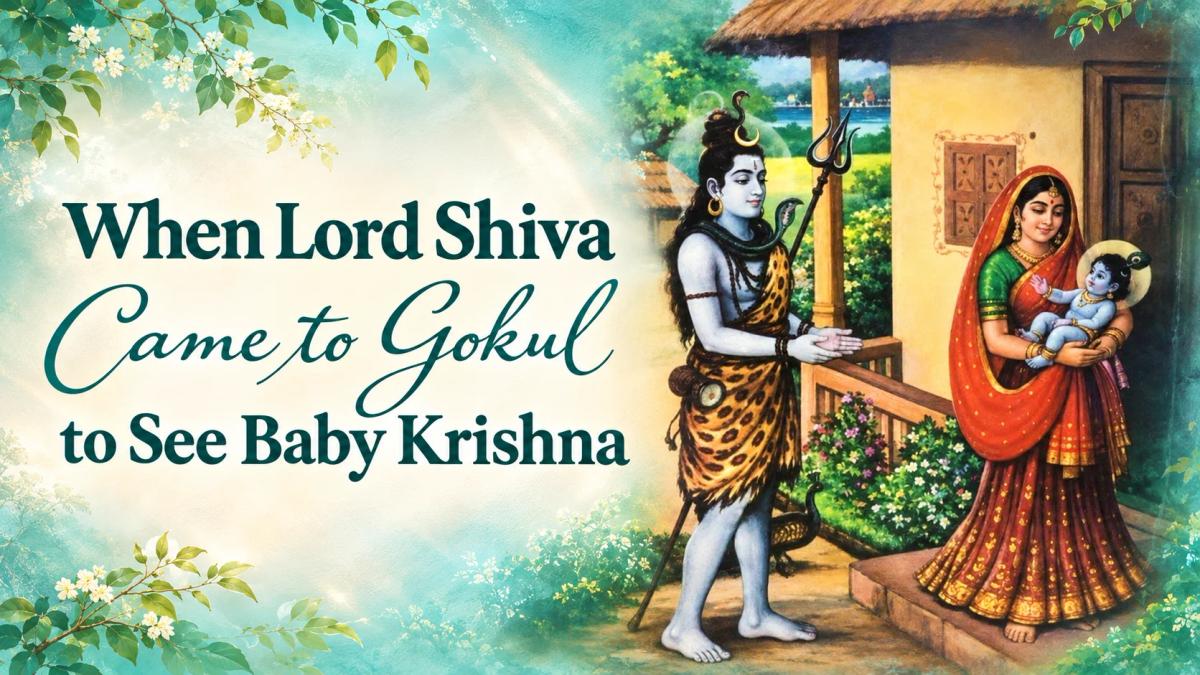
So he dropped the disguise. Three eyes. Matted locks holding the Ganga. His body smeared with ash from the cremation grounds, wrapped in a tiger skin. Live snakes coiled around his neck, arms, waist and ankles — and, the speaker adds with a smile, a belt of scorpions. Damaru in hand, he walked to Nand Bhavan.
3. A mother says no
At the door he called out, "Bhavati bhiksham dehi!" — "Mother, give me alms!"
Yashoda came out. Seeing this fearsome sadhu, she bowed respectfully — from a safe distance. "Welcome, Baba. What can I give you?"
"I need no gifts or alms. I have heard a divine son has been born to you. I have come only for His darshan."
"That is impossible," said Yashoda. "Ask for anything else and I will give it gladly. Fresh milk, food, clothes, wealth — take them and go. But I will not bring my baby out, and I will not let you in."
When she offered him grain, Shiva smiled. "I am the husband of Annapurna herself. I have not come for food. I want only one glance at your little boy."
Yashoda would not move. Her refusal was not unkindness. It was pure vatsalya, a mother's love. What if her tender baby was frightened? What if a snake or a scorpion fell from this Baba onto her child?
4. Meditation by the Yamuna
Shiva could not enter without the permission of the mistress of the house. So he walked to the bank of the Yamuna, sat down, and fixed his mind on Krishna's lotus feet.
"O Lord, You are the cause of creation, maintenance and destruction. This infant form of Yours is rare even in Vaikuntha. I have come all the way from Kailash. Please, give me just one glance."
Inside Nand Bhavan, the baby in the cradle heard that prayer. All-pervading, Krishna had watched everything. And He had a plan: a loving contest between two great devotees — Shiva in the mood of the servant, dasya, and Yashoda in the mood of the mother, vatsalya.
5. The baby who would not stop crying
Suddenly, Krishna began to cry. Tears rolled down His cheeks. Yashoda rocked Him, sang to Him, fed Him — nothing worked. The whole household gathered, and still He cried.
An elder gopi named Lalita came close. "Yashoda, did you speak harshly to any saintly person today?"
Yashoda thought, and told her about the frightening sadhu she had sent away.
"That is the reason," said Lalita. "A saint's heart is tender. When it is hurt, everything is disturbed. Bring him back, put Laala in front of him, and let him bless the child. Then Laala will be well."
A messenger ran to the Yamuna and found Shiva still in meditation. He was invited back to Nand Bhavan.
6. The darshan
Yashoda brought out her weeping baby and placed Him carefully in Shiva's arms. "Baba, you have so many snakes and scorpions! Be very careful that not one of them touches my Laala."
The moment Krishna was in Shiva's hands, He stopped crying. He opened His eyes and gave Shiva a sweet, merciful sidelong glance.
Shiva's hair stood on end. Tears of love poured from his eyes like the Ganga flowing from his locks. "O Jagannath, O Parameshwar! Great sages perform austerities for thousands of years and still do not see You. And here You lie, a tiny baby in the home of a cowherd woman. Millions of obeisances at Your lotus feet!" He touched the baby's soft feet to his forehead. According to tradition, it was in this moment that Shiva recited the Gopala Sahasranama, the thousand names of Gopala, which he later taught to Parvati.
7. A mother's love wins
Shiva was lost in prayer, and Yashoda grew worried again. "Baba, why are you holding my Laala so long? Careful — your snakes!"
In that moment Shiva understood who Yashoda really is: not an ordinary village woman, but the eternal mother of the Lord, His own internal potency. In his heart he bowed down to her, and gently gave Krishna back.
Then he remembered his promise. Before he could even ask, Yashoda went inside and came back with a large pot of fresh butter. "Baba, take this prasadam. You have brought so much joy to my child."
8. The empty pot
Shiva set out for Kailash, the pot of butter in his hands and Krishna's form filling his heart. Absorbed in that form, he began tasting the butter — just a little — then a little more. Mile after mile, remembering Krishna, he kept licking the mahaprasadam.
When he reached Kailash, Parvati was waiting. "Did you have darshan?"
"Yes! His form is more beautiful than words can say."
"And where is my Gokul butter?"
Shiva looked down. The pot was completely empty. He handed it to her and folded his hands. "Parvati, forgive me. When I held Him, I lost myself. All the way home I was remembering Him and tasting His prasadam, and I didn't even notice that I had finished it all."
Parvati was upset to miss such rare mahaprasadam. But devotees say the story ends with a smile — because if even Mahadev cannot stop tasting Krishna's prasadam, how sweet must it be?
The Scripture Behind the Story
This pastime is not narrated in the Srimad-Bhagavatam itself. It lives in the devotional tradition of Braj and is told in temples and satsangs across Gokul and Nandgaon. But the truths it carries are rooted in shastra. Three verses sit at its heart.
1. Shiva, the best of Vaishnavas — Srimad-Bhagavatam 12.13.16
nimna-gaanaam yathaa gangaa devaanaam acyuto yathaa vaishnavaanaam yathaa shambhuh puraanaanaam idam tathaa
As the Ganga is the greatest of rivers and Lord Achyuta the greatest of deities, so Shambhu (Shiva) is the greatest of Vaishnavas — and the Bhagavatam is the greatest of Puranas.
This is why a Vaishnava never looks at Shiva as a rival to Krishna. He is Krishna's dearest servant, and he showed it at Yashoda's door: he wanted nothing — not food, not honour — only darshan.
2. Krishna's form is eternal — Brahma-samhita 5.1
ishvarah paramah krishnah sac-cid-ananda-vigrahah anadir adir govindah sarva-karana-karanam
Krishna, known as Govinda, is the Supreme Lord. His form is eternal, full of knowledge and full of bliss. He has no beginning, He is the beginning of everything, and He is the cause of all causes.
Shiva walked home absorbed in exactly this sac-cid-ananda form. That is how he could finish a whole pot of butter without noticing.
3. The thousand names of Gopala
The speaker mentions that Shiva recited the Gopala Sahasranama while holding baby Krishna. This stotra comes down through the tantric tradition (it is often linked with the Narada Pancharatra) and is framed as Shiva teaching Parvati the thousand names of Gopala. Many devotees still recite it on Janmashtami.
Related pastimes worth reading
Krishna's birth and naming: Srimad-Bhagavatam, Canto 10, Chapters 5 and 8 describe the festival in Gokul and Garga Muni's naming ceremony.
Shiva's longing for the rasa dance: the Braj tradition of Gopeshwar Mahadev, where Shiva takes the form of a gopi to enter the rasa, is the same longing as this story, one step further.
What Mahadev Teaches Us
Why does a story about Shiva belong in a bundle of Krishna stories? Because in Braj, Shiva is the model devotee. Every step of his journey is a lesson for ours.
1. Love binds God more than power.
Shiva is the lord of yogis, but at Yashoda's door he was helpless. Krishna arranged this "contest" to show the world that a mother's simple love (vatsalya) holds Him even more tightly than reverent service (dasya). We don't need power or learning to reach Krishna. We need love.
2. Come as you are.
Shiva dropped his disguise at the border of Braj. Before Krishna there is no need for masks. Approach Him honestly, with your real heart, faults and all.
3. The door to Krishna is His devotee.
Even Mahadev could not enter Nand Bhavan without Yashoda's permission. Krishna's mercy comes through those who love Him: our guru, the Vaishnavas, the Brajvasis. That is why Shiva bowed to Yashoda in his heart.
4. Never hurt a sadhu's heart.
Krishna cried until the sadhu at the riverbank was brought back. Lalita understood at once: when a devotee is grieved, Krishna is grieved. Respect for devotees is not a formality. It is the way to keep Krishna happy.
5. When you are refused, sit down and pray.
Shiva didn't argue or curse. He went to the Yamuna and meditated on Krishna's feet, and the answer came. Patience and prayer open doors that force never can.
6. Prasadam is not ordinary food.
One pot of Gokul butter kept Mahadev in ecstasy all the way to Kailash. Honour prasadam with that same remembrance of Krishna.
Try this at home
On Monday, Shivaratri or Janmashtami, read this story aloud to your family, especially to children.
Offer fresh butter or mishri to Laddu Gopal, and share it as prasadam while remembering Shiva's empty pot.
When you visit a Shiva temple, pray to Mahadev as Krishna's great devotee: "Please give me devotion to Krishna, as you have."
Meeting Mahadev in Braj Today
| Place | Where | Why devotees visit |
|---|---|---|
| Gokul and Mahavan (Old Gokul) | Across the Yamuna, about 15 km from Mathura | Nanda Maharaj's home and Krishna's infant pastimes, where this story took place |
| Gopeshwar Mahadev | Vrindavan, near Vamshivat | Shiva as a gopi, longing to enter the rasa dance |
| Bhuteshwar Mahadev | Mathura | One of the four Shiva guardians of Mathura |
| Chakleshwar Mahadev | Govardhan, on Manasi Ganga | Shiva protecting the devotees of Govardhan |
| Nandishwar Hill | Nandgaon | Tradition says this hill is Shiva himself, holding Nanda's village on his head |
| Kameshwar Mahadev | Kamyavan | Guardian Shiva of Kamyavan forest |
Visiting tip: When you visit Gokul, sit quietly on the bank of the Yamuna for a few minutes, as Shiva did. Chant the holy name and pray to see Krishna through the eyes of His devotees.
Closing Thoughts
Lord Shiva can burn the universe with one glance. Yet he stood at a cowherd woman's door and waited, then sat by the river and prayed, just for one glance from a baby. That is the secret of Braj. Here God is not won by power. He is won by love, and the greatest of gods becomes a humble beggar at the door of love.
May Mahadev bless us with even a drop of his longing for Krishna.