
 Donate Now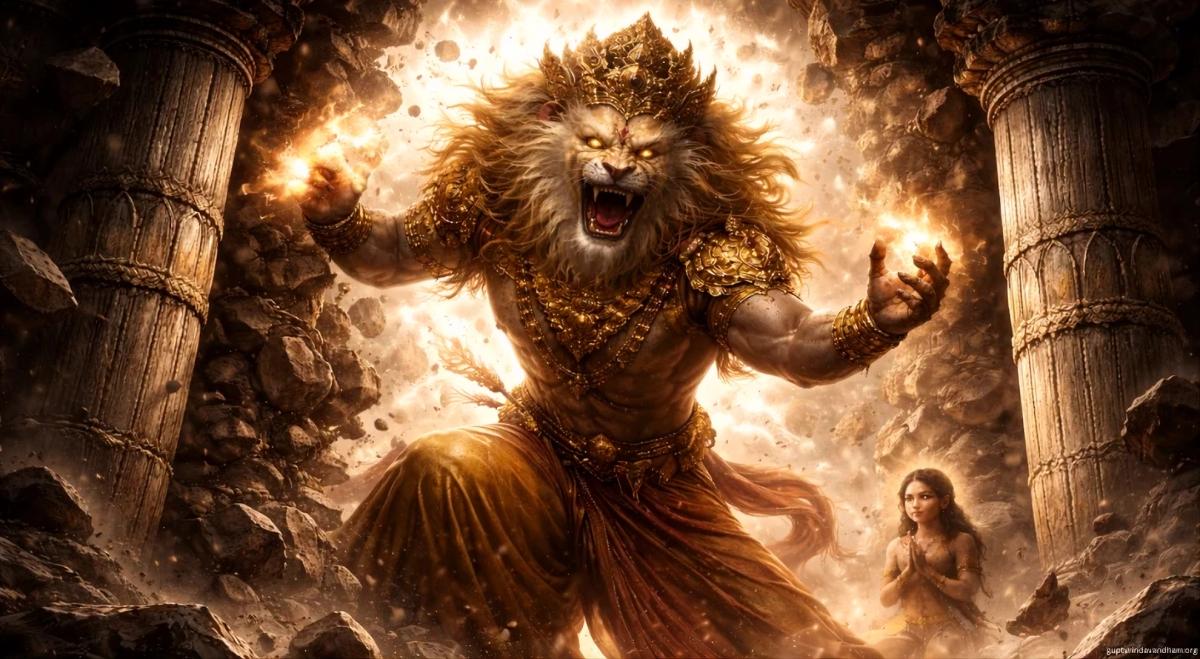
The Narasimha avatar story is one of the most powerful and deeply moving narratives within Hindu Vedic history. It forms a crucial part of the Dashavatara, the ten major incarnations of Lord Vishnu who descend to earth to destroy evil and restore balance.
Lord Vishnu incarnates from age to age to eradicate the forces of adharma and protect His beloved devotees. The appearance of Narasimha specifically highlights the divine commitment of the Lord to answer the call of a humble soul facing overwhelming tyranny.
Origin and Incarnation of Lord Narasimha
4th Incarnation of Lord Vishnu
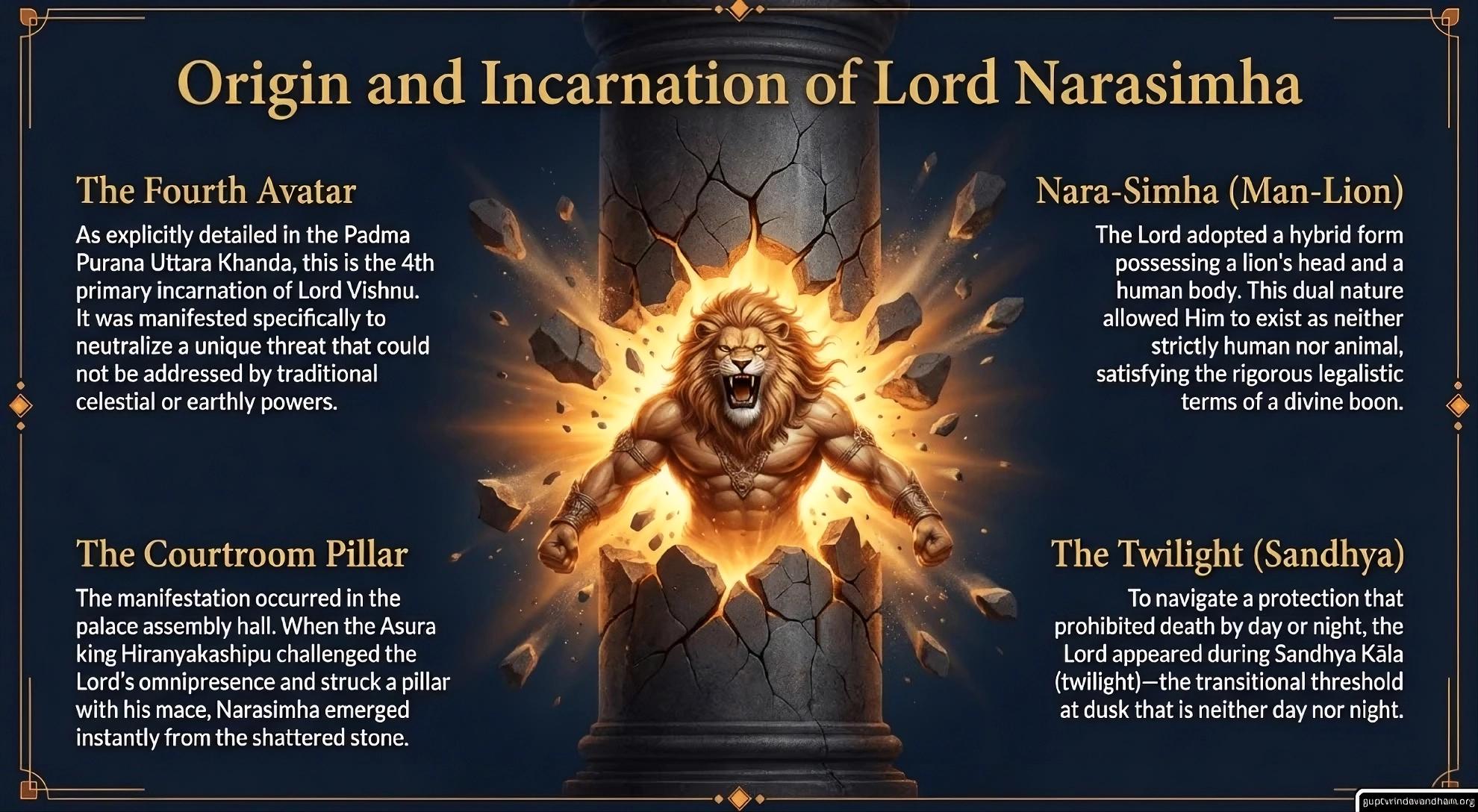
As explicitly detailed in the Padma Purana Uttara Khanda, Narasimha is the fourth of the ten primary avatars. This specific incarnation was required to address a unique and complex threat that could not be neutralized by traditional celestial or earthly powers.
Half-Man Half-Lion Form
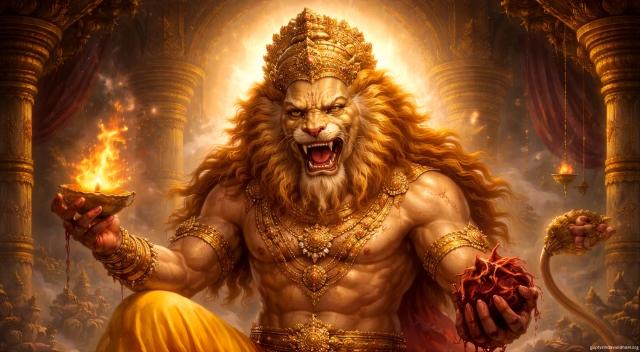
The name “Nara-Simha” describes His extraordinary physical appearance, possessing the head of a ferocious lion and the body of a man. This hybrid form allowed the Lord to manifest as neither strictly human nor animal to satisfy the legalistic terms of a divine boon.
Appearance from the Courtroom Pillar
The Lord Narasimha story reaches its dramatic climax in the palace assembly hall. After the Asura king Hiranyakashipu challenged the Lord’s omnipresence and struck a courtroom pillar with his mace, Narasimha manifested instantly from the shattered stone.
Manifested During Twilight
To navigate the conditions of complex protection, the Lord appeared during twilight, known as Sandhya Kāla. This specific time of dusk is considered a transitional period that is neither day nor night.
Hiranyakashipu – The Demon King
Twin Brother of Hiranyaksha
Hiranyakashipu was the brother of the Asura Hiranyaksha, who was previously slain by Lord Vishnu in His Varaha, boar, avatar. Consumed by a desire for revenge, Hiranyakashipu sought to destroy the influence of the Devas and Lord Hari.
Severe Penance to Lord Brahma
The king journeyed to the jungle to perform extreme penance to please Lord Brahma, the Creator. His meditation was so long and intense that anthills and plants grew over his stationary body while he remained focused on his goal.
The Invincibility Boon Conditions
Impressed by his austerity, Lord Brahma granted a boon that Hiranyakashipu carefully designed to ensure near-absolute invincibility. He requested that he could not be killed:
i) By any man, beast, or God.
ii) Neither during the day nor at night.
iii) Neither inside a house nor outside of it.
iv) Neither on the earth, in the sky, nor in the water.
v) By any animate or inanimate weapon.
vi) Not on account of aging or natural death.
Reign of Terror and Ego
With these protections, the Asura king conquered the three worlds and forced all beings to worship him as the sole God. He banned the chanting of “Narayana” and established a regime of ego-driven terror across heaven and earth.
Prahlada – The Exalted Devotee
Son of Hiranyakashipu
In a profound irony of the Narasimha story, the tyrannical king was the father of a saintly son named Prahlada. Despite being born into a lineage of Asuras, the young prince became an unwavering devotee of Lord Vishnu.
Devotion Learned in the Womb
While the king was away performing penance, his pregnant wife, Kayadhu, received shelter at the ashram of Narada Muni. The sage provided her with protection and shared glorious stories of Lord Vishnu's pastimes and divinity.
Influence of Narada Muni
The unborn Prahlada absorbed Narada Muni’s sacred teachings from within the womb. This early exposure led to his innate, unshakable devotion to Lord Narayana, which remained his only source of strength.
Preached to Demonic Classmates
Upon being sent to the Gurukulam, or school, Prahlada refused to acknowledge his father as the supreme ruler. He instead preached the “Narayana” mantra to his classmates, teaching them that the Lord is the true master of the universe.
Attempts to Kill Prahlada
Poisonous Snakes and Poisoned Food
Enraged by his son's defiance, Hiranyakashipu attempted to execute Prahlada using venomous serpents and lethal toxins. Because the boy remained in deep meditation on Lord Hari, the poisons and fangs failed to harm him.
Thrown from Mountain Tops
The king ordered his soldiers to hurl the young boy from high cliffs and mountain peaks. Prahlada remained completely unhurt during the fall, as if he were being cradled by the divine hand of the Lord.
Trampled by Mad Elephants
Hiranyakashipu also attempted to have his son crushed by mad elephants in a public display of power. However, the beasts refused to harm the child, further infuriating the king and baffling his ministers.
Holika and the Burning Fire
The king’s sister, Holika, possessed a boon that rendered her immune to fire. She sat in a roaring pyre with Prahlada in her lap, but in a divine reversal, she was consumed by the flames while the boy emerged untouched. This victory is celebrated today as the festival of Holi.
The Divine Appearance of Narasimha
Fulfillment of Boon Conditions
The Narasimha story showcases how divine intelligence perfectly addressed every condition of Hiranyakashipu’s “smart” boon. While the king thought he was immortal, the Lord found a path through the specific constraints of the blessing.
Neither Inside nor Outside – Threshold
Narasimha dragged the Asura king to the threshold of the courtroom door. By holding him on the doorstep, the execution occurred in a space that was neither inside the palace nor outside of it.
Neither Day nor Night – Twilight
The final confrontation took place exactly at twilight. Because it was the moment of sunset, the Lord ensured the king was not killed during the day or the night.
Neither Land, Sky, nor Water – On Lord’s Lap
Narasimha placed the Asura across His own lap to deliver the final blow. This meant the king was not on the land, not in the sky, and not in the water, bypassing those specific protections.
Neither Man nor Beast – Narasimha
Because the Lord appeared as a man-lion, He was neither a human being nor a member of the animal kingdom. He was also not a “God” in any traditional sense that the Asura had anticipated.
No Weapons – Sharp Nails
Narasimha did not use any forged tools or living creatures as weapons. He used His sharp nails, which are considered part of the body, neither animate beings nor inanimate weapons, to tear apart the king.
Spiritual Significance of Narasimha Avatar
Narasimha Jayanti Festival
The appearance of this avatar is celebrated annually as Narasimha Jayanti. It occurs on the 14th day, Chaturdashi, of the Shukla Paksha in the month of Vaishakha, which typically falls between April and May.
Victory of Dharma over Adharma
The Lord Narasimha story is the ultimate testament to the triumph of righteousness over ego and evil. It serves as a reminder that the laws of Dharma are supreme and cannot be bypassed by cleverness or worldly power.
Omnipresence of God
The Lord's manifestation from a pillar proves that He resides everywhere, from the grandest palace to the smallest twig. This teaches devotees that the Divine is always present and ready to manifest for those with true vision.
Protection of the Meek and Devotees
This avatar appeared specifically to honor the faith of a child and fulfill the promise of protection to His followers. It emphasizes that no devotee is too small or too weak for the Lord to intervene personally.
Life Lessons from Lord Narasimha
1. God protects true devotion: Sincere faith, like that of Prahlada, creates a bond that the Divine will always honor, regardless of the obstacles.
2. Ego leads to destruction: Arrogance and the belief that one is superior to the Divine law are the primary causes of an inevitable downfall.
3. Faith is stronger than fear: Prahlada’s story teaches that when one is anchored in the Divine, even the most terrifying threats lose their power.
4. Divine justice is inevitable: While humans may see a loophole in a boon, the Divine sees only the restoration of Dharma, ensuring that justice is always served.
Why Narasimha Avatar is Relevant Today
The Narasimha god story offers timeless hope and courage for navigating the modern world’s many hardships. It reminds us that when we face seemingly insurmountable moral dilemmas or indestructible problems, a divine solution is always possible.
By maintaining an unshakable core of faith, we can find the inner strength to stand for truth and overcome the Asuras of ego and fear within ourselves.
FAQs
Conclusion
The enduring legacy of the Lord Narasimha story remains a guiding light for all seekers of truth and courage. It illustrates that the Divine will always find a way to restore balance in the universe, no matter how powerful the forces of darkness may appear.
May the story of Prahlada’s devotion and Narasimha’s ferocity inspire us to remain steadfast in our faith and righteous in our actions.