
 Donate Now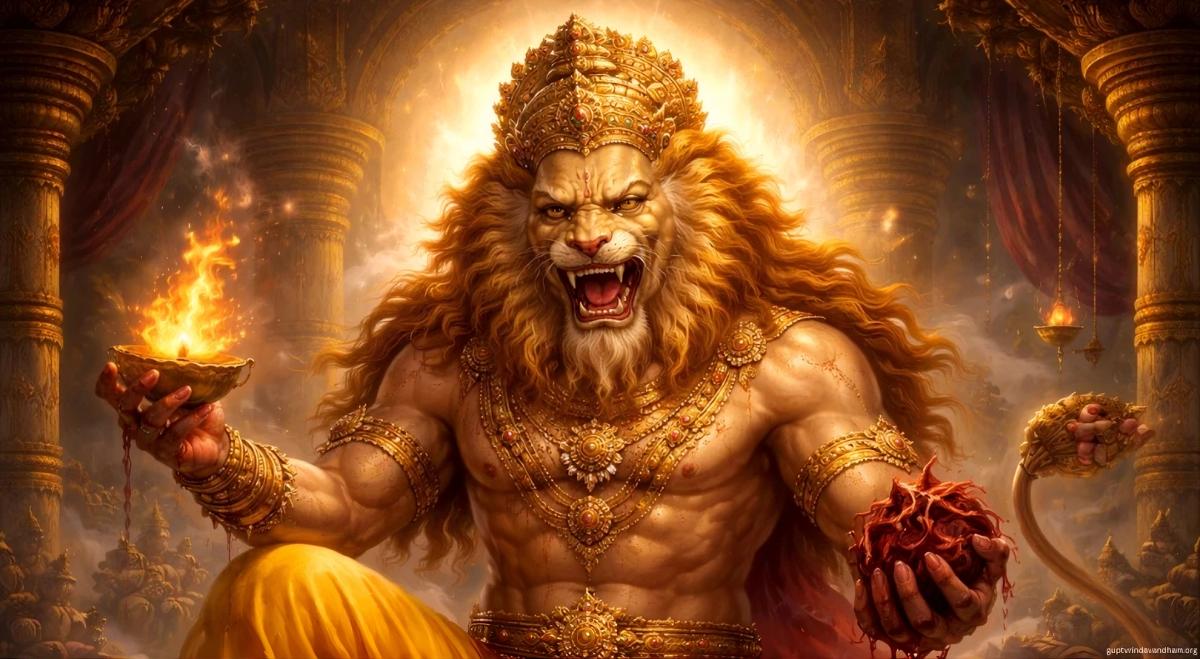
In the Dashavatara of Lord Vishnu, the Narasimha form was especially incarnated to protect His devotee from the evil demon king, Hiranyakashipu.
It showed the protective and fierce side of the Supreme Lord, as Lord Narasimha, when He rescued His pure devotee, Prahlada.
Let us walk through the Narasimha Lila and understand why it is known to be very popular in the Vedic scriptures.
Prahlada – The Ideal Devotee
The narration of Narasimha Lila is focused on the unwavering devotion of a five-year-old child, Prahlada.
He was the prince of the demon dynasty and the son of Hiranyakashipu. From his very early childhood years, he started to chant Lord Vishnu's name and worship Him.
Prahlada was a unique child with totally different qualities from the entire demonic family. He was kind, humble, intelligent, and heartily devoted to Lord Vishnu.
When the children of his age were busy playing with each other, he was spending his entire time chanting and dancing to the holy names of Lord Vishnu.
His father was not happy to realize that he was devoted to the one he hated the most, Lord Vishnu. So, he appointed some teachers to tutor Prahlada on what a demon should be.
Even after so many lessons of hate, domination, and cruelty, Prahlada stood still in his faith and devotion towards Lord Vishnu.
Getting tired of this, he tried many times to kill his son, but failed every time. It was because the Lord was protecting him from every obstacle.
In the Srimad Bhagavatam, Canto 7, Chapter 5, it is said:
श्रीप्रह्राद उवाच
श्रवणं कीर्तनं विष्णो: स्मरणं पादसेवनम् ।
अर्चनं वन्दनं दास्यं सख्यमात्मनिवेदनम् ॥ २३ ॥
इति पुंसार्पिता विष्णौ भक्तिश्चेन्नवलक्षणा ।
क्रियेत भगवत्यद्धा तन्मन्येऽधीतमुत्तमम् ॥ २४ ॥
~ŚB 7.5.23-24
Translation: Prahlāda Mahārāja said: Hearing and chanting about the transcendental holy name, form, qualities, paraphernalia and pastimes of Lord Viṣṇu, remembering them, serving the lotus feet of the Lord, offering the Lord respectful worship with sixteen types of paraphernalia, offering prayers to the Lord, becoming His servant, considering the Lord one’s best friend, and surrendering everything unto Him (in other words, serving Him with the body, mind and words) — these nine processes are accepted as pure devotional service.
One who has dedicated his life to the service of Kṛṣṇa through these nine methods should be understood to be the most learned person, for he has acquired complete knowledge.
Hiranyakashipu and the Boon of Brahma
The demon king, Hiranyakashipu, was not just a ruler, but a powerful warrior with a blessed boon.
Many years ago, when Lord Varaha Deva killed his twin brother Hiranyaksha, Hiranyakashipu started to perform a penance to please Lord Brahma and become powerful.
Lord Varaha Deva was also a divine form of Lord Vishnu. Hiranyakashipu wanted to defeat Lord Vishnu so that he could become God and be worshipped like one.
Once the penance was completed, Lord Brahma was pleased with his tapasya and asked him for any blessing or boon. Without wasting any time, Hiranyakashipu asked not to be killed by any of the following:
i) Any man or animal
ii) Any live or dead weapon
iii) Neither inside nor outside the palace.
iv) Neither in day nor night.
v) Neither on earth nor in the sky.
It is clearly mentioned in the Srimad Bhagavatam, Canto 7, Chapter 3:
व्यसुभिर्वासुमद्भिर्वा सुरासुरमहोरगै: ।
अप्रतिद्वन्द्वतां युद्धे ऐकपत्यं च देहिनाम् ॥ ३७ ॥
सर्वेषां लोकपालानां महिमानं यथात्मन: ।
तपोयोगप्रभावाणां यन्न रिष्यति कर्हिचित् ॥ ३८ ॥
~ŚB 7.3.37-38
Translation: Grant me that I will not meet death from any entity, living or nonliving. Grant me, further, that I not be killed by any demigod or demon or by any great snake from the lower planets. Since no one can kill you on the battlefield, you have no competitor. Therefore, grant me the benediction that I too may have no rival. Give me sole lordship over all the living entities and presiding deities, and give me all the glories obtained by that position. Furthermore, give me all the mystic powers attained by long austerities and the practice of yoga, for these cannot be lost at any time.
After getting the boon, Hiranyakashipu started spreading his terror on the earth and the heavens. He desired to be worshipped like the most powerful and superior one.
Out of his anger, he also tortured the devotees of Lord Vishnu to death. He burned down many houses of the devotee families, including the sages, their wives, and their children.
Appearance of Lord Narasimha
When Hiranyakashipu noticed that all his efforts to kill Prahlada had gone in vain, he tried to kill him with his own hands.
At the time when Prahlada reached the assembly court of the palace, his father challenged him to call his God, or he would kill him at that very moment.
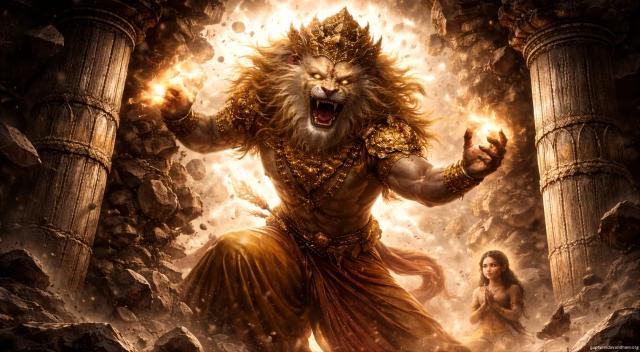
Prahlada said that the Lord is already everywhere. Listening to this, his father protested and asked his son if the Lord is in the pillars, and he calmly replied, yes.
Accepting the challenge, Lord Narasimha, a half-man, half-lion form, emerged from the pillars as soon as Hiranyakashipu hit it with his weapon.
It is mentioned in the Srimad Bhagavatam, Canto 7, Chapter 8, as:
सत्यं विधातुं निजभृत्यभाषितं
व्याप्तिं च भूतेष्वखिलेषु चात्मन: ।
अदृश्यतात्यद्भुतरूपमुद्वहन्
स्तम्भे सभायां न मृगं न मानुषम् ॥ १७ ॥
~ŚB 7.8.17
Translation: To prove that the statement of His servant Prahlāda Mahārāja was substantial — in other words, to prove that the Supreme Lord is present everywhere, even within the pillar of an assembly hall — the Supreme Personality of Godhead, Hari, exhibited a wonderful form never before seen. The form was neither that of a man nor that of a lion. Thus the Lord appeared in His wonderful form in the assembly hall.
स सत्त्वमेनं परितो विपश्यन्
स्तम्भस्य मध्यादनुनिर्जिहानम् ।
नायं मृगो नापि नरो विचित्र-
महो किमेतन्नृमृगेन्द्ररूपम् ॥ १८ ॥
~ŚB 7.8.18
Translation: While Hiraṇyakaśipu looked all around to find the source of the sound, that wonderful form of the Lord, which could not be ascertained to be either a man or a lion, emerged from the pillar. In amazement, Hiraṇyakaśipu wondered, “What is this creature that is half man and half lion?”
Spiritual Lessons from Narasimha Lila
Divine Protection is unstoppable: The divine appearance of Lord Narasimha teaches us that when bhakti is intense and pure like Prahlada, the Lord Himself protects His devotee from every negativity.
False ego is the key to self-harm: After getting the boon from Lord Brahma, Hiranyakashipu became arrogant. He thought of himself as superior to everyone in the three worlds. As a result, he started to harm the devotees and other innocent people to show off his powers. This led him to his destruction when the Lord finally appeared.
Every divine incarnation is purposeful: Lord Vishnu has a Dashavatara, and the Narasimha form is the fourth incarnation. Each of His divine forms has a purpose to accomplish. But the Narasimha form is the divine incarnation that appeared to save His dear devotee.
Intense faith overcame the fear: In the Narasimha Lila, Hiranyakashipu tried many ways to kill Prahlada, but every time the Lord saved him. This could happen because Prahlada had intense faith towards the Lord, which is why he never felt the fear of death even after seeing it with his own eyes.
Conclusion
The above Narasimha Lila is not an ancient myth; it is the eternal truth. Every time a pure devotee is harmed or will be harmed, the Lord appears or will appear.