
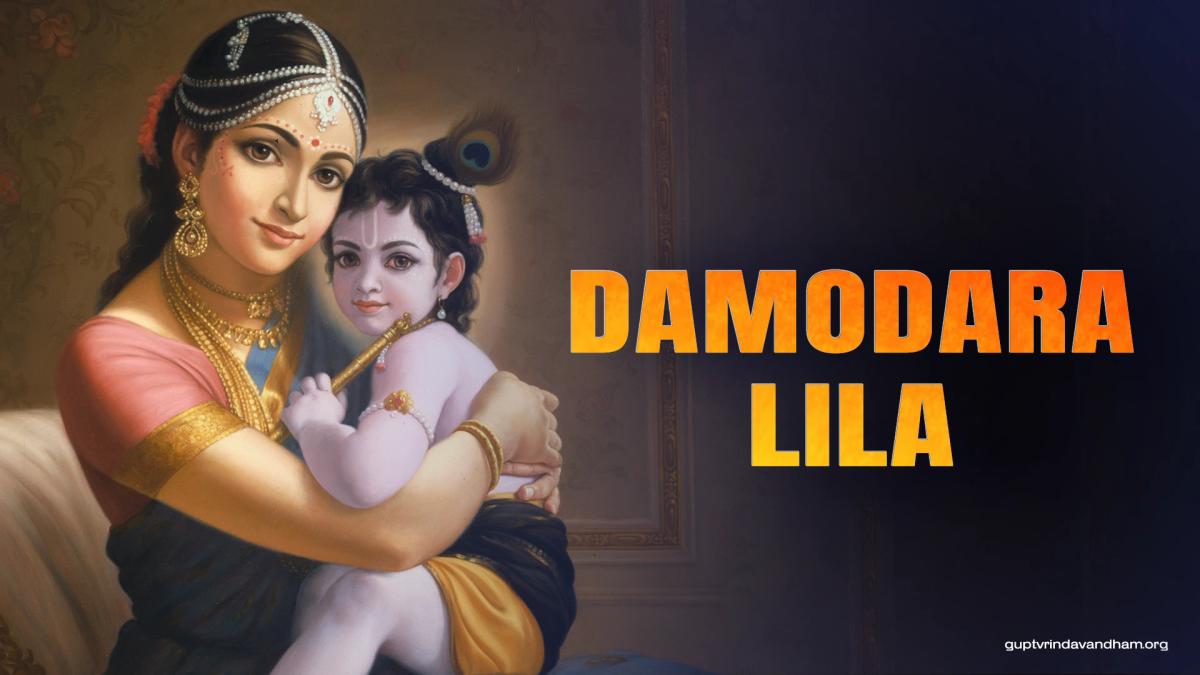
Damodar Lila is the childhood pastime in which Mother Yashoda binds Lord Krishna to a wooden mortar after His butter-stealing mischief. Yet every rope she joins remains two fingers short—until Krishna sees her loving effort and agrees to be bound.
This tender exchange reveals how the Supreme Lord responds to His devotee’s affection. The story continues with Krishna freeing Nalakuvara and Manigriva from their lives as twin arjuna trees. Both episodes are described in Srimad Bhagavatam, Canto 10, Chapters 9–10, and Srila Prabhupada’s Krishna Book, Chapters 9–10.
What Does Damodara Mean?
The name Damodara combines the Sanskrit words dama, meaning rope, and udara, meaning belly. It recalls Krishna being bound around His belly by Mother Yashoda.
This name preserves a deeply personal exchange between the Lord and His mother. Yashoda’s concern is to care for her child and correct His mischief, while Krishna accepts her affection in the sweetness of their mother-and-son relationship.
The Damodar Lila Story
1. Mother Yashoda Churns Butter
One day, when the household maidservants were occupied elsewhere, Mother Yashoda began churning yogurt herself. As she worked, she sang about Krishna’s childhood activities, keeping her beloved son in her thoughts.
Srila Prabhupada explains that she wanted to prepare especially pleasing butter for Krishna. Her work was an expression of love: she personally cared for His food while remembering His pastimes.
Krishna approached her, hungry and eager for attention. Yashoda stopped churning, placed Him on her lap and began nursing Him.
2. The Milk Begins to Boil Over
While Yashoda was feeding Krishna, milk heating on the stove began to overflow. She quickly set Him down and went to attend to it.
Krishna had not finished drinking. Upset at the interruption, He became angry, bit His lips and picked up a small stone. He then broke the yogurt pot and went elsewhere to eat butter.
3. Krishna Feeds Butter to the Monkeys
After saving the milk, Mother Yashoda returned and saw the broken pot. Krishna was no longer there, and she understood that He had caused the disturbance.
She found Him standing on an overturned wooden mortar, reaching butter suspended above Him and sharing it with monkeys. Aware of His mischief, Krishna glanced around watchfully.
When He saw His mother approaching with a stick, He climbed down and ran away.
4. Mother Yashoda Chases Krishna
Yashoda followed her quick-moving child. As she ran, her hair loosened and flowers fell from it. Eventually, she caught Him.
Krishna rubbed His tearful eyes with His hands and looked fearfully towards His mother. Seeing His distress, Yashoda put aside the stick. She decided to bind Him to the mortar to restrain His further mischief.
Her wish was to discipline and protect her son. The Lord who cannot easily be approached through yogic meditation was allowing Himself to be caught by His loving mother.
5. The Rope Remains Two Fingers Short
Mother Yashoda brought a rope, but its ends would not meet. It was short by the width of two fingers.
She joined another rope to it. The same gap remained.
Again and again, she added more rope, yet the shortage did not change. What appeared to be a simple household task became astonishing: all her efforts could not bind her little child.
Srimad Bhagavatam 10.9.15 describes the two-finger shortage. In the purport, Srila Prabhupada explains that Krishna was revealing that He could not be bound without His agreement.
6. Krishna Agrees to Be Bound
Yashoda continued until she was perspiring and exhausted. Seeing His mother’s loving labour, Krishna became merciful and allowed her to bind Him.
The decisive change came through the Lord’s willingness. Bhagavatam 10.9.18 describes:
“He became merciful to her and agreed to be bound.”
Mother Yashoda could now secure Krishna to the wooden mortar and return to her household duties.
Why Was the Rope Two Fingers Short?
The repeated shortage reveals Krishna’s unlimited nature. Although He appeared before Yashoda as a small child, He could not be measured and restrained like an ordinary person.
Srila Prabhupada’s explanation in Bhagavatam 10.9.15 emphasises that success came when Krishna agreed. Loving service brings the devotee closer to Him, while His revelation remains an act of His own will.
Gaudiya Vaishnava commentators also explain the two fingers through the devotee’s endeavour and Krishna’s mercy:
- Endeavour: Yashoda continued her service with determination.
- Mercy: Krishna saw her effort and willingly accepted the binding.
This explanation is discussed in the commentaries of Srila Jiva Goswami and Srila Vishvanatha Chakravarti Thakura, as presented in Back to Godhead. It is a devotional explanation of the episode, alongside the verse’s description of the rope’s actual shortage.
For a practitioner, the teaching encourages sincere service and dependence on Krishna. Effort matters, while the Lord’s mercy remains freely given.
How Could Mother Yashoda Bind the Supreme Lord?
Krishna allowed Himself to be bound because of Mother Yashoda’s pure love.
Bhagavatam 10.9.19 explains that the universe is under Krishna’s control, yet He displays the extraordinary quality of becoming subordinate to His devotees. Srila Prabhupada clarifies that this submission is to their pure love; Krishna always remains independent.
Yashoda’s relationship with Krishna is one of vatsalya-bhava, or parental affection. She serves Him by feeding, protecting and caring for Him. Her intimate love allows her to think chiefly of His needs as her child.
Damodar Lila reveals the sweetness of this relationship: the Supreme Lord takes pleasure in accepting His mother’s care and correction.
Krishna Delivers Nalakuvara and Manigriva
The story continues while Krishna is still bound to the mortar. Nearby stand two arjuna trees—the forms of Nalakuvara and Manigriva, the sons of Kuvera.
Why Had They Become Trees?
The brothers had become proud through wealth and privilege. On one occasion, intoxicated and behaving without restraint, they failed to show proper respect in the presence of Narada Muni.
Narada desired their welfare. He pronounced that they would become trees, depriving them of the freedom they had misused. Yet he also blessed them to retain their memory and eventually see Lord Krishna.
His intervention therefore carried a merciful purpose: the brothers would be freed from their pride and receive the opportunity for devotion. They became the twin arjuna trees in Nanda Maharaja’s courtyard.
Krishna Uproots the Twin Arjuna Trees
To fulfil Narada Muni’s words, Krishna moved towards the trees, dragging the mortar behind Him.
His small body passed between their trunks, but the mortar became lodged across the gap. Krishna pulled, uprooting both trees with a tremendous sound.
From the fallen trees emerged Nalakuvara and Manigriva in radiant forms. They approached the child Krishna and bowed before Him. Although He remained bound to the mortar, He had released them from their condition as trees.
The Brothers Pray for Devotional Service
The brothers recognised Krishna’s supreme position and expressed gratitude for Narada Muni’s mercy.
Their prayers were specific. They wished to use their speech to glorify the Lord, their ears to hear His activities, their hands in His service and their minds in remembrance of His lotus feet.
After their earlier misuse of privilege, they now desired to engage their abilities in devotion. Krishna blessed them with devotion to Him and instructed them to return to their father’s residence.
Later, when Nanda Maharaja found Krishna bound to the mortar, he released Him. This completes the household episode following the fall of the trees.
Damodar Lila’s Connection with Kartik and Diwali
Damodar Lila is especially remembered during Kartik Maas. In his purport to Bhagavatam 10.9.1–2, Srila Prabhupada cites earlier acharyas who place the breaking of the yogurt pot and Yashoda’s binding of Krishna on Dipavali.
During Kartik, the Damodarashtakam prayer helps devotees remember this form of the Lord. Its descriptions of Krishna’s tears, His mother’s affection and the deliverance of Kuvera’s sons connect prayer with the narrative.
Hearing the story gives these descriptions context, allowing the prayer to be recited with attention to the Lord’s pastimes.
Devotional Lessons from Damodar Lila
Remember Krishna During Daily Work
Yashoda remembered and sang about Krishna while churning. Srila Prabhupada draws attention to her constant Krishna consciousness in the purport to Bhagavatam 10.9.1–2.
A practical reflection is to make room for remembrance within daily responsibilities—for example, by hearing Krishna katha during a suitable task or offering food with attention and gratitude.
Serve Sincerely and Depend on Mercy
Yashoda’s determination and Krishna’s compassionate response show the place of both effort and grace. We can apply this by maintaining our devotional practices sincerely, without treating service as a transaction that obliges the Lord to grant a result.
Use Our Abilities in Service
Nalakuvara and Manigriva prayed to engage their senses in devotion. Their prayers give concrete direction: speak about Krishna, hear His pastimes, remember Him and use our hands in service.
Their transformation also encourages humility towards saintly guidance. What they initially experienced as a restriction ultimately brought them before the Lord.
Conclusion
Damodar Lila reveals Krishna’s loving response to Mother Yashoda and His mercy towards Nalakuvara and Manigriva. Bound to a mortar, He accepts His mother’s affection while granting freedom and devotion to others.
Remembering Lord Damodara invites us to serve with sincerity, receive saintly guidance with humility and seek the shelter of His loving mercy.