
 Donate Now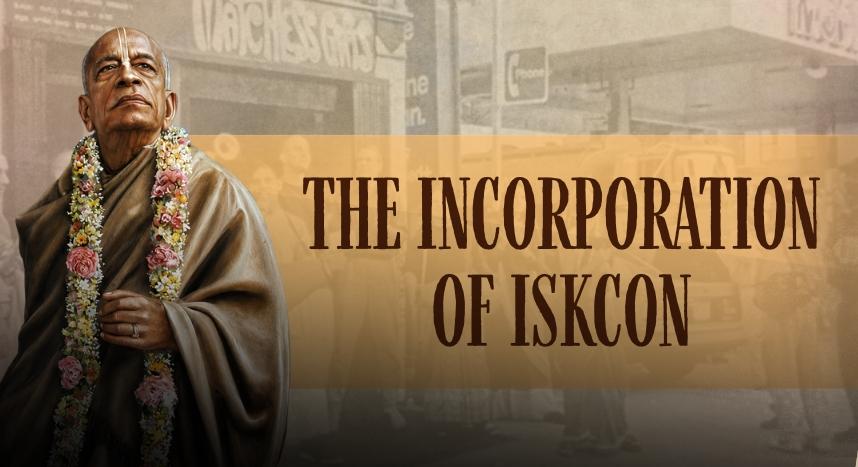
ISKCON Incorporation Day
The International Society for Krishna Consciousness (ISKCON) is one of the most remarkable success stories of the 20th century. Srila Prabhupada arrived in the United States with no money, no followers, and no institutional support, only to establish a global movement that would fulfill a 500-year-old prophecy.
Every year, devotees observe July 13th as a day to commemorate Srila Prabhupada's incorporation of ISKCON. According to the Vaishnava lunar calendar, this year the incorporation day of ISKCON is going to be celebrated on 7th August. The date changes each year according to the corresponding tithi (lunar day).
This blog explores the chronological journey of the establishment of the Hare Krishna Movement, focusing on the pivotal moments of Srila Prabhupada’s arrival in the West and the formal legal incorporation of ISKCON.
Why Srila Prabhupada Came to America: Fulfilling the Divine Order
Srila Prabhupada’s mission was not a personal ambition but a divine instruction given during his first meeting with his spiritual master, Srila Bhaktisiddhanta Sarasvati Thakura. He preached in India in English by publishing magazines, but this did not help him too much to execute his mission. He finally decided to go to the West at the age of sixty-nine.
For a deeper understanding of this topic, visit this page: Srila Prabhupada Biography
The First Year in the West: A Period of Solitary Struggle
Srila Prabhupada entered New York City with only a suitcase, an umbrella, a supply of dry cereal, books, and forty rupees (seven dollars) in hand. Initially, he lived in Butler, Pennsylvania; later he moved to New York. He faced so many challenges, but his faith in his spiritual master and Lord Krishna led to the success of the preaching mission.
For a deeper understanding of this topic, visit this page: Srila Prabhupada Biography
The Legal Incorporation of Srila Prabhupada’s ISKCON
As the number of students grew, Srila Prabhupada realized the need for a formal organization to handle the increased activities and provide a legal structure for the movement.
On July 11, 1966, ISKCON was registered in the state of New York; it was officially incorporated on July 13. The lawyer who finalized the formalities was Mr. Steven J. Goldsmith.
Srila Prabhupada’s choice of legal structure was significant. He incorporated ISKCON under Article 10 of the Religious Corporation Law of New York, which meant that the society would be a member corporation. This ensured that the members were the corporation and would eventually elect their own trustees, rather than having a fixed, perpetual board.
The first elected members of the society were:
- Brahmananda Das – President
- Satsvarupa Das – Secretary
- Gargamuni Das – Treasurer
Infrastructure for Growth: The GBC and BBT
As the movement expanded, Srila Prabhupada established two vital administrative bodies to ensure its permanence and purity.
The Governing Body Commission (GBC)
On July 28, 1970, Srila Prabhupada issued the "Direction of Management", which established the Governing Body Commission (GBC). He appointed the first 12 GBC members to oversee the spiritual and organizational standards of ISKCON's branches worldwide, allowing the society to function as a confederation of autonomous centers while remaining united under his instructions.
The Bhaktivedanta Book Trust (BBT)
Srila Prabhupada considered his books the "vani" (eternal instructions) and the true basis of the movement. In 1972, he established the Bhaktivedanta Book Trust (BBT) to publish his writings exclusively for the benefit of ISKCON. The BBT eventually became the world’s largest publisher of Vedic literature, with books translated into more than 110 languages.
Global Expansion and Worldwide Growth
From a single storefront in 1966, ISKCON expanded with "unprecedented speed". Between 1965 and 1977, Srila Prabhupada circled the globe 14 times, lecturing on six continents.
- Rapid Branching: Centers were quickly established in San Francisco, Montreal, Boston, Buffalo, and Los Angeles.
- International Reach: By 1971, there were branches in London, Tokyo, Hamburg, and Sydney.
- Cultural Impact: In London, Srila Prabhupada’s disciples met George Harrison of The Beatles, who helped produce a record of the Hare Krishna mantra that reached #1 on the UK charts, exposing millions to the holy name.
By the time of his physical departure in 1977, Srila Prabhupada had founded over 100 temples, ashrams, and cultural centers, and initiated more than 10,000 disciples.
Srila Prabhupada famously said, "I will never die. I shall live for my books". Through the formal incorporation of ISKCON and the distribution of his teachings, he ensured that the "door to liberation" would remain open for all humanity for thousands of years to come.
Conclusion
Srila Prabhupada did everything for the propagation of Lord Chaitanya’s movement, starting from worldwide preaching, establishing ISKCON, literature, and Temples. He humbly gave all the credit to his Guru Maharaja (spiritual master), saying that because he was carrying out his spiritual master's order, his Guru Maharaja was always with him.
Srila Prabhupada says, “A devoted disciple... would rather die with the spiritual master than fail to execute the spiritual master's mission”. Therefore, it is the duty of each follower to take charge of the mission of Srila Prabhupada and execute it properly without considering his personal comfort; then the life will be successful.