
 Donate Now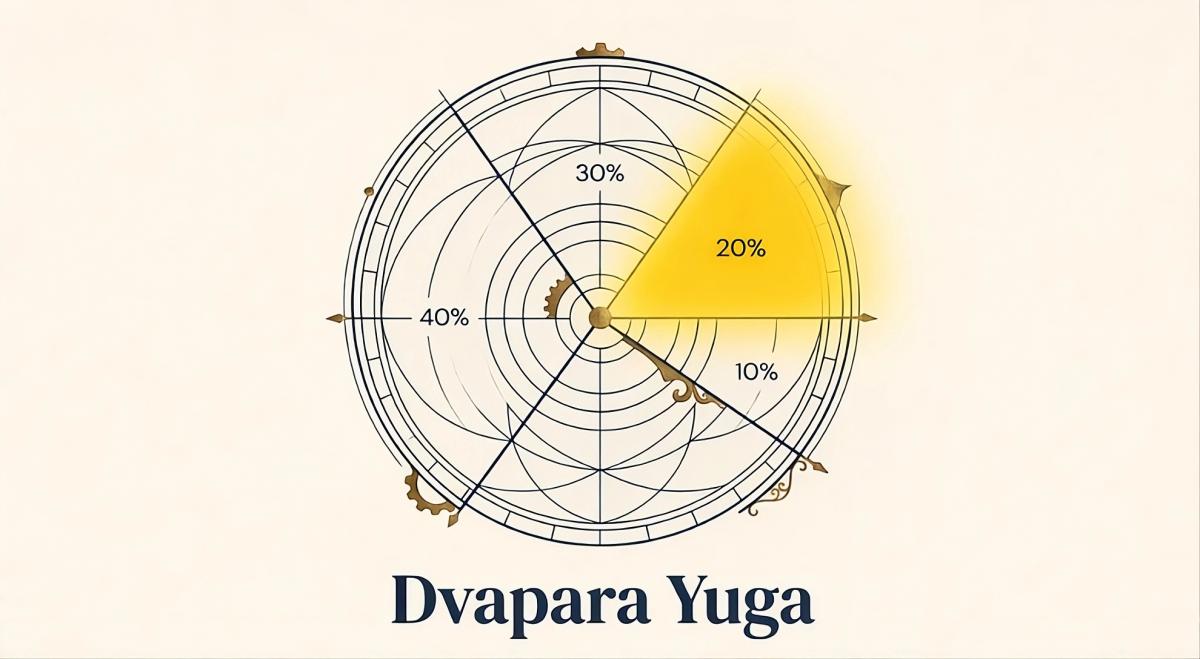
How did the world change from a time of perfect peace to the busy, difficult world we see today? Ancient history tells us that time moves in giant circles. One of the most important parts of this circle is the Dwapara Yuga.
In Hindu history, the Dwapara Yuga is known as the "Bronze Age." It was a unique time of balance. Unlike the ages before or after it, good and bad were exactly equal. It was an era where the divine and the everyday world mixed together. People were still powerful and wise, but they began to struggle with ego and greed.
Understanding the Yuga Cycle (Mahayuga)
In ancient teachings, time is not a straight line. Instead, it is a giant cycle called a Mahayuga. One full cycle lasts 4.32 million years and is made of four different ages.
As the cycle moves forward, goodness, health, and truth get shorter and weaker. This is called the "Ratio of Decline" (4:3:2:1). Think of it like a battery slowly losing its charge over millions of years.
The four ages are:
- Satya Yuga: The Age of Truth. Everything was 100% good.
- Treta Yuga: The Silver Age. The world was 75% good.
- Dwapara Yuga: The Bronze Age. The world was 50% good and 50% bad.
- Kali Yuga: The Iron Age. This is our current time, which is only 25% good.
What Does "Dwapara Yuga" Mean?
The name comes from a "Sandhi," which is a Sanskrit word for a union of two words:
Dva: This means "two."
Apara: This means "after."
When you join them together, Dwapar literally means the age that comes "after two" other ages. It is the third stage in the great cycle of time.
The Symbol of the Bull: Why the World Became Less Stable
Ancient stories use a "Dharma Bull" to show how steady the world is. Dharma is the divine law of doing what is right. When the world is perfect, the bull stands on four strong legs. These legs are the pillars of a good life:
- Penance: Hard work for the spirit.
- Purity: Keeping the mind and body clean.
- Compassion: Being kind to all living things.
- Truth: Being honest in everything you do.
During the Dwapara Yuga, the world became less stable. The first two legs—Penance and Purity—were lost. This left the bull to balance on only two legs: Compassion and Truth. These last two legs were under constant attack by "enemies" like dissatisfaction, untruth, violence, and enmity.
Duration and Timeline of Dwapara Yuga
The Dwapara Yuga was a very long era. In human years, it lasted for 864,000 years. Like a day has a sunrise and a sunset, this age had transition periods called "Dawn" and "Dusk."
The Dawn (867,102 BCE): The transition from the Silver Age.
The Core Age (795,102 BCE): The main part of the Bronze Age.
The Dusk (75,102 BCE): The slow transition leading into our current age.
The Dvapara Yuga ended at a very specific time: Midnight on February 17/18, 3102 BCE. This was the exact moment Lord Krishna left the Earth to return to his divine home.
Role of Lord Krishna in the Dwapara Yuga
Lord Krishna is the most important figure of this era. He is called the "Purnavatar" or "Complete Avatar." This means he showed the full spectrum of divine power.
Krishna's life was a series of lessons. He was born in a prison, lived as a hero, and served as a master strategist. During the great Mahabharata war, he drove the chariot for the warrior Arjuna. While on that chariot, he gave the lessons of the Bhagavad Gita.
His three main lessons were:
- Duty (Dharma): Do what is right because it is your job, even if it is difficult.
- Letting Go: Do your work well, but do not worry about the reward or the "fruits" of your labor.
- The Soul: The body is like a suit of clothes that wears out, but the soul lives forever.
Major Events of Dwapara Yuga
Two major events changed history during this time:
- The Kurukshetra War: This was a massive war meant to "cleanse" the Earth of bad leaders. It was a difficult time because "good" and "bad" were mixed together. Even great heroes had to choose sides based on complex oaths. This made the war a "Grey Zone" where doing the right thing was not always easy or clear.
- The Splitting of the Vedas: In the ages before, humans had amazing memories. They could remember all the holy secrets of the "Vedas" (the books of knowledge) by heart. Back then, it was just one big book. But as the Dwapara Yuga went on, human brains became less able to remember everything. A wise man named Vyasa split the one Veda into four parts—Rig, Sama, Yajur, and Atharva—so they would be easier to learn.
Mythology vs Science
Life was very different thousands of years ago. People were much healthier than we are today.
- Long Life: The average person lived for about 1,000 years.
- Youth: People looked young and strong until the very end of their lives.
- The Science Paradox: This era saw a boom in material science and building. This happened because humans were losing their "internal divine intuition." Since they could no longer understand the world through their spirits, they turned to "external measurements" and logic to quantify the world around them.
Comparison with Other Yugas
| Feature | Satya Yuga | Treta Yuga | Dwapara Yuga | Kali Yuga |
|---|---|---|---|---|
| Duration (Human Years) | 1,728,000 | 1,296,000 | 864,000 | 432,000 |
| Pillars of Dharma | 4 (Truth, Mercy, Penance, Purity) | 3 | 2 (Compassion, Truth) | 1 (Truth) |
| State of Virtue | 100% Virtue | 75% Virtue | 50% Virtue / 50% Sin | 25% Virtue |
| Primary Practice | Dhyana (Meditation) | Yajna (Sacrifice) | Ritual & Charity | Nama-Sankirtana |
| Nature of Yajna | For Divinity | For Duty | For Material Benefit | Rarely performed |
FAQs
The Dwapara Yuga is more than just an old story. It is a lesson in balance. It shows us how to stay righteous in a world where things aren't always "black and white."
Today, we can still use the "leg" of Compassion and the lessons of the Bhagavad Gita to help us stay steady. Even in a difficult world, doing your duty and being kind can help you find your own internal balance.
What is your favorite lesson from the story of Lord Krishna or the Bhagavad Gita? Share your thoughts in the comments below!