
 Donate Now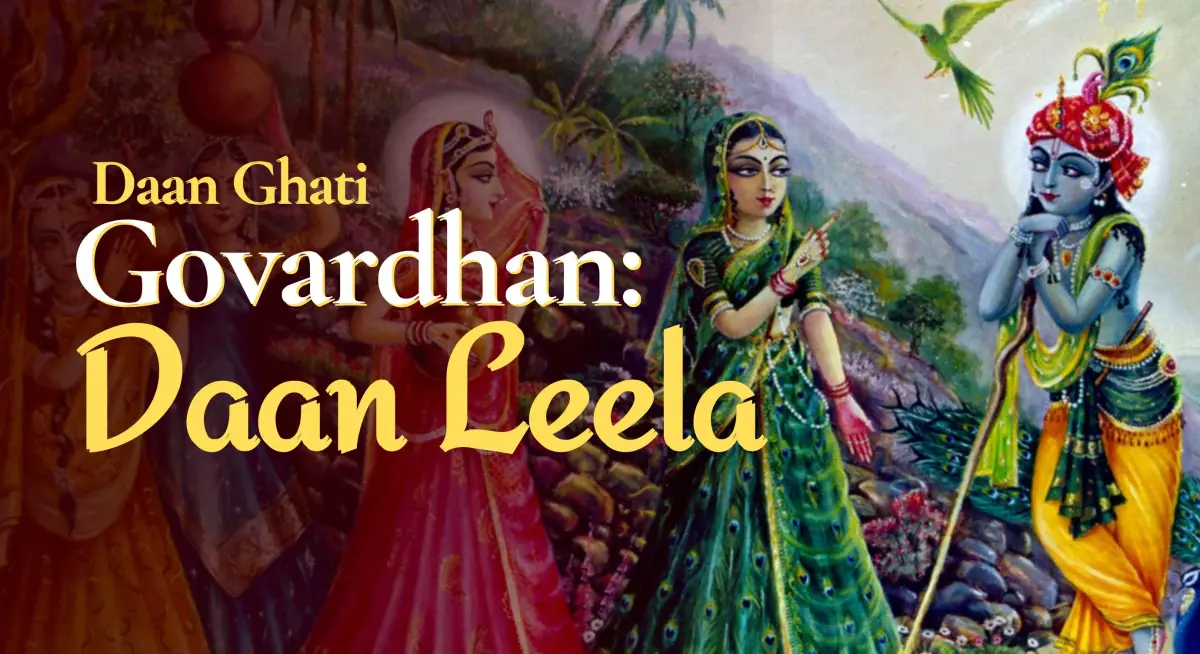
Daan Ghati is a sacred place at the foot of Govardhan Hill associated with Shri Krishna’s daan leela. Krishna would joyfully stop the gopis and demand a large tax on the milk products they carried. This playful exchange would lead to a sweet conversation between Krishna and the gopis, filled with wit, teasing, and loving arguments. This article narrates Krishna's daan leela pastime, taken from Srila Rupa Goswami’s book Dana Keli Kaumudi.
Krishna’s Daan Leela (Tax Collection Pastime)
Shrimati Radharani, along with Her principal sakhis, would make Her way to Govind Kunda near Manasi Ganga every day, carrying pots of fresh ghee on their heads. Paurnamasi, grandmother of Madhumangala and Nandimukhi, advised the gopis to bring the butter pots to the sacrificial arena. These pots were meant for the sacrificial ceremony, which was managed by the sage Bhaguri on behalf of Vasudeva Maharaja to safeguard Krishna and Balarama from all calamities.
Blocking the Path and Tax Collection
When the gopis walk along the narrow path near Shyamala mandapika on the slopes of Govardhan Hill. Lord Krishna, along with His cowherd friends Subala, Madhumangala, Arjuna, and Ujjvala, block their path to collect tax or daan from them. Krishna ordered His friends to blow horns and bugles to proclaim His authority as the appointed master toll collector. Anyone who wishes to pass through this path must pay a tax by the order of Kamadeva (Cupid), the king of the forest.
A Playful Debate & Toll Demands
When Subala and Arjuna blocked the path, Radharani’s companion Lalita and Vishakha argued that paying even a single copper coin as tax would make the offering impure. Madhumangala, acting as Krishna’s tax accountant, calculated a fee of 84 lakh gold coins as a tax based on the weight of ghee carried by the five gopis.
Krishna then reads a letter from the emperor, accusing the gopis of hiding ten extra golden pots under their garments and demanding the hundred-times-increased penalty. Madhumangala then increased the total toll to five billion coins. The chief of the gopis, Lalita, mocks Krishna’s flute and bugle as hole-ridden and crooked. Radharani compares Krishna to a black snake or a highwayman harassing chaste women.
Vishakha sakhi humorously offers their messenger Vrinda as tax, but Subala notes that one Vrinda is insufficient for five billion tax coins. Lalita then hands over Chitra’s jeweled ring and eventually gives Radharani’s priceless pearl necklace. Krishna joyfully accepts the necklace and wears it around His neck, but is still not satisfied with the tax.
Final Settlement by Paurnamasi
Krishna demanded that Radharani Herself be the ultimate tax payment. Grandmother Paurnamasi arrives to resolve the matter. She declared that Radharani is a priceless chintamani jewel who cannot be purchased even with 100 trillion gold coins. Paurnamasi also said that Krishna has successfully attained His heart’s true desire, Radha, as the toll payment. She permits the gopis to proceed to the yajna or sacrifice and grants a boon that Krishna will eternally enjoy these daan lila pastimes with the gopis.
Conclusion
Krishna’s daan keli, or tax collection pastime, is a playful leela filled with humorous dealings with the gopis, who were travelling with the butter pots. Krishna was taking the tax from them and eventually demanded Radharani as the ultimate tax payment. Finally, Paurnamasi explained Radharani as a precious chintamani jewel who cannot be separated from Krishna, and the matter was resolved. This beautiful pastime reveals the loving and playful relationship shared by Radha, Krishna, and their companions.