

Nityananda Trayodashi 2026
- Home /
- Festivals /
- Nityanand Trayodashi
The auspicious occasion of Sri Nityananda Trayodashi will be observed on January 31, 2026, a day of profound spiritual significance for devotees worldwide.
It is a day when the currents of divine mercy flow most freely, inviting all souls to bathe in the boundless compassion of the Lord.
This sacred day celebrates the appearance of Śrī Nityānanda Prabhu, who is the incarnation of Lord Balarāma.
He appeared on Earth to assist Śrī Caitanya Mahāprabhu in His divine mission to establish and propagate the saṅkīrtana movement, the congregational chanting of the holy names of the Lord.
The Unparalleled Significance of Nityananda Trayodashi
Observing Nityānanda Trayodaśī holds deep spiritual importance for devotees aspiring for divine love. The significance of this day is multifaceted, revealing the merciful nature of the Lord.
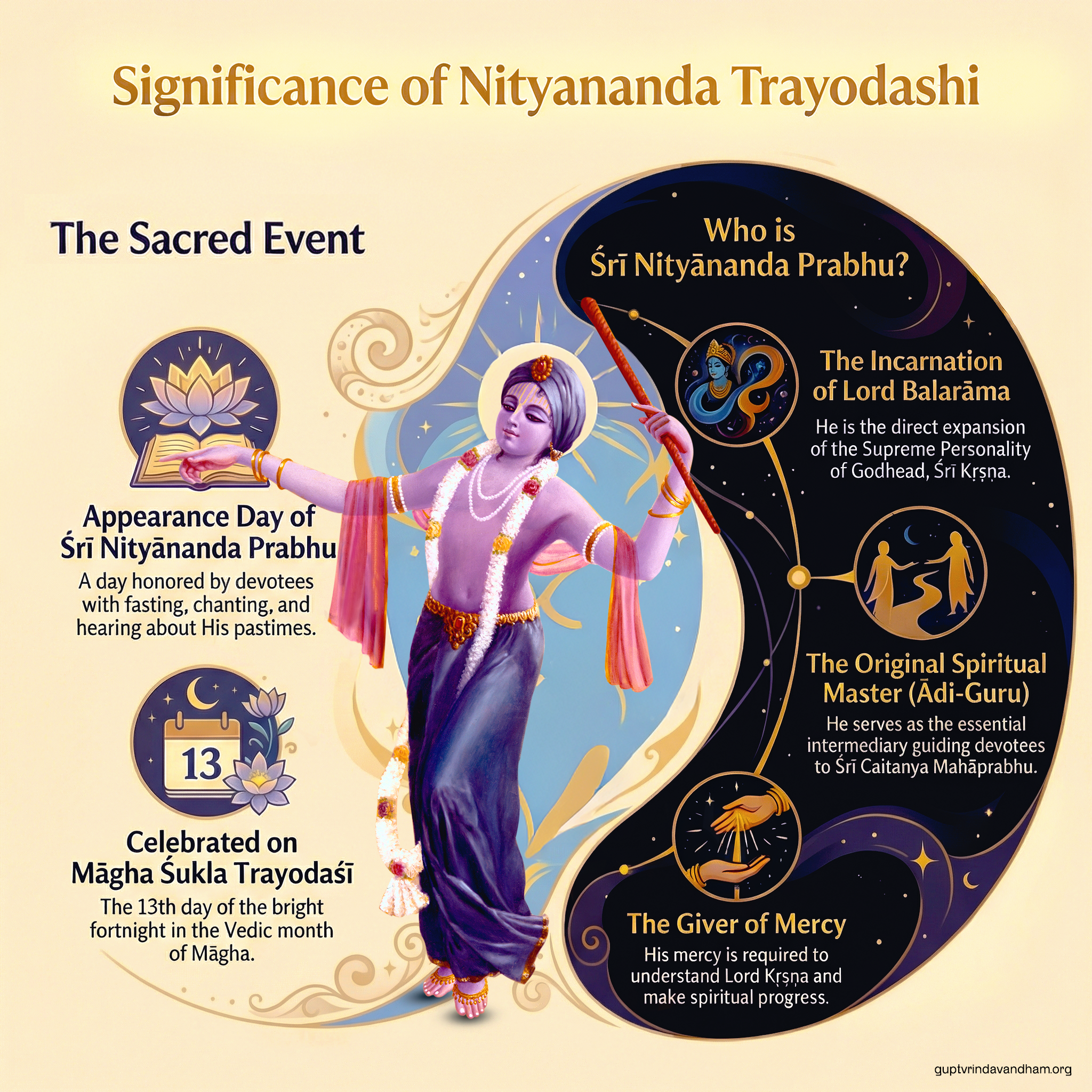
Appearance Day of Śrī Nityānanda Prabhu
Nityānanda Trayodaśī is the auspicious appearance day of Śrī Nityānanda Prabhu. Devotees honor this day with fasting, chanting, and hearing about His divine qualities and pastimes.
Occurs on Māgha Śukla Trayodaśī
This sacred event takes place on the thirteenth day of the bright fortnight of the month of Māgha, a date known in the Vedic calendar as Māgha Śukla Trayodaśī. This typically occurs about a week after Vasant Panchami.
The Incarnation of Lord Balarāma
Śrī Nityānanda Prabhu is the incarnation (avatāra) of Lord Balarāma, the direct expansion of the Supreme Personality of Godhead, Śrī Kṛṣṇa. Just as Lord Balarāma appeared as the elder brother of Lord Kṛṣṇa, Nityānanda Prabhu appeared in the pastimes of Śrī Caitanya Mahāprabhu to serve Him in His mission.
The Original Spiritual Master (Ādi-Guru)
Śrī Nityānanda Prabhu is revered as the original spiritual master, or Ādi-Guru. He is the cardinal guru of all the universes and serves as the essential intermediary between Śrī Caitanya Mahāprabhu and His devotees, guiding them on the path of devotion.
Mercy to Understand Lord Kṛṣṇa
It is emphatically stated in the scriptures that one cannot approach or understand Śrī Caitanya Mahāprabhu or Lord Kṛṣṇa without first receiving the causeless mercy of Śrī Nityānanda Prabhu. He provides the spiritual strength necessary for a devotee to make tangible progress in spiritual life.
Birth and Early Life of Śrī Nityānanda Prabhu
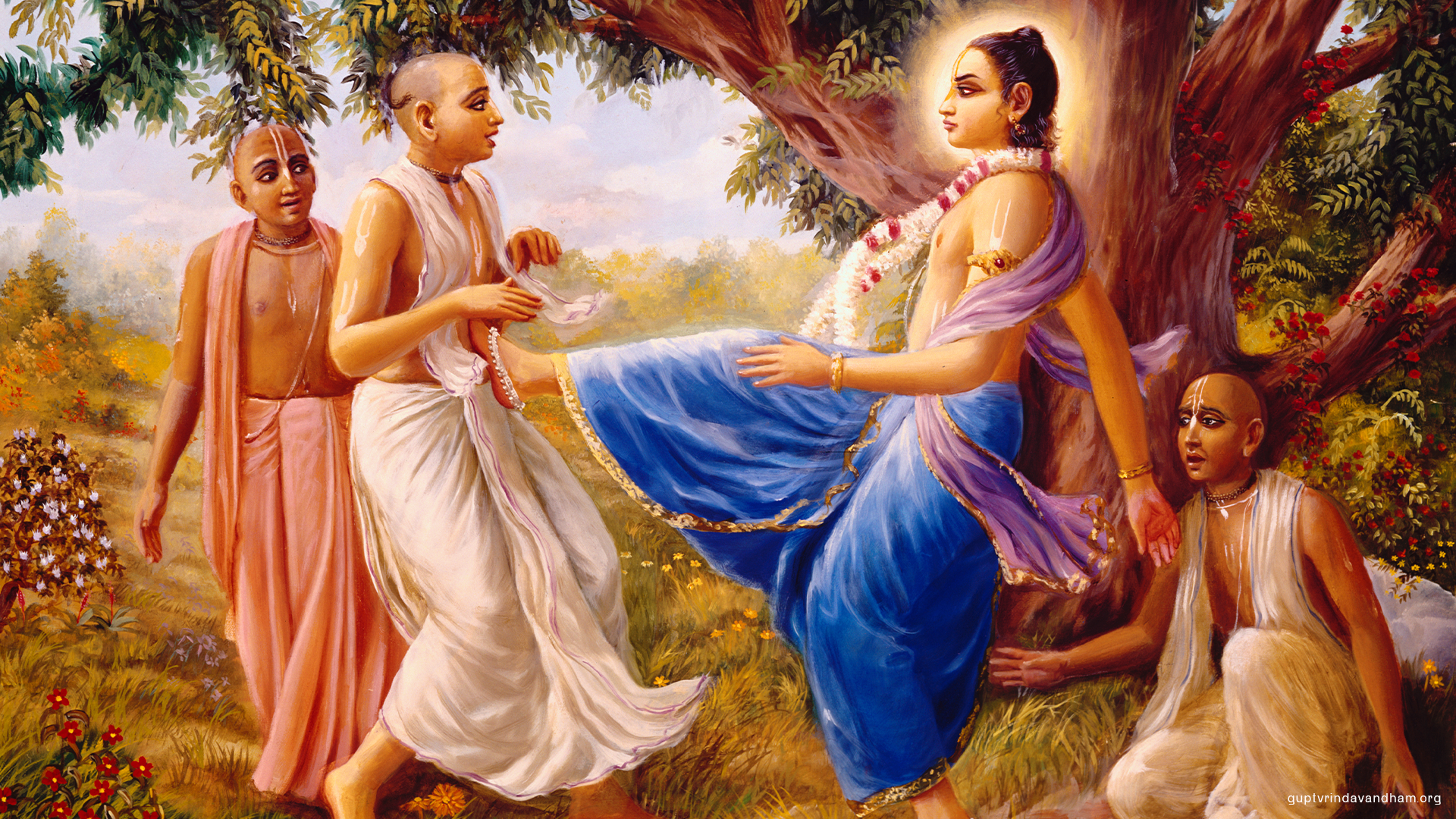
The early life of Lord Nityānanda was filled with divine pastimes that revealed His transcendental nature from the very beginning.
Birth in 1474 AD at Ekachakra, West Bengal
Śrī Nityānanda Prabhu appeared in the year 1474 AD in the humble village of Ekachakra, located in the Birbhum district of West Bengal, India.
Parents: Hadai Paṇḍita and Padmāvatī Devī
His parents were the pious Brahmans Hadai Paṇḍita (also known as Hadai Ojha) and Padmāvatī Devī. From the moment of His birth, all-auspicious symptoms appeared in the land, and all forms of famine and unhappiness immediately disappeared.
Birthplace Temple – Garbhavasa
Today, a temple named Garbhavasa stands in Ekachakra to commemorate His sacred birthplace. This holy site is visited by throngs of pilgrims who come to offer their respects.
Childhood Pastimes
As a child, Nityānanda Prabhu, affectionately called Nitāi, loved to re-enact the divine pastimes of Lord Kṛṣṇa and Lord Rāma with his friends. He performed these roles with such deep absorption and spiritual authority that the entire village became immersed in the love of Godhead.
His friends were amazed at the details he knew, as he enacted the slaying of demons, the lifting of Govardhan Hill, and the pastimes of Lord Rāma.
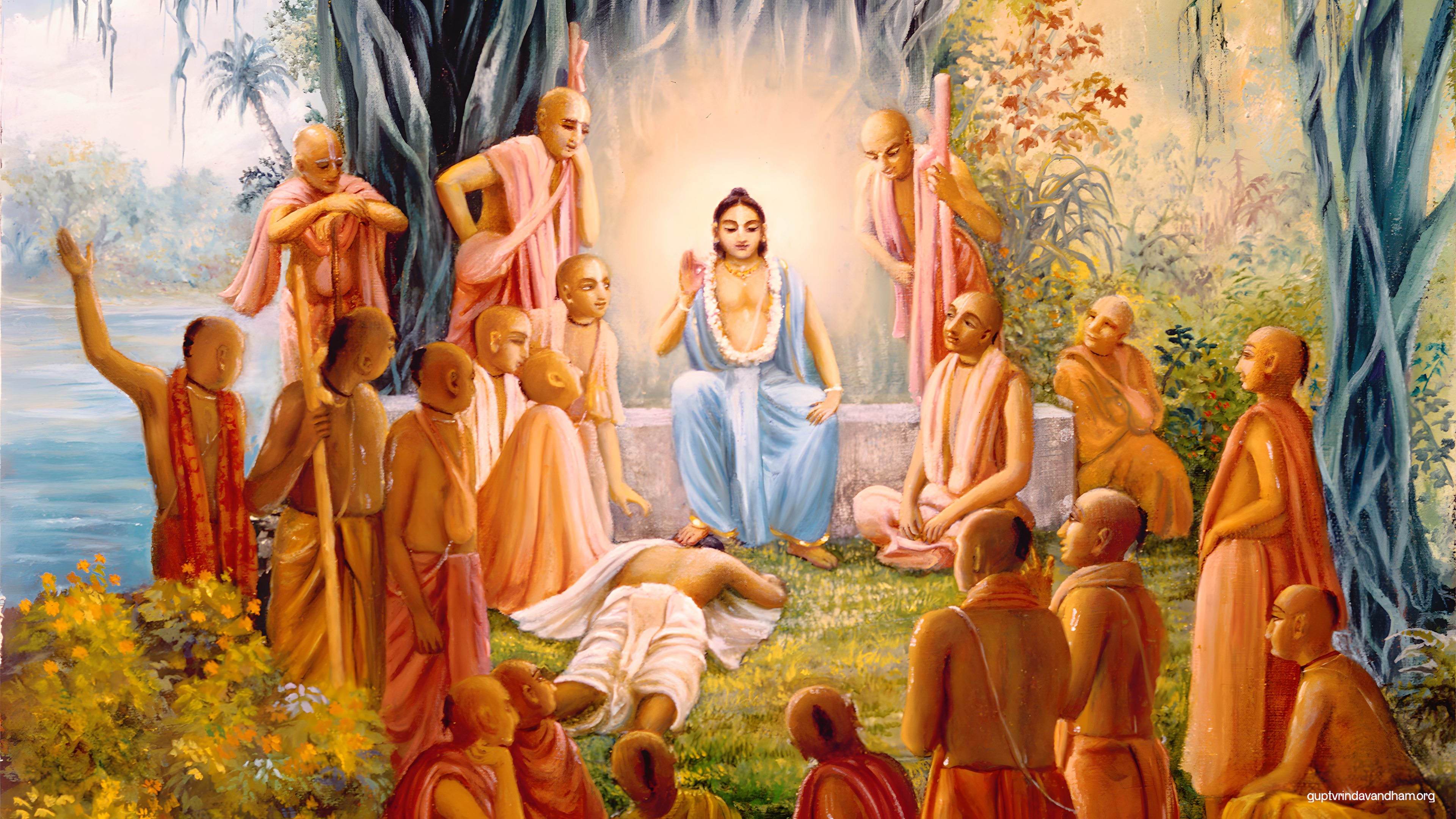
He especially favored the role of Lakṣmaṇa, which he enacted with astonishing authenticity. In one famous pastime, Nitāi, playing the part of Lakṣmaṇa, was struck by the śakti arrow of Indrajit, who was played by another boy.
The "arrow"—a lotus flower—was hurled by the child playing Rāvaṇa, and upon being struck, Nityānanda Prabhu dropped to the ground, senseless. So deep was His absorption in the mood of Lakṣmaṇa that He showed no signs of life.
The other children, forgetting it was a game, began to weep, and soon His parents rushed to the scene, falling unconscious themselves upon seeing their son’s state.
A bystander reminded the children that in the original pastime, Lakṣmaṇa was revived only when Hanumān brought a medicinal herb from Gandhamādana mountain.
Remembering this, one boy took on the role of Hanumān and rushed to retrieve the "medicine." Upon his return, another child acting as a physician applied the herb to Nitāi's nose.
At last, the great Lord Nityānanda regained consciousness and rose to His feet, filling everyone with laughter and relief. These pastimes were early manifestations of His divine identity and His mission to immerse the world in transcendental bliss.
Leaving Home at the Age of 13
When Nitāi was in his thirteenth year, a traveling sannyāsī, identified as the great Lakṣmīpati Tīrtha, visited his home. Enchanted by the boy's devotion, the sannyāsī requested that Nitāi be allowed to travel with him as a companion. Bound by the principles of Vedic culture, his parents could not refuse the guest's request and reluctantly parted with their beloved son. Thereafter, Nitāi left home and traveled to holy places throughout India for nearly two decades.
The Merciful Mission of Śrī Nityānanda Prabhu
Lord Nityānanda's primary purpose was to execute the supremely compassionate mission of Śrī Caitanya Mahāprabhu.
Assisting Śrī Caitanya Mahāprabhu
Lord Nityānanda’s principal mission was to assist Śrī Caitanya Mahāprabhu, the yugāvatāra (incarnation for the age), in delivering the fallen souls of Kali Yuga.
Establishing the Saṅkīrtana Movement
He was instrumental in establishing and propagating the saṅkīrtana movement—the congregational chanting of the Lord's holy names—which is the prescribed spiritual process for this age.
Propagating the Holy Name in Bengal
At the personal request of Caitanya Mahāprabhu, Lord Nityānanda traveled extensively throughout Bengal, spreading the holy name of the Lord to every town and village.
Delivering the Fallen Souls – Jagāi and Mādhāi
A prime example of His boundless mercy is the pastime of delivering the two fallen brothers, Jagāi and Mādhāi. These two were notorious sinners, yet Lord Nityānanda extended His mercy to them and even protected them from the wrath of Śrī Caitanya Mahāprabhu, ensuring their deliverance.
Distributing Kṛṣṇa Prema Without Discrimination
Lord Nityānanda distributed Kṛṣṇa Prema (the pure love of Godhead) to everyone without considering their background, qualification, or eligibility. His mercy was so boundless and causeless that He is considered by great saints to be even more merciful than Lord Caitanya Himself, freely distributing the pure love of Godhead to all.
Theological Expansions of Śrī Nityānanda Prabhu
As Lord Balarāma, Śrī Nityānanda Prabhu is the source of all other divine expansions. His theological position is foundational to the creation of both the spiritual and material worlds.
First Expansion of Lord Kṛṣṇa: In the spiritual world, Lord Balarāma is the very first expansion of Śrī Kṛṣṇa.
Source of Saṅkarṣaṇa and Catur-Vyūhas: From Lord Balarāma, the first quadruple expansion, known as the Catur-vyūha (Saṅkarṣaṇa, Vāsudeva, Pradyumna, and Aniruddha), manifests. Saṅkarṣaṇa further expands into Mahā-saṅkarṣaṇa, from whom a second Catur-vyūha manifests to oversee various cosmic functions.
Source of the Three Puruṣa-Avatāras: To create and maintain the material world, Lord Balarāma further expands Himself into the three Viṣṇu forms, or puruṣa-avatāras:
Mahā Viṣṇu (Kāraṇodakaśāyī Viṣṇu): He lies on the Causal Ocean, and from the pores of His body, innumerable material universes emanate.
Garbhodakaśāyī Viṣṇu: He enters into each one of these universes to oversee its creation and maintenance.
Kṣīrodakaśāyī Viṣṇu: He is the Supersoul (Paramātmā) who resides within the heart of every living being.
Ananta Śeṣa: He also manifests as Ananta Śeṣa, the divine serpent who holds all the universes upon His hoods.
This theological position as the source of all universal maintenance is not merely an abstract concept; Lord Nityānanda demonstrated this protective principle personally and profoundly in His mission to deliver the most fallen souls.
His cosmic function as the sustainer of all worlds found its most intimate expression in His personal mercy upon conditioned souls like Jagāi and Mādhāi.
Later Pastimes of Śrī Nityānanda Prabhu
After meeting Śrī Caitanya Mahāprabhu in 1506, Lord Nityānanda's life was filled with transcendental activities dedicated to spreading the saṅkīrtana movement.
Traveling to Holy Places for 20 Years
Before meeting Lord Caitanya, Nitāi traveled as a pilgrim for approximately 20 years, visiting countless holy places throughout India and purifying them with His presence.
Meeting Mādhavendra Purī
During His travels, He met the great saint Mādhavendra Purī. Upon seeing each other, both were immediately overwhelmed with divine love. The two great teachers rolled on the ground in the ecstasy of divine love, and, transformed by their jubilation, shouted words of joy with voices of thunder. Tears of love flowed like rivers from the eyes of those two great masters.
Marriage to Vasudhā Devī and Jāhnavā Devī
At the request of Caitanya Mahāprabhu, Lord Nityānanda returned to Bengal and accepted the role of a householder (gṛhastha). He married Vasudhā Devī and Jāhnavā Devī, the two daughters of Sūryadāsa Sarakhel.
Jāhnavā Mātā Leading the Sampradāya
After Lord Nityānanda concluded His earthly pastimes, His divine consort Jāhnavā Devī, also known as Jāhnavā Mātā, continued to lead the Gauḍīya Vaiṣṇava Sampradāya, serving as an instructing spiritual master to many great devotees.
Merging into the Deity of Bankim Ray
Lord Nityānanda concluded His manifested pastimes on Earth by merging into the deity of Kṛṣṇa known as Bankim Ray, whose temple is located not far from His birthplace in Ekachakra.
How Nityananda Trayodashi is Celebrated
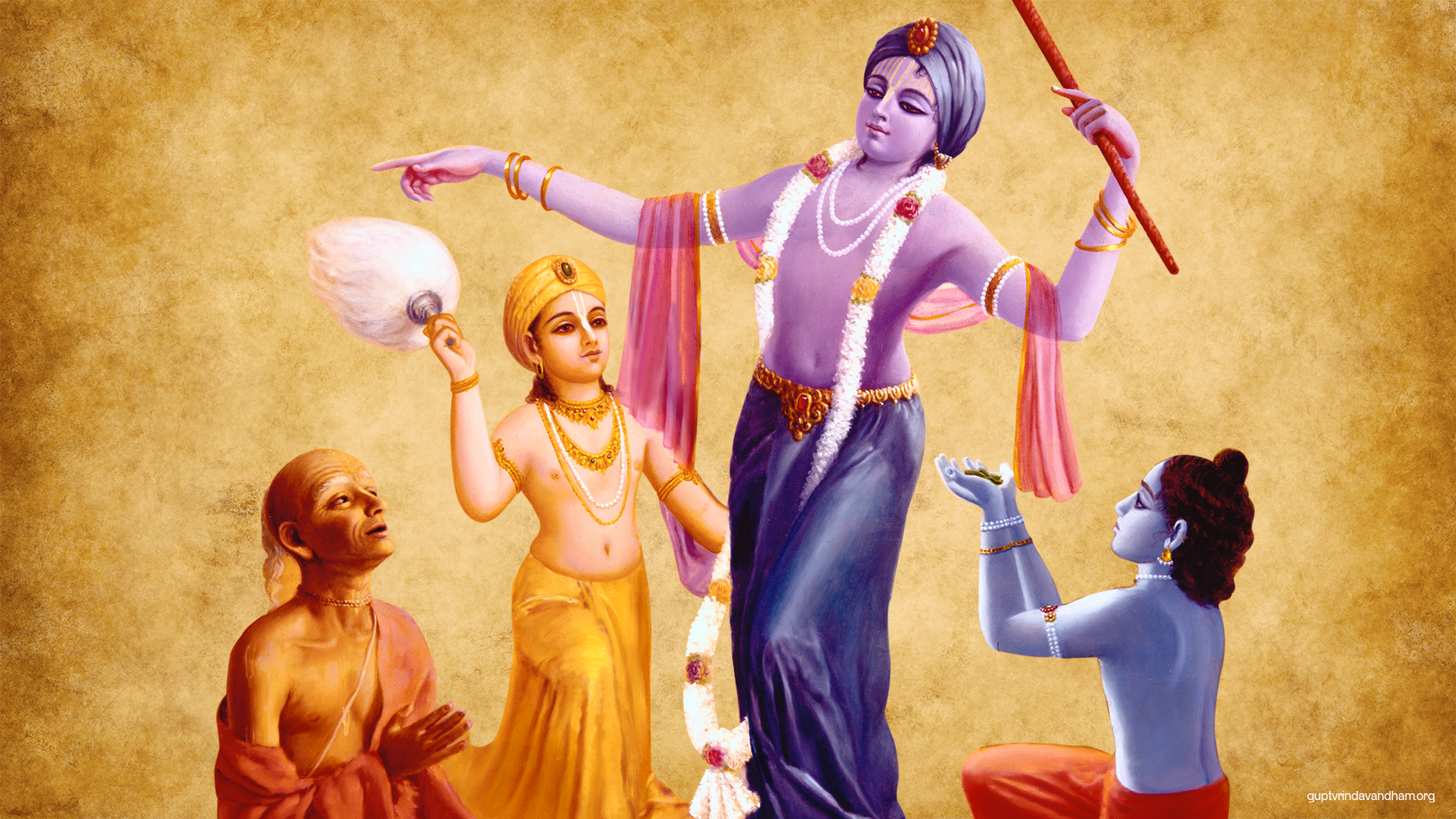
Devotees celebrate this day with great joy and devotion in temples around the world. The festivities typically include:
Fasting: Devotees observe a fast from grains until noon as a spiritual discipline.
Pañcāmṛta Abhiṣeka: An elaborate bathing ceremony (abhiṣeka) is performed for the Deities of Śrī Nitāi Gaurāṅga using auspicious substances like milk, yogurt, ghee, honey, and sweetened water.
Grand Ārati and Saṅkīrtana: A grand ārati ceremony is performed, accompanied by ecstatic congregational chanting (saṅkīrtana) of the Lord's holy names.
Lectures on Glories: Special classes and lectures are given on the divine pastimes, qualities, and glories of Lord Nityānanda.
Feast Prasādam: After the fast is broken at noon, a magnificent feast (prasādam) is distributed to all the assembled devotees.
The Spiritual Benefits of Observing Nityananda Trayodashi
By honoring this day and seeking the blessings of Śrī Nityānanda Prabhu, one can receive immense spiritual benefit. He bestows the spiritual strength needed to overcome obstacles on the path of devotion.
Through His mercy, one can attain true and everlasting happiness, find liberation from all material anxieties, and ultimately receive the priceless treasure of pure love for Kṛṣṇa (Kṛṣṇa Prema).
Observing Sri Nityananda Trayodashi 2026 is a special opportunity to receive this boundless compassion.
Connecting with the Lord of Mercy
Śrī Nityānanda Prabhu is the very embodiment of compassion and is revered as the Lord of Mercy. Devotees are encouraged to connect with Him by praying for His causeless mercy. In this difficult age of Kali, His lotus feet—described as nitāi-pada-kamala, as cooling as millions of moons—are the only true shelter for aspiring devotees seeking to advance in their spiritual lives.
Conclusion
Śrī Nityānanda Trayodaśī is a profound reminder of the infinite mercy of the Supreme Lord, who appeared as Śrī Nityānanda Prabhu to deliver the most fallen souls.
As the original spiritual master and the giver of divine love, His position is paramount. Let us therefore offer our humble obeisances at His lotus feet and joyfully celebrate the upcoming Sri Nityananda Trayodashi, praying for a single drop of His causeless mercy.