
 Donate Now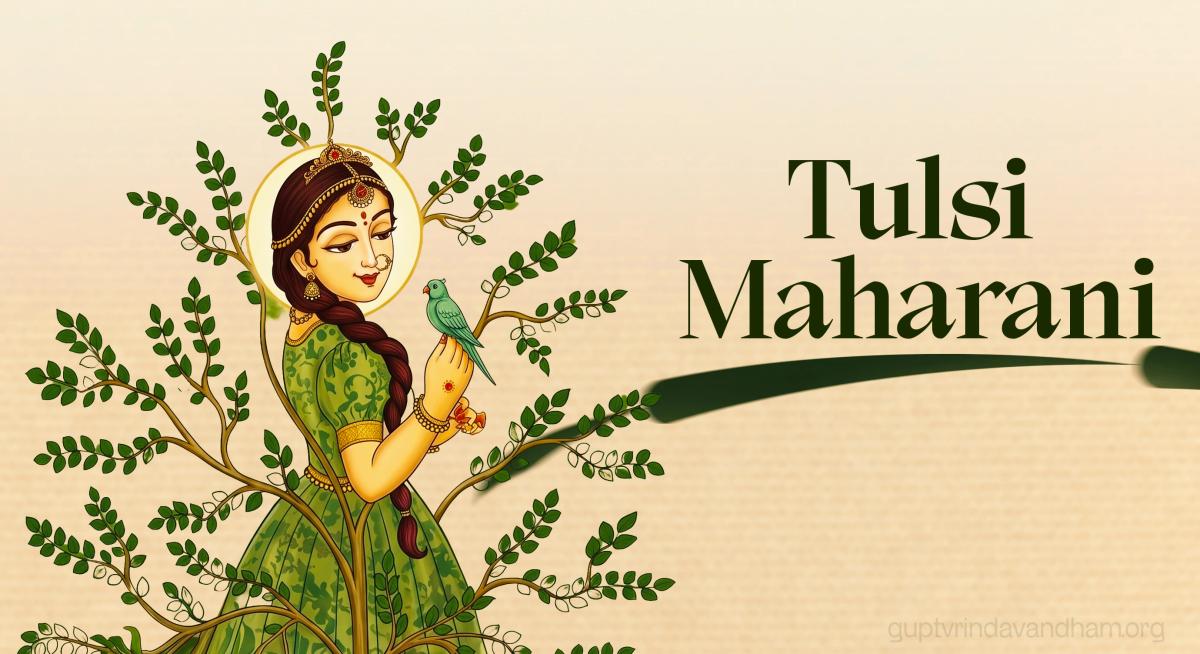
Tulasi is not merely a plant but a great devotee of Lord Krishna, who is worshiped even by pure devotees of the Lord. Tulasi Maharani, also known as Vrinda Devi, descended to this world to facilitate our spiritual awakening. Revered in homes across India, she sanctifies the environment and inspires devotion to Lord Krishna.
Who Is Tulasi Maharani?
Tulasi Maharani is an expansion of the Lord’s internal potency, eternally engaged in His service. The sacred forest of Vrindavan is named after Vrinda Devi. Although Srimati Radharani is the eternal Queen of Vrindavan, Tulasi Devi is lovingly honored as Maharani because she is the director of the divine pastimes of Sri Sri Radha and Krishna.
She is the one who controls the wind, the rain, the bending of the trees, and every environmental and circumstantial detail suitable for Their pastimes. Her presence in this material world allows us to serve her and thereby become dear to Lord Krishna.
Eight Names of Tulasi Devi
| Name | Meaning |
|---|---|
| Vrindavani | One who first manifested in Vrindavan |
| Vrinda | The goddess of all plants and trees |
| Vishvapujita | Worshipped by the entire universe |
| Pushpasara | The topmost of all flowers, without whom Lord Krishna does not like to look upon other flowers |
| Nandini | Seeing whom gives unlimited bliss to the devotees |
| Krishna-jivani | The life of Sri Krishna |
| Vishva-pavani | One who purifies the three worlds |
| Tulasi | One who has no comparison / Incomparable |
The Story of Tulasi Maharani — Vrinda Devi
The descent of Tulasi Maharani to this material world is a part of the Lord’s pastime. This not only fulfilled her desire to serve Lord Vishnu as her eternal consort but also enabled conditioned souls to develop devotion to Him.
Origin in Goloka and the Divine Curse
Tulasi Devi is originally an expansion of Radharani in Goloka Vrindavan, where she serves as a sakhi, friend and assistant. The story begins when Tulasi and one of Lord Krishna’s friends, sakha, had a disagreement. During the argument, Radharani cursed both of them to take birth in the material world; the friend was cursed to be born as a demon, and he, in turn, cursed Tulasi to also take birth on Earth.
Incarnation as the Daughter of Dharmadhvaja
In the material world, there was a king named Vrishdhvaja, who was a great devotee of Lord Shiva. He banned the worship of other deities except Lord Shiva. This led the demigods to curse him that his family would be bereft of the blessings of Lakshmi Devi. Generations later, his grandsons Dharmadhvaja and Kushadhvaja performed severe penance to regain Lakshmi’s favor.
Pleased by their devotion, Lakshmi Devi agreed to be born as their daughters. She appeared as Tulasi to Dharmadhvaja and as Vedavati to Kushadhvaja. Tulasi Devi eventually went to Badrikashrama to perform intense penance with the desire to marry Lord Narayana. Lord Brahma informed her that she could not marry Narayana directly and must first marry a demon.
The Story of Jalandhara and the Shaligram Curse
Tulasi was born again as the daughter of the demon Kalanemi, but she was a pure devotee of Lord Vishnu. Her father married her to a demon named Jalandhara, sakha in Goloka. Jalandhara possessed a divine protection: as long as his wife remained perfectly chaste, no one could defeat him.
When Jalandhara attempted to kidnap Mother Parvati, a war broke out with Lord Shiva. Despite his power, Shiva could not kill Jalandhara because of Tulasi’s unwavering chastity. To save the world, Lord Vishnu took the form of Jalandhara and approached Tulasi. The moment he touched her, her chastity was technically broken, allowing Shiva to defeat and kill Jalandhara.
Upon realizing the deception, Tulasi cursed Lord Vishnu to become a stone. Vishnu accepted this curse, leading to His manifestation as Shaligram Shilas, sacred stones found in the Gandaki River. Lord Vishnu explained that this was a way for Him to be accessible for worship to everyone. Tulasi then gave up her material body, and from it emerged the Tulasi plant, Holy Basil.
Tulasi Devi Worship
Tulasi Devi can be worshipped at home with simple offerings. More important than the ritual is a sincere mood of service and prayer to receive her blessings for spiritual advancement.
Daily Tulasi Worship includes:
Paying respectful obeisances
Offering incense sticks, agarbatti, and ghee lamp, deep
Offering flowers
Tulasi Pranam Mantra and Aarti recitation
Watering the roots
Tulasi Parikrama — 4 rounds minimum
The worship described above may also be performed in the evening, except for watering Tulasi.
Why Is Tulasi So Dear to Lord Krishna?
Tulasi Maharani is so dear to Lord Krishna because she is His eternal devotee and an expansion of His internal spiritual potency, completely dedicated to His pleasure. The Lord takes no pleasure in worship offered without Tulasi Maharani.
The Vedic scriptures repeatedly state that the Lord does not accept offerings made without Tulasi leaves. Even if one simply offers a Tulasi leaf with devotion, the Lord accepts it. Tulasi manjaris are dearer to Lord Krishna than thousands of flowers. He is greatly pleased when offered a garland of Tulasi leaves, sandalwood paste mixed with Tulasi, or any offering accompanied by a Tulasi leaf.
Spiritual Importance of Tulasi Maharani
The glories of Tulasi Maharani are not confined to this earthly planet alone. Her sanctifying presence and worship extend throughout Svarga, Bhu, and Patala Loka. In the Padma Purana, Lord Shiva tells his son Kartikeya that even if he were to describe the glories of Tulasi Devi for eternity, he would not be able to reach their conclusion.
1. One who has a Tulasi leaf in the mouth or on the body at the time of death will not suffer in hell, as mentioned in the Brahma Purana.
2. For those who plant, protect, water, see, or touch Tulasi Devi, she burns away the sinful reactions committed through the body, mind, and words, as mentioned in the Garga-Samhita.
3. Tulasi Maharani is auspicious in every way. By seeing, touching, remembering, praying to, bowing before, hearing about, or planting her, one receives spiritual benefit and lives eternally in the Vaikuntha world, as explained by Srila Prabhupada.
4. One who hears Tulasi Devi’s glories will have all his sinful reactions, stored from many births, destroyed and very quickly attain the lotus feet of Sri Sri Radha and Krishna, as mentioned in the Padma Purana.
Conclusion
The glories of Tulasi Maharani are unlimited; even great demigods cannot reach their end. She is worshiped by both conditioned and liberated souls.
It is her mercy that she descends to this material world, allowing us to receive her blessings through devotional service. By serving her, the Lord becomes pleased with us, and we get a chance to associate with the Lord in Vaikuntha.