
 Donate Now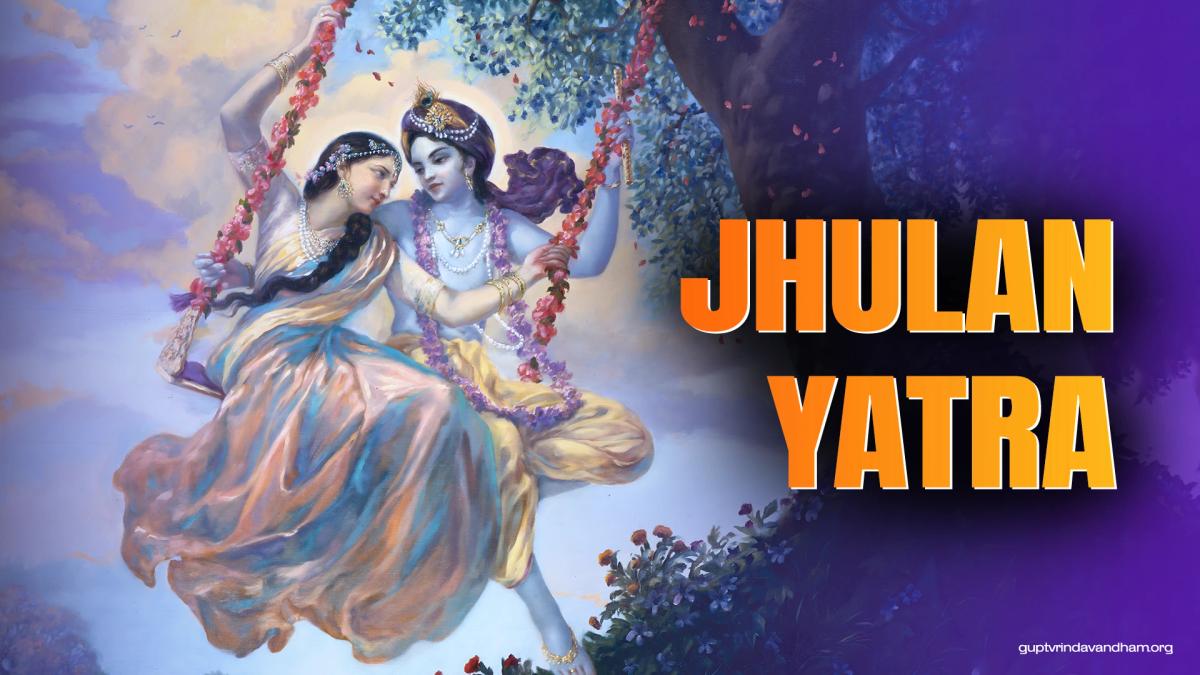
Jhulan Yatra is a spiritually rich celebration observed by Vaishnavas worldwide. This auspicious festival celebrates the divine Jhulan Leela of Shri Krishna and Srimati Radharani. The Jhulan utsav reflects Their eternal loving pastimes and invites devotees to express their bhakti through kirtan, jhulan seva, and temple shringar.
Jhulan Yatra 2026 Date and Duration
Jhulan Yatra 2026 begins on August 23, 2026, on Pavitropana Ekadashi and ends on August 28, 2026, on Balarama Purnima or Shravan Purnima, lasting for 5 days.
In Vrindavan, however, Jhulan Yatra is traditionally celebrated for 13 days. This year it begins on August 15 (Shravan Shukla Tritiya) and concludes on August 28 (Shravan Purnima).
Meaning, Origin and Story Behind Jhulan Yatra
Meaning
The term Jhulan refers to the swing, and Yatra signifies a procession or festival, so Jhulan Yatra literally translates to swing festival. Devotees prepare a jhula or swing using wood and decorate it with flowers and leaves, lovingly placing the divine couple Radha and Krishna and expressing their devotion through jhula seva.
Origin
The tradition of Jhulan Yatra originates from the divine Jhulan pastime of Srimati Radharani and Lord Krishna, which took place in Vraj. Vaishnava texts such as the Brahma Vaivarta Purana and Hari-bhakti-vilasa are associated with descriptions and practices related to Their divine pastimes and worship.
Story
In Indian culture, it is a custom for married daughters to visit their parents’ home during the month of Shravan (July–August). Following this custom, Shrimati Radharani travelled from her in-laws' home in Yavat to visit her father’s home in Barsana. On the top of Vilasa Garh Hill, which is traditionally regarded as an incarnation of Shri Krishna Himself, Her friends placed Shri Radha on a beautifully decorated swing or jhulan to cheer Her up.
Suddenly, an unknown dark gopi with her face covered by a sari appeared. The sakhis invited this stranger to sit on the swing with Radharani, but as they began to swing, the mysterious gopi fainted in ecstasy. When the friends checked her to help, they discovered Krishna’s flute and realized He had come in disguise just to be with Her.
Seeing Krishna before Her, Shri Radha’s separation disappeared, and the Divine Couple were reunited. Then Her friends joyfully continued the swing pastime, filling the surroundings with devotional happiness. Thus, this sweet pastime of Shri Radha and Krishna is lovingly remembered through the celebration of Jhulan Yatra.
Jhulan Yatra, Monsoon Season, and Its Connection to Vraj
In the sacred month of Shravan, the dark, rain-filled clouds in the sky resemble the beautiful complexion of Lord Krishna. During the monsoon season, all the 12 forests of Vraj become lush and green, filled with cool, refreshing air. This monsoon beauty recalls the enchanting atmosphere of Vraj, where Shri Radha and Krishna enjoy Their intimate pastimes.
The swinging or jhulan pastime of Shri Radha and Krishna is deeply connected with Vraj, where the Gopis are said to have tied a jhula on the giant imli (tamarind) tree for Their pleasure. Therefore, Jhulan Yatra is especially associated with Vraj Dham, where devotees remember Their swinging pastime and joyfully serve the divine couple.
The Devotional Meaning of Jhulan Seva
Jhulan Seva is the beautiful form of devotional service to Shri Radha and Krishna. Lord Krishna is the master and proprietor of everyone, and this festival reminds us to render loving devotional service to the Lord. Every little service, whether decorating the jhulan, contributing to Jhulan Seva, or gently swinging the jhula on which Shri Radha and Krishna are seated, allows devotees to please the Lord.
Spiritual Significance of Jhulan Yatra
Jhulan Yatra is a festival centered on pleasing Shri Radha and Krishna through loving devotional service. The gopis of Vraja were always eager to serve Them by decorating the swing, arranging the jhulan, and singing Their glories simply to see Them happy. Their mood teaches us that true devotion lies in seeking the pleasure of Shri Radha and Krishna rather than our own.
By following this mood of service, we too can offer even the smallest activities for Their pleasure. Whether through jhulan seva, kirtan, or sincere remembrance, every service can deepen our devotion and bring us closer to eternal spiritual happiness.
Jhulan Yatra Songs
One of the famous Jhulan Yatra songs composed by Jagannatha Dasa Babaji, beautifully portraying the loving swing pastime of Srimati Radharani and Krishna.
(1)
dekho sakhi jhulata yugala kisora
nilamani jadaola kascana jora
lalita visakha sakhi jhulayata sukhe
anande magana heri donhe donha mukhe
Translation: Look, O sakhi, at the Yugala Kisora on the swing, resembling a sapphire embraced by gold! Lalita and Visakha blissfully push the swing, while the Divine Pair is absorbed in bliss, admiring each other’s faces!
(2)
garajata gagane saghane ghana ghora
rangini sangini gherata cauttara
vividha kusume sabe raciya hindola
dolaya yugala sakhi anande vibhola
Translation: Clouds loudly rumble in the sky as Rangini (playful Radhika) sits on the swing, that is decorated with different flowers, surrounded by Her girlfriends that are ecstatically swinging the Divine Pair.
(3)
jhulaota sakhigana karatali diya
suvadani kohe pache giraye bandhuya
vigalita dukula udita sveda bindu
amiya jharaye yeno duhun mukha indu
Translation: The sakhis are pushing the swing with their handpalms (so hard that) Suvadani (fair-faced Radhika) says (to Krsna): “O friend! We will fall backwards!” Their garments loosen and the sweat drops that appear on Their moon-like faces resemble drops of nectar.
(4)
heri sab sakhigana donhakara srama
camara vijana lei koroye sevana
bhramara kokila sab bosi taru dale
rati jaya radha-krsna radha krsna bole
kohe jagannatha kobe hobe subha dine
sakhi sahe donhakare heribo vipine
Translation: Seeing how the Divine Pair perspires of fatigue, all the sakhis begin to serve Them by fanning Them with yaktail fans. The bumblebees and cuckoos are sitting on the branches of the trees and are singing: “Jaya Radha Krsna! Jaya Radha Krsna!” with great love. Jagannatha dasa says: “When will that blessed day be mine when I can see both of them in the forest with the sakhis?
Apart from this wonderful song, there are songs like Vibhavari Shesha, Jay Jay Radha Krishna, Radhe Jay Jay Madhav Dayite, Radha Krishna Prana Mora and Vrindavana Ramya Sthana which are sung on Jhulan Yatra.
Conclusion
Thus, Jhulan Yatra is a beautiful opportunity to remember the sweet pastimes of Shri Radha and Krishna and follow the mood of loving service shown by the devotees of Vraja. By participating in jhulan seva, kirtan, and devotional offerings, we can engage ourselves in Their service and pray for Their mercy. May this Jhulan Yatra inspire us to always seek the pleasure of Shri Radha and Krishna and remain engaged in Their loving service.