

Balaram Jayanti 2026: Balaram Purnima Date, Celebration & Significance
- Home /
- Festivals /
- Balarama Jayanti
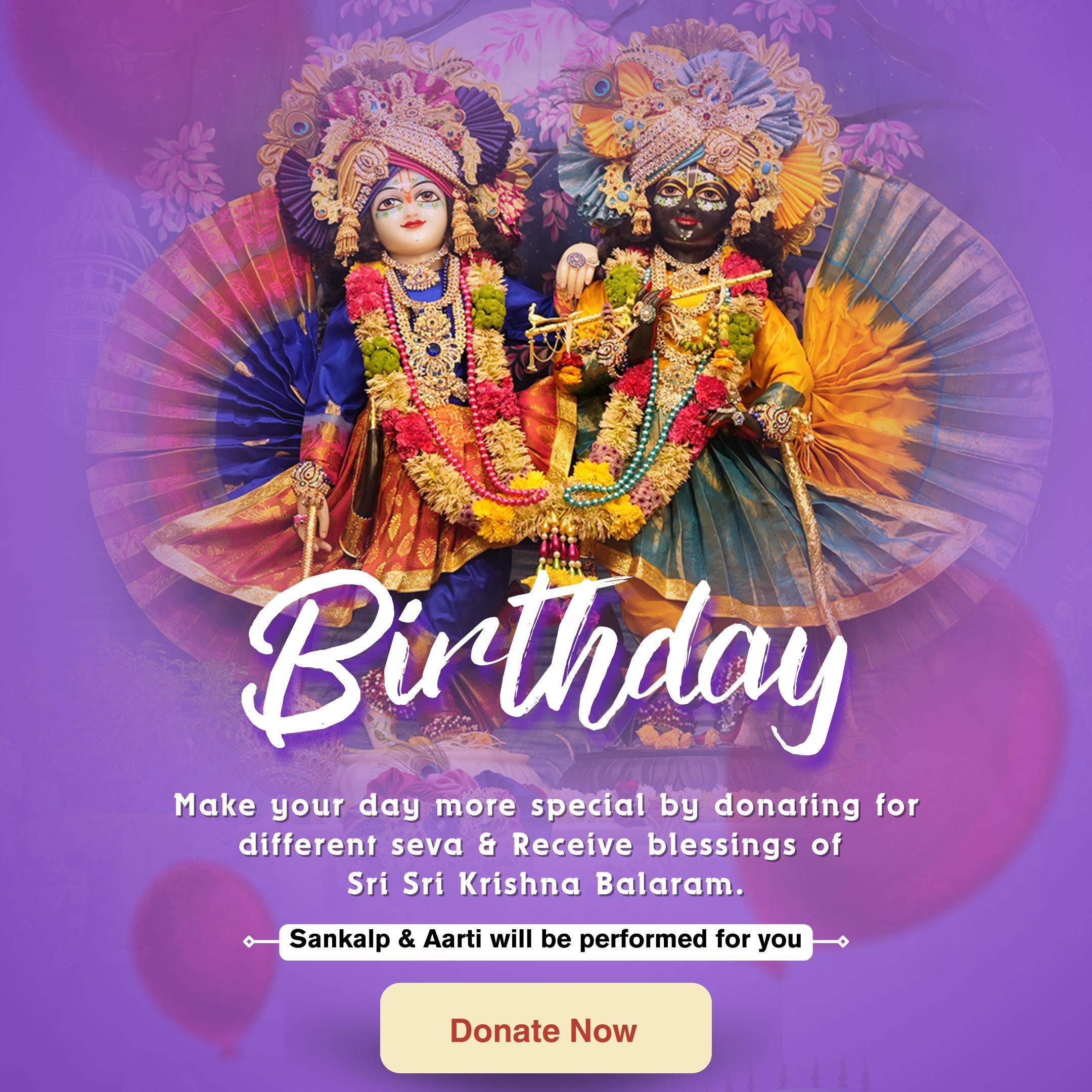
Balaram Purnima or Balaram Jayanti is the auspicious appearance day of Lord Balaram, the elder brother of Lord Krishna. This year, the sacred occasion falls on Friday, August 28, 2026. By remembering and worshipping Lord Balaram on this auspicious day, devotees pray for the spiritual strength to overcome obstacles, remain steady in devotional service, and deepen their loving relationship with Lord Krishna.
Who is Lord Balaram?
Lord Balaram is the original expansion of Lord Sri Krishna. While they are non-different in potency, Lord Balaram appears with a white complexion, whereas Lord Krishna is dark (*shyama*). Srila Prabhupada explains that “Bala” means spiritual strength and “Rama” signifies the reservoir of supreme spiritual pleasure and happiness.
One cannot attain the highest bliss or spiritual perfection without being sufficiently favored by Balaram's spiritual potency. Thus, Balaram is the source of the divine power that qualifies a soul to experience eternal, genuine happiness beyond all material miseries,
Appearance of Lord Balaram
Lord Balaram appeared on the full moon day (Purnima) of the month of Shravana. He first appeared in the womb of Mother Devaki as her seventh child, then was transferred to the womb of Mother Rohini in Gokul through the agency of Yogamaya. Because He was "drawn away" from one womb to another, He received the name Sankarshana.
His appearance took place shortly before the advent of Lord Krishna, preparing the way for the Supreme Lord's divine pastimes in Gokul. Just as the residents of Gokul love Lord Krishna, they also cherish Lord Balaram with equal affection. Both brothers are the life and soul of the Brajvasis.
Lord Balaram Pranam Mantra
namas te halagraha
namas te musalayudha
namas te revati-kanta
namas te bhakta-vatsala
namas te dharani-dhara
namas te balanam srestha
pralambare namas te 'stu
ehi mam krsna-purvaja
Translation: Obeisances to You, O holder of the plow. Obeisances to You, O wielder of the mace. Obeisances to You, O darling of Revati. Obeisances to You, O kind benefactor of Your devotees.
Obeisances to You, O upholder of the earth. Obeisances to You, O best of the strong. Obeisances to You, O enemy of Pralamba. Please come to me, older brother of Krsna.
Main pastimes
The Slaying of Dhenukasura
In the Talavana forest, the cowherd boys were eager to eat ripe palm fruits, but they were terrorized by the ass-demon Dhenukasura. Lord Balaram entered the forest and began jerking the trees with His arms, causing the fruits to fall. When Dhenukasura attacked, Balaram seized the demon by his hind legs, whirled him around, and threw him into a palm tree, terminating his life. He then killed the rest of the demon's associates in the same manner.
Subduing Pralambasura
While playing a wrestling game where the defeated party had to carry the victors, a demon named Pralambasura disguised himself as a cowherd boy to kidnap Balaram. As the demon carried Balaram away, He began to feel like a heavy mountain. The demon assumed his real, terrifying form, appearing like a dark cloud with lightning, while Balaram, on his back, was compared to the radiant moon. Realizing the demon's intent, Balaram struck his head with a powerful fist and killed him at once.
Dragging the Yamuna River
While in a playful mood near the sacred forest of Vrindavan, Lord Balaram desired to bathe along with His companions. He called upon the **River Yamuna**, requesting her to alter her course so they could conveniently enjoy the water. When Yamuna neglected His request, Balaram used His **plough (*hala*)** to drag the river toward the forest. Recognizing His supreme power, the Yamuna surrendered and offered humble prayers
Plough and mace symbolism
Lord Balaram is uniquely identified by His two iconic transcendental weapons: the Plough (Hala) and the Mace (Musala)
The Plough (Hala)
The plough represents both agricultural cultivation and spiritual preparation. Just as a farmer uses a plough to prepare the soil for sowing, Lord Balaram "tills" the hardened soil of the devotee's heart. He uses His divine potency to uproot the "weeds" of material desires, such as lust, anger, greed, and pride, making the heart fertile for the seed of devotion (*bhakti-lata-bija*).
The Mace (Musala)
The mace symbolizes the destruction of the false ego. The mace is used to shatter demonic mentalities and the deep-seated spiritual ignorance that prevents a soul from surrendering to Lord Krishna. As the eternal protector of devotees, Balaram uses the mace to provide the safety and stability needed to progress in spiritual life without being overcome by danger.
Balaram as the original spiritual master
Lord Balaram is recognized as the Adi-Guru, the original spiritual master. Lord Balaram is known as *Swayam Prakash* or the revelation element because He reveals the Lord’s service to all living entities. He acts like a torchlight in the darkness of the material world, illuminating the path toward Krishna and generating knowledge of the Supreme within the seeker's heart.
Every genuine spiritual master in the disciplic succession is considered a representative and a manifestation of the mercy of Lord Balaram. The Guru supplies the necessary spiritual strength to the disciple, acting as Balaram’s agent to deliver souls from the cycle of birth and death.
Balaram Purnima Date & Fasting
Balaram Purnima will be observed on August 28, 2026. On this sacred festival, devotees follow two types of fasting (upvaas) based on their capacity and faith.
1. Nirjala (without food and water):
This is a strict fast where devotees abstain from both food and water from sunrise to sunset. It is mentioned in the shastras as the most ideal form of austerity, symbolizing complete surrender and control over the senses.
2. Phalahar (non-grain food):
In this type of fast, devotees avoid grains, pulses, onions, garlic, spices, and all types of processed or fast food. Only sattvic items are consumed — foods that are light, pure, and offered with devotion. Common dishes include Sabudana Khichdi, boiled potatoes, fruits, nuts, and fresh dairy like milk or curd.
Significance of Balaram Purnima
It holds great spiritual importance for the devotees of Lord Krishna. This sacred day celebrates His divine appearance in this material world, who performed various pastimes to give pleasure to the devotees. He teaches that true power lies in surrendering to the Lord and dedicating oneself fully to His mission.
For devotees, this day is a reminder to walk firmly on the path of dharma and bhakti, without being distracted by material desires. Remembering Lord Balaram’s example inspires the heart to develop qualities like patience, simplicity, and spiritual courage — all essential for progressing in Krishna consciousness.
Balaram Purnima at Gupt Vrindavan Dham
At Gupt Vrindavan Dham, devotees celebrate Balarama Purnima every year with great devotion, joy, and spiritual enthusiasm through various devotional activities. The celebration begins at 6:30 p.m. with the Utsava Vigrahas (festival deities) of Lord Krishna and Lord Balarama being gracefully seated on a palanquin (palaki). Accompanied by the joyful chanting of the holy names, devotees carry the palaki to the abhishekam area.
Devotees perform the abhishekam ceremony, bathing the deities with panchamrita (milk, yoghurt, ghee, honey, and sweet water), panchagavya (cow dung, cow urine, milk, ghee, yogurt), and juices from varieties of fruits. Before the abhishekam begins, Vedic mantras are chanted along with the Hare Krishna Mahamantra, creating a sacred and devotional atmosphere.
After the grand abhishekam ceremony, the Deities are respectfully placed back on the palanquin (palaki) and carried in a joyous procession to the temple hall. Devotees shower flowers upon the Deities while singing and dancing in kirtan during the Palaki Utsava. The celebration concludes with the distribution of prasadam in the Jagannatha Hall.
Srila Prabhupada on Balaram Purnima
Lord Krishna and Balarama are not two different Personalities of Godhead. God is one without a second, but He expands Himself in many forms without their being separate from one another. They are all plenary expansions.
The immediate expansion of Lord Krishna is Baladeva, and Brahma, born from the lotus flower from Garbhodakashayi Vishnu, is an expansion of Baladeva. This indicates that Krishna and Baladeva are not subject to the regulations of the universe; on the contrary, the whole universe is under their subjugation.
Conclusion
Balaram Purnima has great importance in the life of a devotee because a little devotional service done to him can strengthen our bhakti. Without Lord Balarama's mercy, no one can truly understand the Supreme Lord or make genuine spiritual advancement. So, on this occasion we seek the Lord’s mercy and guidance in the path of bhakti at every step.
FAQ
Q1. What is Balaram Purnima?
Ans: Balaram Purnima or Balaram Jayanti is the auspicious appearance day of Lord Balaram, the elder brother of Lord Krishna.
Q2. Is fasting observed on Balarama Purnima?
Ans: Yes, devotees follow two types of fasting (upvaas) based on their capacity: Nirjala and Phalahar.
Q3. What is the fasting time for Balaram Purnima?
Ans: The fasting period observed in the ISKCON temple ends at noon (12 p.m.).
Q4. What does Balaram mean?
Ans: Srila Prabhupada explains that “Bala” means spiritual strength and “Rama” signifies the reservoir of supreme spiritual pleasure and happiness.