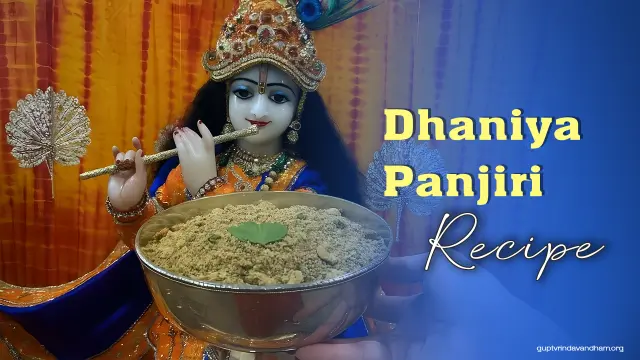

When the Supreme Lord appeared in his original form, Lord Shri Krishna, the festival felt like a divine presence, and the prasadam felt like a divine joy. On the occasion of Krishna Janmashtami, a special offering is made to the Lord. It includes the offering of Daniya Panjiri and Panchamrita. These are prepared in all the Hare Krishna Temples.
Among them, panchamrita is the most special offering. It has simple preparation steps, yet smells amazing and tastes like a pure nectar.
What is Panchamrit?
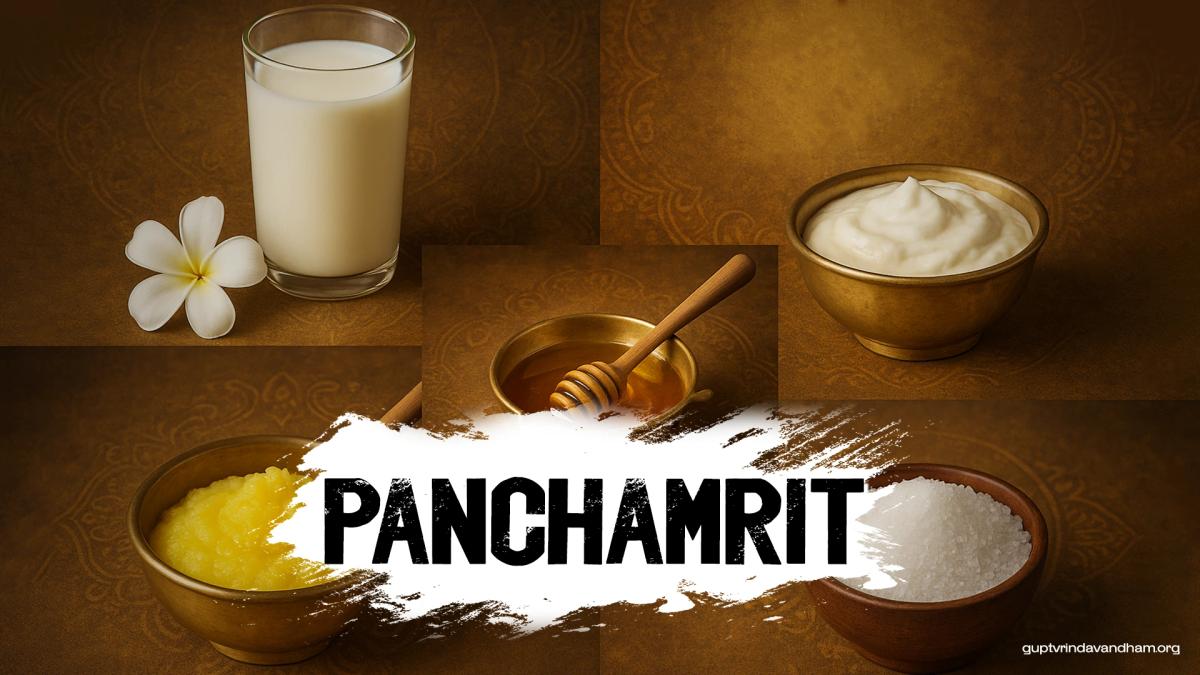
Panchamrita is the pure mixture of five basic ingredients: milk, curd, honey, sugar, and cow's ghee.
In Sanskrit, Pancha means five, and Amrita means nectar. It is a nectar of five pure ingredients. These are combined in a precise quantity and abhishek the deity of Lord Krishna.
Ingredients Needed to Make Panchamrit
The most beautiful part of making Panchamrita is that it only takes five basic ingredients and provides a blissful experience. The quantities listed below are for 4 to 5 people.
Here is the list of traditionally used ingredients:
1) Milk - Use half a cup of milk, boiled and cooled. Prefer cow's milk.
2) Curd - Use fresh, unsourced, and thick yogurt, a half cup.
3) Honey - one tablespoon
4) Powdered Sugar/ Jaggery powder - one tablespoon
5) Cow's milk ghee - use melted and warm ghee, one tablespoon.
Here are the additional ingredients that are used in any Hare Krishna Temple (optional):
1) Tulsi leaves - Fresh 5 to 7 leaves, not dried.
2) Gangajal - a tablespoon
3) Crushed Dry fruits - Usually, almonds, makhane, cashews, and raisins are used.
How to Make Panchamrit – Step-by-Step Method
If you need a clear guide on how to make Panchamrita for Janmashtami, here are the steps for you to follow:
Step 1: Gather all the above ingredients. Use a bowl to mix the ingredients. Make sure not to use anything made of plastic, a bowl, or a spoon.
Step 2: Add the ingredients in sequence.
i) Pour the milk into the bowl.
ii) Add the curd, a tablespoon of honey, and whisk it slowly.
iii) Now, add melted ghee and other optional ingredients, if needed. At last, whisk it properly and offer.
Tips for Making Panchamrit Perfectly
Panchamrita is a popular offering during Janmashtami. Here are the tips to make it taste better:
i) Use the fresh ingredients:
Before making any offering, it is obvious to choose fresh ingredients. Do not even use yesterday's items from the fridge. Just pick up everything from the market on the same day.
In temples, the Panchamrit offering is used to pour upon the deity of Lord Krishna.
ii) Maintain hygiene:
Before making the prasadam of Lord Krishna, make sure everything is cleaned. It involves your hygiene, a clean kitchen, and properly washed dishes.
When you maintain cleanliness, it purifies the environment and makes it suitable for a spiritual mood.
iii) Do not use metal/plastic items:
When you make the Panchamrita offering, use the puja utensils. Alternatively, you can also choose the steel utensils if you don't have any puja utensils.
iv) Use Cow's milk products:
A cow is the most worshipable animal. Especially on the occasion of Janmashtami, cow's milk is preferred the most. So, use cow's milk, ghee, and curd to prepare the Panchamrita.
Significance of Panchamrit on Janmashtami
The Panchamrit abhishek is used at midnight of the Janmashtami celebration. At that time, the deity of Lord Krishna is bathed with this Panchamrita.
In some temples, the panchamrita is used directly to pour on the deity, while in some other temples, the ingredients are used one by one.
Here is the spiritual significance behind using it everywhere for the Abhishek ceremony:
i) Reflects Purity:
The ingredients that are used in the panchamrita are often used in various other puja ceremonies. The ingredients, milk, curd, honey, sugar, and ghee, are ayurvedically and spiritually pure.
ii) Welcome of Divine Energy:
When the deity of Lord Krishna is bathed with the Panchamrita, it is addressed as his welcome. On this very day of Janmashtami, the Lord was born at midnight. So, we celebrate the divine appearance by showering him with pure and fragmented Panchamrita.
iii) A fragrance of Vrindavan:
Panchamrita includes all the ingredients that Lord Krishna grew up loving in Vrindavan. This is another reason why it is used for the abhishek of Lord Krishna on every Janmashtami celebration.
Panchamrit vs Charanamrit – Is There a Difference?
Panchamrita and Charnamrit are two different terms used by devotees. They may appear to be similar in definition, but their purpose is different in the Abhishek ceremony.
Panchamrita is the mixture of five nectars that is used to bathe the deity of Lord Krishna. It is performed in the midnight ceremony. It is the offering of devotees to the Lord.
Charanamrit is translated as 'Charan' means feet, and Amrit means nectar. It is defined as the "nectar of the feet". Once the Panchamrit is poured on the deity, it becomes charanamrit.
This is what is distributed among everyone after the abhishek ceremony.
Health Benefits of Panchamrit
Although Panchamrita is the one choice to bathe the deities on many special festivals, like Janmashtami. This includes high ayurvedic nutrition value. When mixed in a proper quantity and proper manner, it provides medicinal properties.
The mixture of all the ingredients - milk, curd, ghee, honey, and sugar is not only a nourishment for the soul but for the body as well.
Here is the list of benefits of taking Panchamrita:
i) Body detox:
Ghee is an ingredient present in the Panchamrit. It acts as a detoxifier for the body. It removes the fat-soluble toxins from the body through organs like the kidneys. It also provides smooth digestion without any side effects.
ii) Nourishes the Skin:
In Ayurveda, the Panchamrita ingredients - milk, curd, honey, sugar, and ghee are considered as 'Rasayana'. Rasayana means the substance that destroys old age & diseases from the body through the processes of conservation, transformation, and revitalization.
iii) Removes fatigue and laziness:
During Janmashtami fasting, one feels tired, lazy, and heavy in mind. Having panchamrita after midnight brings freshness to the body and coolness to the mind. It cures the body's fatigue and distress from the mind.
iv) Improves metabolism:
1. Ghee: 'Ghee' is known to be a lubricant agent in the body. It smoothens the blood circulation all over the body, resulting in a healthy heart.
2. Curd: Curd(yogurt) is rich in probiotics. Probiotics are defined as the good bacteria that help in easing digestion. In Ayurveda, it is strictly not allowed to be consumed on an empty stomach or at night.
But, as in panchamrita, it is combined with other ingredients in a proper amount, it provides nourishment to the body.
3. Honey: Honey contains natural sweeteners, offering a better taste in Panchamrit. It has antibacterial as well as anti-inflammatory properties. These properties help in healing and proper digestion.
4. Sugar: Sugar is an energy-providing source. In the full-day fasting period, one feels loss of energy. It works as a quick-energy provider, uplifting your body and mind.
FAQs:
Q. Can I add Tulsi leaves or Gangajal to Panchamrit?
Yes, tulsi leaves and gangajal are used in many Hare Krishna temples' panchamrit prasadam.
Just make sure of the following points:
1. Use fresh tulsi leaves only, not dried.
2. Add only one or two drops of gangajal; otherwise, it will ruin the taste of panchamrita. `
Q. Can Panchamrit be made in advance and stored?
No, do not store the panchamrita. The panchamrita should be fresh when used for offering. Also, it loses its taste and medicinal properties when stored in the fridge for a long.
Only during an emergency, just store it for one day after Janmashtami and finish it on the next day.
Q. Can I make a vegan or plant-based version of Panchamrit?
Yes, there is a way to make lactose-free Panchamrit for the lactose intolerants, vegan and without any dietary restriction.
1) Use almond or coconut milk in place of cow milk.
2) Use vegan curd
3) Use vegan ghee like coconut oil
4) Honey can be replaced by date syrup
5) Use jaggery powder in place of powdered sugar
However, it can't be used in the Abhishek of Lord Krishna. And, it wouldn't taste like regular Panchamrit.
Conclusion
Panchamrit is more than a mixture of five pure ingredients. It is a nectar which becomes blissful after it is used for the abhishek of Lord Krishna.
In this year's Janmashtami, make the Panchamrit with proper ingredients and the method of mixing. Offer it to Lord Krishna and distribute it among the family and neighbours.