
 Donate Now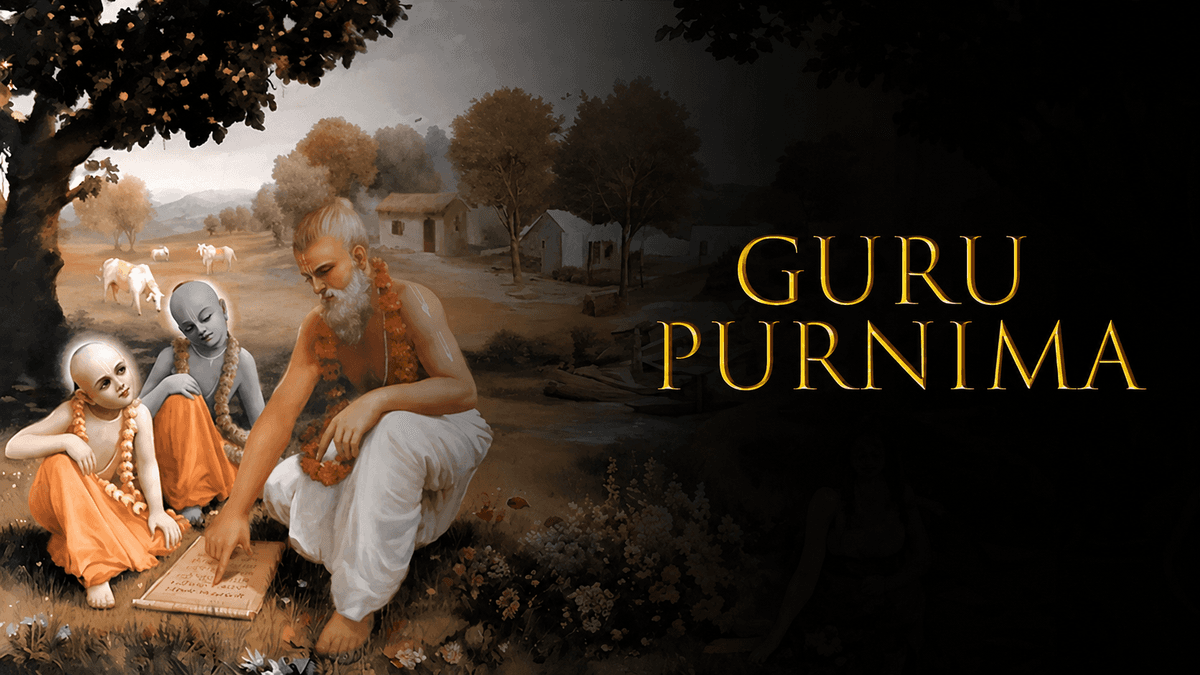
What is Guru Purnima?
yasya prasadad bhagavat-prasado
yasyaprasadan na gatih kuto ’pi
- Sri Gurvastakam
Translation: “By the mercy of the spiritual master one receives the benediction of Krsna. Without the grace of the spiritual master, one cannot make any advancement.”
The word guru is derived from the Sanskrit roots gu, meaning “darkness,” and ru, meaning “the one who removes it.” A guru, then, is literally the person who removes the darkness and ignorance from one’s life. So, the festival of Guru Purnima is the day primarily celebrated to offer gratitude to that guru, whether a spiritual master, an academic teacher, or an elder who has shaped one's path.
To acknowledge the exact Guru Purnima 2026 dates and other Purnima observances through the year, check our Purnima dates article.
The Story of Guru Purnima
1. Vyasa Purnima: The Birth of Veda Vyasa
May that inexhaustible Supreme Personality of Godhead become our spiritual master, for He is the original spiritual master of all other spiritual masters. - SB 8.24.48
Guru Purnima's most widely known origin traces back to the birth of Veda Vyasa. Born to the sage Parashara and Satyavati on an island in the Yamuna River, Sage Vyasa became one of the greatest gurus in the Hindu tradition. He divided the single Veda into four parts, Rig, Yajur, Sama, and Atharva, and taught them to his four principal disciples, Paila, Vaisampayana, Jaimini, and Sumantu.
He was also renowned for citing and compiling the great war of Mahabharata and the eighteen Puranas. Moreover, due to Maharishi Vyasa's remarkable contributions to Vedic knowledge, his disciples across generations have honored the sacred day of Guru Purnima as Vyasa Purnima, paying tribute to the guru who preserved our scriptural knowledge.
2. Lord Shiva as the Adi Guru
As historical evidence from legendary scriptures shows, Adi Guru Shankaracharya, who established four pilgrimage sites (Chaar Dham), was an incarnation of Lord Shiva Himself, making Him the very first guru of this cosmic creation. Shiva shared the wisdom of yoga with the Saptarishis, the seven great sages who waited for Him for 84 long years near the lake Kantisarovar in the Himalayas. After giving teachings, Adi Guru asked His newly enlightened sages for “Guru Dakshina”. However, as the sages had no traditional or physical wealth, they surrendered all of their knowledge unto the feet of Adi Guru (Shiva).
Since that day, this full-moon day has been revered as Guru Purnima, becoming the origin point of the guru-shishya tradition itself.
3. Lord Buddha:
In the Buddhist tradition, Guru Purnima is revered as the day on which Lord Buddha gave His first sermon at Sarnath, Uttar Pradesh. After attaining enlightenment at Bodh Gaya, Lord Buddha traveled to Sarnath to share His realization of the Four Noble Truths with His five former disciples.
This first instance is seen as a pivotal event, known as the Dhammacakkappavattana Sutta (the turning of the wheel of dharma), which set the tone for Buddhism.
Each of these Guru Purnima stories reflects the ultimate truth and true meaning of Guru: that knowledge is meant to be transmitted from a realized teacher to a sincere student.
The Vaishnava Guru-Parampara on Guru Purnima
While Guru Purnima is widely celebrated across religions such as Hinduism, Buddhism, and Jainism, for a Gaudiya Vaishnava devotee, this day holds a deeper, more personal meaning. It is not only a day to worship and pay respect to Sage Vyasa, Lord Shiva, or Lord Buddha.
But in the abstract, it is a day to restore one's connection to the living guru-parampara, the unbroken chain of spiritual masters through which pure devotional knowledge has been spread and passed on to several generations.
Guru-Tattva and the Disciplic Succession
In the Vaishnava tradition, the guru is not a self-appointed teacher but a genuine representative of the Supreme Lord, authorized to guide the sincere seeker back to Lord Krishna, the ultimate liberator.
The Padma Purana states that:
sampradāya-vihīnā ye mantrās te niṣphalā matāḥ
ataḥ kalau bhaviṣyanti catvāraḥ sampradāyinaḥ
Translation: Any mantra that does not come in disciplic succession is considered to be useless. Therefore, in the age of Kali, there will be four authorized disciplic successions [founders].
So, this verse clearly states that to attain liberation and the Lord's mercy in this age of Kaliyuga, one should have a Guru or master who can guide one on the path, as without a Guru it is not easy to attain the Lord’s divine shelter.
Srila Prabhupada and the Brahma-Madhva-Gaudiya Sampradaya
Gaudiya Vaishnavas follow the Brahma-Madhva-Gaudiya Sampradaya, a disciplic lineage that began with Lord Krishna Himself and passed down through Brahma, Madhvacharya, and, eventually, Chaitanya Mahaprabhu, who laid the foundation of Gaudiya Vaishnavism, a sampradaya centered on loving devotion to Radha and Krishna.
In the modern era, this parampara reached the Western world through the devotional efforts of His Divine Grace A.C. Bhaktivedanta Swami Srila Prabhupada, the 32nd spiritual master of the Gaudiya Vaishnav sampradaya, who spread the teachings and the Hare Krishna Mahamantra given by his guru, Srila Bhaktisiddhanta Sarasvati Thakur.
On the divine occasion of Guru Purnima, devotees specifically remember this chain, understanding that their own spiritual life is only possible because it has been faithfully protected and transmitted from guru to guru without any change.
Who Celebrates Guru Purnima?
tad-vijñānārthaṁ sa gurum evābhigacchet samit-pāṇiḥ śrotriyaṁ brahma-niṣṭham - Mundaka Upanisad
Translation: To realize the Supreme Truth, one must approach a Guru who is well-versed in the scriptures and firmly established in Brahman.
Guru Purnima is not limited to one tradition. Hindus honor Veda Vyasa and their personal spiritual masters. Buddhists observe this day in remembrance of the Buddha's first sermon at Sarnath, reflecting on the Four Noble Truths and the Eightfold Path. Jains venerate their Tirthankaras and teachers, marking the beginning of Chaturmasya.
Across all communities and religions, the spirit of Guru Purnima remains the same: deep gratitude to the one who dispels ignorance and points the way to liberation. In modern times, praising and attaining the shelter of a spiritual guru is very hard, so people in countries like the US, Canada, and Europe celebrate Teacher’s Day to honor academic guides, yoga practitioners, and life mentors.
Why Guru Purnima Matters
“Guru is the creator Brahma, Guru is the preserver Vishnu, Guru is the destroyer Shiva. Guru is directly the supreme spirit – I offer my salutations to this Guru.” - Adi Guru Shankaracharya.
A guru's importance cannot be neglected in one’s life. The Srimad Bhagavatam explains that a spiritual master is the direct representative of the Supreme Personality of Godhead, descended to reclaim fallen souls from the darkness of material existence.
The spiritual master should be worshiped like the Supreme Personality of Godhead; he is the most confidential servant of the Lord. - Srila Prabhupada
Additionally, Srila Prabhupada often emphasized that without approaching a guru and inquiring from him submissively, real knowledge of the self and the Lord cannot be attained.
So, Guru Purnima is not simply a day of ritual observance; it is an annual occasion to praise the guru's teachings transmitted over the past year and to renew one's commitment for the year ahead.
How to Celebrate Guru Purnima
Offer Prayers and Chant the Gurvastakam
Devotees traditionally begin the day by offering prayers of gratitude to their spiritual master. Many chant the Sri Gurvastakam, an eight-verse composition by Srila Vishvanatha Chakravarti Thakura in glorification of the guru, traditionally recited during the early-morning hours of mangala-aarati.
Read Srila Prabhupada's Books
Since a spiritual master's instructions are considered his most direct form of association, many devotees dedicate extra time on this day to reading Srila Prabhupada's books, particularly Bhagavad-gita As It Is, Srimad-Bhagavatam, and Chaitanya Charitamrita.
Chanting and Harinam Sankirtan
Congregational chanting of the Hare Krishna maha-mantra holds special significance on Guru Purnima, as it is considered the direct instruction and gift of the guru-parampara to the modern age. Temples often organize extended Harinam Sankirtan processions throughout the day.
Seva Opportunities on Guru Purnima
On Guru Purnima 2026, engage in acts of compassion, such as daan and seva, and promote Srila Prabhupada's mission, which he dreamt of a long time ago, of building a replica of the Sri Sri Krishna Balaram temple like the one in Vrindavan, in Jaipur. You can help with mandir nirman seva, prasadam distribution seva, or support Gau Seva, which is dear to both the Guru and the Lord.
Conclusion
Guru Purnima 2026 is not just an occasional date; it’s a time of year to remember, embrace, and share the teachings of one's Guru. It does not matter whom you follow; what matters most is that you inherit the lessons and pay homage to your Guru. Beyond that, as a devotee, on Guru Purnima, you should engage in seva and remember the true meaning of Guru Parampara.