
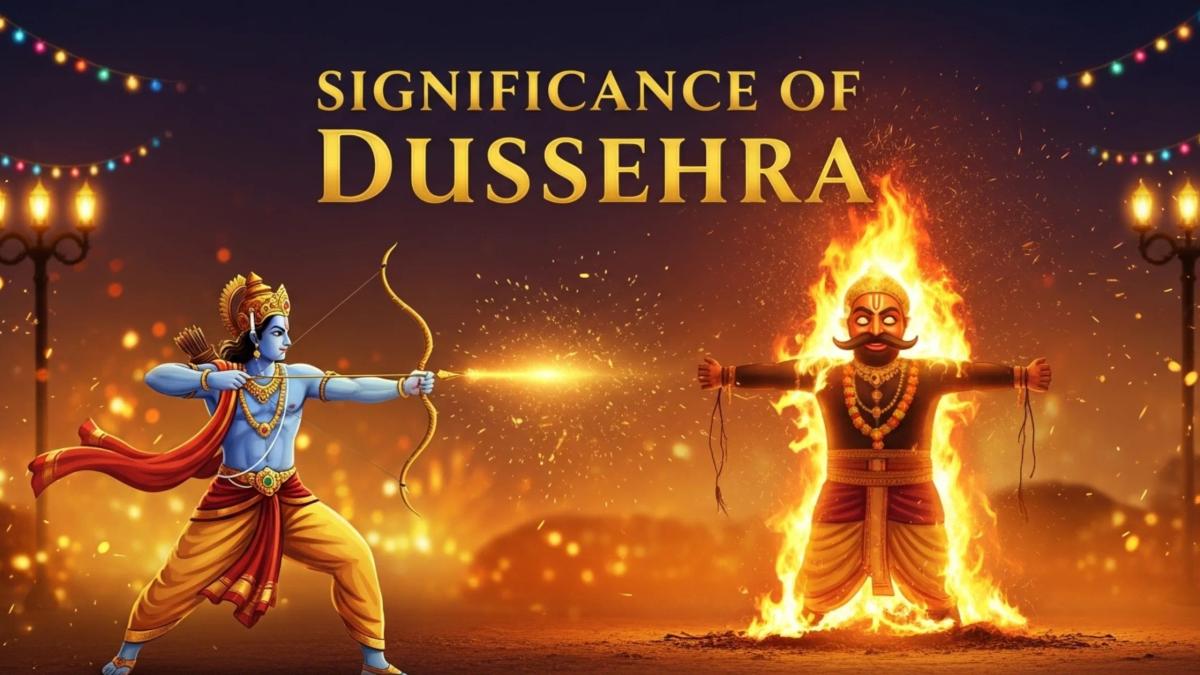
Every year, Dussehra reminds millions of people that truth and righteousness eventually overcome pride and adharma. But behind the effigies and celebrations lies a deeper story, and a deeper message for our own lives.
This guide explains what Dussehra means, the Ramayana story behind it, what Ravana's ten heads represent and the lessons devotees can take from Lord Rama's victory. If you are looking for the festival date and muhurat, see our Dussehra 2026 date and Vijay Muhurat guide.
What Does Dussehra Mean?
The word Dussehra comes from Sanskrit: dasha means ten and hara means defeat or removal. It refers to the defeat of Ravana, the ten-headed king of Lanka, by Lord Ramachandra.
The festival is also called Vijayadashami, the "victorious tenth day", because it falls on the Dashami of the bright fortnight of Ashwin. The name itself carries the message: victory belongs to dharma.
The Story Behind Dussehra
The story is told in the Valmiki Ramayana.
Ravana was a learned scholar and a great devotee of Lord Shiva. Through severe austerities he received powerful boons, but instead of using them for good, he grew proud and began harassing sages, disturbing yajnas and troubling the devatas.
When Lord Rama was in the forest on exile with Sita and Lakshmana, Ravana abducted Mother Sita and took her to Lanka. Rama then allied with Sugriva and the vanaras. Hanuman leapt across the ocean, found Sita in Ashoka Vatika and returned with news of her. The vanara army built a bridge across the sea, and the great war of Lanka followed.
Ravana's brother Vibhishana advised him to return Sita. When Ravana refused, Vibhishana left and surrendered to Rama, who accepted him warmly. In the end, Lord Rama defeated Ravana, and dharma was restored. Dussehra commemorates that day of victory.
What Do Ravana's Ten Heads Represent?
Ravana was brilliant and powerful, yet he fell. Spiritual teachers explain his ten heads as ten weaknesses that can overpower even a gifted person:
- Lust
- Anger
- Greed
- Delusion
- Pride
- Envy
- Ego
- Selfishness
- Injustice
- Cruelty
Ravana had knowledge but no humility. This is why the burning of his effigy is meant to remind us to look at these qualities within ourselves, not only at an enemy outside.
Dussehra Through a Vaishnava Lens
In the Vaishnava understanding, Rama is not merely a great king but the Supreme Lord Himself descending in Treta Yuga. In the Bhagavad Gita (4.7-8), Lord Krishna explains that the Lord appears whenever there is a decline of dharma, to protect the devotees and destroy the miscreants.
The Srimad-Bhagavatam (Canto 7) also explains that Ravana and Kumbhakarna were the gatekeepers of Vaikuntha, Jaya and Vijaya, who took birth as demons after a curse. Even Ravana's fall thus took place within the Lord's own plan.
The Gita (16.21) names lust, anger and greed as the three gates to hell. These are exactly the qualities that led to Ravana's downfall.
The Message of Vijayadashami
Ravana had knowledge, power and boons, yet he fell because he lacked humility and self-control. Lord Rama's victory shows the opposite path: firm adherence to dharma and complete surrender to the Supreme Lord. This Vijayadashami, along with remembering the victory in Lanka, we can also reflect on the "ten heads" within us and seek the Lord's help through the chanting of His holy names.