


Vyasena Vraja Lilayam Nitya Tattvam
Bhajan | Bhaktivinoda Thakura
Verse 1
vyasena vraja-lilayam nitya-tattvam prakasitam
prapasca-janitam jsanam napnoti yat svarupakam
Verse 2
jivasya siddha-sattayam bhasate tattvam uttamam
durata-rahite suddhe samadhau nirvikalpake
Verse 3
maya-sutasya visvasya cic-chayatvat samanata
cic-chakty-aviskrte karye samadhav api catmani
Verse 4
tasmat tu vraja-bhavanam krsna-nama-gunatmanam
gunair jadyatmakaih sasvat sadrsyam upalaksyate
Verse 5
sva-prakasa-svabhavo'yam samadhih kathyate budhaih
atisuksma-svarupatvat samsayat sa vilupyate
Verse 6
vayam tu samsayam tyaktva pasyamas tattvam uttamam
vrndavanantare ramye sri-krsna-rupa-saubhagam
Verse 7
nara-bhava-svarupo'yam cit-tattva-pratiposakah
snigdha-syamatmako varnah sarvananda-vivardhakah
Verse 8
tri-tattva-bhańgima-yukto rajiva-nayananvitah
sikhi-piccha-dharah sriman vana-mala-vibhusitah
Verse 9
pitambarah suvesadhyo vamsi-nyasta-mukhambujah
yamuna-puline ramye kadamba-talam asritah
Verse 10
etena cit-svarupena laksanena jagat-patih
laksito nandajah krsno vaisnavena samadhina
Verse 11
akarsana-svarupena vamsi-gitena sundarah
madayan visvam etad vai gopinam aharan manah
Verse 12
jatyadi-mada-vibhrantya krsnaptir durhrdam kutah
gopinam kevalam krsnas cittam akarsane ksamah
Verse 13
gopi-bhavatmakah siddhah sadhakas tad-anukrteh
dvividhah sadhavo jseyah paramartha-vida sada
Verse 14
samsrtau bhramatam karne pravistam krsna-gitakam
balad akarsayams cittam uttaman kurute hi tan
Verse 15
pumbhave vigate sighram stri-bhavo jayate tada
purva-rago bhavet tesam unmada-laksananvitah
Verse 16
srutva krsna-gunam tatra darsakad dhi punah punah
citritam rupam anviksya vardhate lalasa bhrsam
Verse 17
prathamam sahajam jsanam dvitiyam sastra-varnanam
trtiyam kausalam visve krsnasya cesa-rupinah
Verse 18
vraja-bhavasraye krsne sraddha tu raga-rupaka
tasmat sańgo'tha sadhunam vartate vraja-vasinam
Verse 19
kadacid abhisarah syad yamuna-tata-sannidhau
ghatate milanam tatra kantena sahitam subham
Verse 20
krsna-sańgat paranandah svabhavena pravartate
purvasritam sukham garhyam tat-ksanad gospadayate
Verse 21
vardhate paramanando hrdaye ca dine dine
atmanamatmani presthe nitya-nutana-vigrahe
Verse 22
cid-anandasya jivasya saccid-ananda-vigrahe
ya'nuraktih svatah-siddha sa ratih priti-bijakam
Verse 23
sa rati rasam asritya vardhate rasa-rupa-dhrk
rasah pasca-vidho mukhyah gaunah sapta-vidhas tatha
Verse 24
santa-dasyadayo mukhyah sambandha-bhava-rupakah
rasa viradayo gaunah sambandhotthah svabhavatah
Verse 25
rasa-rupam avapyeyam ratir bhati svarupatah
vibhavair anubhavais ca sattvikair vyabhicaribhih
Verse 26
esa krsna-ratih sthayi bhavo bhakti-raso bhaved
baddhe bhakti-svarupa sa mukte sa priti-rupini
Verse 27
mukte sa vartate nitya baddhe sa sadhita bhavet
nitya-siddhasya bhavasya prakatyam hrdi sadhyata
Verse 28
adarsac cin-mayad visvat sampraptam susamadhina
sahajena mahabhagair vyasadibhir idam matam
Verse 29
maha-bhavavirbhavo maha-rasavadhih kriya
nitya-siddhasya jivasya nitya-siddhe paratmani
Verse 30
etavaj jada-janyanam vakyanam carama gatih
yad-urdhvam vartate tan no samadhau paridrsyatam
Verse 1
By Vyāsa, the eternal truth regarding Vraja-līlā has been revealed — its own true nature, which knowledge born of the material world (prapañca) cannot attain.
Verse 2
In the perfected existence of the jīva, the supreme truth shines forth — within pure, undifferentiated samādhi that is free from all remoteness.
Verse 3
Because the universe, born of māyā, is but a shadow of consciousness (cit), a resemblance is perceived between that shadow and the effect manifested by the spiritual potency (cit-śakti), present both in samādhi and in the self.
Verse 4
Therefore the moods of Vraja, whose very nature is the name and qualities of Kṛṣṇa, are perceived — through material, inert qualities — as bearing an eternal resemblance to their spiritual counterparts.
Verse 5
This samādhi, self-luminous by nature, is so described by the wise; but because its true form is exceedingly subtle, it is effaced through doubt.
Verse 6
We, however, having cast aside doubt, behold the supreme truth: the beauteous form of Śrī Kṛṣṇa within delightful Vṛndāvana.
Verse 7
This form, though resembling a human form, nourishes the spiritual truth; His complexion, tenderly dark (śyāma), increases the bliss of all.
Verse 8
Standing in the threefold-bending posture, His eyes like lotuses, He wears a peacock feather; glorious, He is adorned with a garland of forest flowers.
Verse 9
Clad in yellow garments and richly adorned, His lotus face set upon the flute, He stands beneath a kadamba tree on the delightful bank of the Yamunā.
Verse 10
By these spiritual characteristics, the Lord of the universe — Kṛṣṇa, son of Nanda — is recognized through Vaiṣṇava samādhi.
Verse 11
The beautiful Lord, whose very nature is to attract, enchants this entire universe with the song of His flute, stealing away the minds of the gopīs.
Verse 12
How can those whose hearts are hardened by the delusion of pride in birth and the like ever attain Kṛṣṇa? It is the gopīs' hearts alone that Kṛṣṇa is capable of drawing to Himself.
Verse 13
Those whose very being consists of the gopīs' mood are the perfected souls; those who cultivate that mood through emulation are the practitioners (sādhakas). Thus the saintly should always be known by knowers of the supreme truth as twofold.
Verse 14
For those wandering in saṁsāra, the song of Kṛṣṇa, once it enters the ear, forcibly draws the mind and indeed elevates them.
Verse 15
When the male disposition swiftly departs, a feminine mood arises in its place; for such devotees there then arises pūrva-rāga, love's dawning stage, marked by symptoms of madness.
Verse 16
Hearing repeatedly of Kṛṣṇa's qualities from one who reveals them, and beholding His form as if painted before the eyes, their longing intensifies greatly.
Verse 17
First comes innate, natural knowledge; second, the description given in scripture; and third, skillful discernment in the world — regarding Kṛṣṇa, who is the Supreme Lord Himself.
Verse 18
Faith in Kṛṣṇa, the very shelter of Vraja's moods, takes the form of rāga, spontaneous loving attachment; from that follows the association of saintly persons, the residents of Vraja.
Verse 19
Sometimes an abhisāra, a secret tryst, occurs near the bank of the Yamunā, where an auspicious meeting takes place with the beloved.
Verse 20
From Kṛṣṇa's association, supreme bliss arises naturally; the happiness once cherished before now appears contemptible, reduced in that instant to the size of a mere cow's hoof-print.
Verse 21
Supreme bliss increases in the heart day by day, as the self delights in the dearmost self, whose form is eternally, ever fresh and new.
Verse 22
That innate, self-established attraction of the jīva — whose nature is consciousness and bliss — toward the Lord whose form is being, consciousness, and bliss (sac-cid-ānanda), is called rati, the seed of prema.
Verse 23
That rati, resting upon rasa, grows and takes the very form of rasa. Rasa is of five primary kinds, and likewise of seven secondary kinds.
Verse 24
Śānta, dāsya, and the rest are the primary rasas, embodying the mood of direct relationship with the Lord; the secondary rasas, beginning with vīra (heroism), likewise arise naturally from relationship.
Verse 25
Having attained the form of rasa, this rati shines forth in its own true nature — through vibhāvas, anubhāvas, sāttvika-bhāvas, and vyabhicārī-bhāvas.
Verse 26
This rati for Kṛṣṇa is the sthāyi-bhāva, the permanent emotion, which becomes bhakti-rasa. In the bound soul it exists in the form of bhakti; in the liberated soul it takes the form of prīti.
Verse 27
In the liberated soul it exists eternally; in the bound soul it must be cultivated through practice. What is to be achieved is the manifestation, in the heart, of this eternally perfect mood.
Verse 28
Attained through perfect, spontaneous samādhi, as if from a mirror reflecting the spiritual universe — this is the teaching held by Vyāsa and other great souls.
Verse 29
The manifestation of mahā-bhāva is the culminating activity, the very limit of the great rasa, experienced by the eternally perfected jīva in relation to the eternally perfect Supreme Self.
Verse 30
This much is the final reach of words born of the material realm. Whatever lies beyond that, let it be seen by us directly in samādhi.
Verse 1
vyasena vraja-lilayam nitya-tattvam prakasitam
prapasca-janitam jsanam napnoti yat svarupakam
Verse 2
jivasya siddha-sattayam bhasate tattvam uttamam
durata-rahite suddhe samadhau nirvikalpake
Verse 3
maya-sutasya visvasya cic-chayatvat samanata
cic-chakty-aviskrte karye samadhav api catmani
Verse 4
tasmat tu vraja-bhavanam krsna-nama-gunatmanam
gunair jadyatmakaih sasvat sadrsyam upalaksyate
Verse 5
sva-prakasa-svabhavo'yam samadhih kathyate budhaih
atisuksma-svarupatvat samsayat sa vilupyate
Verse 6
vayam tu samsayam tyaktva pasyamas tattvam uttamam
vrndavanantare ramye sri-krsna-rupa-saubhagam
Verse 7
nara-bhava-svarupo'yam cit-tattva-pratiposakah
snigdha-syamatmako varnah sarvananda-vivardhakah
Verse 8
tri-tattva-bhańgima-yukto rajiva-nayananvitah
sikhi-piccha-dharah sriman vana-mala-vibhusitah
Verse 9
pitambarah suvesadhyo vamsi-nyasta-mukhambujah
yamuna-puline ramye kadamba-talam asritah
Verse 10
etena cit-svarupena laksanena jagat-patih
laksito nandajah krsno vaisnavena samadhina
Verse 11
akarsana-svarupena vamsi-gitena sundarah
madayan visvam etad vai gopinam aharan manah
Verse 12
jatyadi-mada-vibhrantya krsnaptir durhrdam kutah
gopinam kevalam krsnas cittam akarsane ksamah
Verse 13
gopi-bhavatmakah siddhah sadhakas tad-anukrteh
dvividhah sadhavo jseyah paramartha-vida sada
Verse 14
samsrtau bhramatam karne pravistam krsna-gitakam
balad akarsayams cittam uttaman kurute hi tan
Verse 15
pumbhave vigate sighram stri-bhavo jayate tada
purva-rago bhavet tesam unmada-laksananvitah
Verse 16
srutva krsna-gunam tatra darsakad dhi punah punah
citritam rupam anviksya vardhate lalasa bhrsam
Verse 17
prathamam sahajam jsanam dvitiyam sastra-varnanam
trtiyam kausalam visve krsnasya cesa-rupinah
Verse 18
vraja-bhavasraye krsne sraddha tu raga-rupaka
tasmat sańgo'tha sadhunam vartate vraja-vasinam
Verse 19
kadacid abhisarah syad yamuna-tata-sannidhau
ghatate milanam tatra kantena sahitam subham
Verse 20
krsna-sańgat paranandah svabhavena pravartate
purvasritam sukham garhyam tat-ksanad gospadayate
Verse 21
vardhate paramanando hrdaye ca dine dine
atmanamatmani presthe nitya-nutana-vigrahe
Verse 22
cid-anandasya jivasya saccid-ananda-vigrahe
ya'nuraktih svatah-siddha sa ratih priti-bijakam
Verse 23
sa rati rasam asritya vardhate rasa-rupa-dhrk
rasah pasca-vidho mukhyah gaunah sapta-vidhas tatha
Verse 24
santa-dasyadayo mukhyah sambandha-bhava-rupakah
rasa viradayo gaunah sambandhotthah svabhavatah
Verse 25
rasa-rupam avapyeyam ratir bhati svarupatah
vibhavair anubhavais ca sattvikair vyabhicaribhih
Verse 26
esa krsna-ratih sthayi bhavo bhakti-raso bhaved
baddhe bhakti-svarupa sa mukte sa priti-rupini
Verse 27
mukte sa vartate nitya baddhe sa sadhita bhavet
nitya-siddhasya bhavasya prakatyam hrdi sadhyata
Verse 28
adarsac cin-mayad visvat sampraptam susamadhina
sahajena mahabhagair vyasadibhir idam matam
Verse 29
maha-bhavavirbhavo maha-rasavadhih kriya
nitya-siddhasya jivasya nitya-siddhe paratmani
Verse 30
etavaj jada-janyanam vakyanam carama gatih
yad-urdhvam vartate tan no samadhau paridrsyatam
Verse 1
By Vyāsa, the eternal truth regarding Vraja-līlā has been revealed — its own true nature, which knowledge born of the material world (prapañca) cannot attain.
Verse 2
In the perfected existence of the jīva, the supreme truth shines forth — within pure, undifferentiated samādhi that is free from all remoteness.
Verse 3
Because the universe, born of māyā, is but a shadow of consciousness (cit), a resemblance is perceived between that shadow and the effect manifested by the spiritual potency (cit-śakti), present both in samādhi and in the self.
Verse 4
Therefore the moods of Vraja, whose very nature is the name and qualities of Kṛṣṇa, are perceived — through material, inert qualities — as bearing an eternal resemblance to their spiritual counterparts.
Verse 5
This samādhi, self-luminous by nature, is so described by the wise; but because its true form is exceedingly subtle, it is effaced through doubt.
Verse 6
We, however, having cast aside doubt, behold the supreme truth: the beauteous form of Śrī Kṛṣṇa within delightful Vṛndāvana.
Verse 7
This form, though resembling a human form, nourishes the spiritual truth; His complexion, tenderly dark (śyāma), increases the bliss of all.
Verse 8
Standing in the threefold-bending posture, His eyes like lotuses, He wears a peacock feather; glorious, He is adorned with a garland of forest flowers.
Verse 9
Clad in yellow garments and richly adorned, His lotus face set upon the flute, He stands beneath a kadamba tree on the delightful bank of the Yamunā.
Verse 10
By these spiritual characteristics, the Lord of the universe — Kṛṣṇa, son of Nanda — is recognized through Vaiṣṇava samādhi.
Verse 11
The beautiful Lord, whose very nature is to attract, enchants this entire universe with the song of His flute, stealing away the minds of the gopīs.
Verse 12
How can those whose hearts are hardened by the delusion of pride in birth and the like ever attain Kṛṣṇa? It is the gopīs' hearts alone that Kṛṣṇa is capable of drawing to Himself.
Verse 13
Those whose very being consists of the gopīs' mood are the perfected souls; those who cultivate that mood through emulation are the practitioners (sādhakas). Thus the saintly should always be known by knowers of the supreme truth as twofold.
Verse 14
For those wandering in saṁsāra, the song of Kṛṣṇa, once it enters the ear, forcibly draws the mind and indeed elevates them.
Verse 15
When the male disposition swiftly departs, a feminine mood arises in its place; for such devotees there then arises pūrva-rāga, love's dawning stage, marked by symptoms of madness.
Verse 16
Hearing repeatedly of Kṛṣṇa's qualities from one who reveals them, and beholding His form as if painted before the eyes, their longing intensifies greatly.
Verse 17
First comes innate, natural knowledge; second, the description given in scripture; and third, skillful discernment in the world — regarding Kṛṣṇa, who is the Supreme Lord Himself.
Verse 18
Faith in Kṛṣṇa, the very shelter of Vraja's moods, takes the form of rāga, spontaneous loving attachment; from that follows the association of saintly persons, the residents of Vraja.
Verse 19
Sometimes an abhisāra, a secret tryst, occurs near the bank of the Yamunā, where an auspicious meeting takes place with the beloved.
Verse 20
From Kṛṣṇa's association, supreme bliss arises naturally; the happiness once cherished before now appears contemptible, reduced in that instant to the size of a mere cow's hoof-print.
Verse 21
Supreme bliss increases in the heart day by day, as the self delights in the dearmost self, whose form is eternally, ever fresh and new.
Verse 22
That innate, self-established attraction of the jīva — whose nature is consciousness and bliss — toward the Lord whose form is being, consciousness, and bliss (sac-cid-ānanda), is called rati, the seed of prema.
Verse 23
That rati, resting upon rasa, grows and takes the very form of rasa. Rasa is of five primary kinds, and likewise of seven secondary kinds.
Verse 24
Śānta, dāsya, and the rest are the primary rasas, embodying the mood of direct relationship with the Lord; the secondary rasas, beginning with vīra (heroism), likewise arise naturally from relationship.
Verse 25
Having attained the form of rasa, this rati shines forth in its own true nature — through vibhāvas, anubhāvas, sāttvika-bhāvas, and vyabhicārī-bhāvas.
Verse 26
This rati for Kṛṣṇa is the sthāyi-bhāva, the permanent emotion, which becomes bhakti-rasa. In the bound soul it exists in the form of bhakti; in the liberated soul it takes the form of prīti.
Verse 27
In the liberated soul it exists eternally; in the bound soul it must be cultivated through practice. What is to be achieved is the manifestation, in the heart, of this eternally perfect mood.
Verse 28
Attained through perfect, spontaneous samādhi, as if from a mirror reflecting the spiritual universe — this is the teaching held by Vyāsa and other great souls.
Verse 29
The manifestation of mahā-bhāva is the culminating activity, the very limit of the great rasa, experienced by the eternally perfected jīva in relation to the eternally perfect Supreme Self.
Verse 30
This much is the final reach of words born of the material realm. Whatever lies beyond that, let it be seen by us directly in samādhi.
STAY CONNECTED
Subscribe to get updates on new songs, mantras, and devotional Content.
Explore More Categories
Find more bhajans grouped by devotional theme.
Dependency
253 Songs
Glories of the Holy Name
184 Songs
Prayer for Mercy
149 Songs
Other
366 Songs

Shri Chaitanya Mahaprabhu
323 Songs
Stotram & Ashtakam
216 Songs
Tulasi Songs
5 Songs
Pranam Mantras
54 Songs
Spiritual Master
61 Songs
Shri Nityananada Prabhu
34 Songs
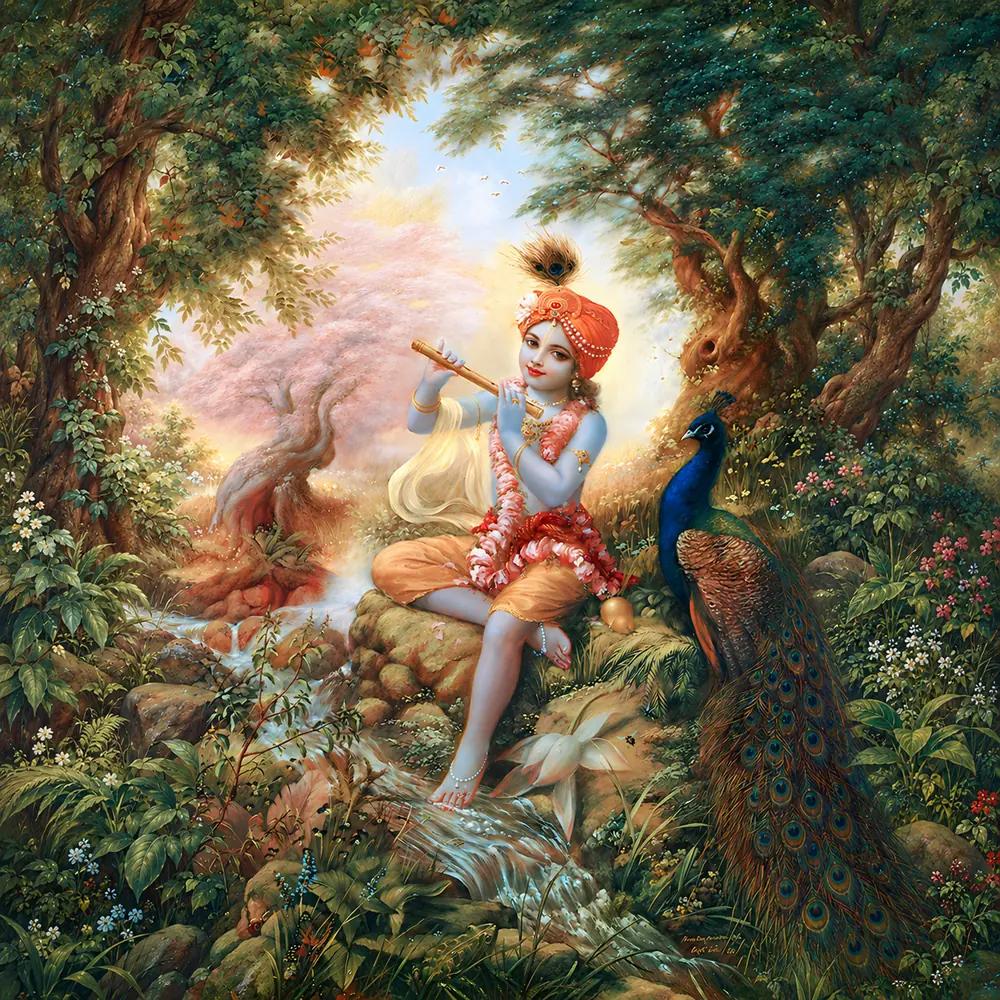
Lord Shri Krishna
575 Songs
Shrimati Radharani
107 Songs
Narasimha Prayers
10 Songs
Be a Part of Building Gupt Vrindavan Dham
Your support helps strengthen temple construction, Gau Seva, Annadaan Seva, cultural education, and devotional programs. Participate in Square Feet Seva, Mandir Nirman Seva, Annadaan, Gau Seva, and other sacred initiatives.