


Brahma-stuti (Lord Brahma's Prayers to Krsna)
Bhajan | Lord Brahma
Verse 1
śrī-brahmovāca
naumīḍya te 'bhra-vapuṣe taḍid-ambarāya
guñjāvataṁsa-paripiccha-lasan-mukhāya
vanya-sraje kavala-vetra-viṣāṇa-veṇu-
lakṣma-śriye mṛdu-pade paśupāṅgajāya
Verse 2
asyāpi deva vapuṣo mad-anugrahasya
svecchā-mayasya na tu bhūta-mayasya ko 'pi
neśe mahi tv avasituṁ manasāntareṇa
sākṣāt tavaiva kim utātma-sukhānubhūteḥ
Verse 3
jñāne prayāsam udapāsya namanta eva
jīvanti san-mukharitāṁ bhavadīya-vārtām
sthāne sthitāḥ śruti-gatāṁ tanu-vāṅ-manobhir
ye prāyaśo 'jita jito 'py asi tais tri-lokyām
Verse 4
śreyaḥ-sṛtiṁ bhaktim udasya te vibho
kliśyanti ye kevala-bodha-labdhaye
teṣām asau kleśala eva śiṣyate
nānyad yathā sthūla-tuṣāvaghātinām
Verse 5
pureha bhūman bahavo 'pi yoginas
tvad-arpitehā nija-karma-labdhayā
vibudhya bhaktyaiva kathopanītayā
prapedire 'ñjo 'cyuta te gatiṁ parām
Verse 6
tathāpi bhūman mahimāguṇasya te
viboddhum arhaty amalāntar-ātmabhiḥ
avikriyāt svānubhavād arūpato
hy ananya-bodhyātmatayā na cānyathā
Verse 7
guṇātmanas te 'pi guṇān vimātuṁ
hitāvatīṛnasya ka īśire 'sya
kālena yair vā vimitāḥ su-kalpair
bhū-pāṁśavaḥ khe mihikā dyu-bhāsaḥ
Verse 8
tat te 'nukampāṁ su-samīkṣamāṇo
bhuñjāna evātma-kṛtaṁ vipākam
hṛd-vāg-vapurbhir vidadhan namas te
jīveta yo mukti-pade sa dāya-bhāk
Verse 9
paśyeśa me 'nāryam ananta ādye
parātmani tvayy api māyi-māyini
māyāṁ vitatyekṣitum ātma-vaibhavaṁ
hy ahaṁ kiyān aiccham ivārcir agnau
Verse 10
ataḥ kṣamasvācyuta me rajo-bhuvo
hy ajānatas tvat-pṛthag-īśa-māninaḥ
ajāvalepāndha-tamo-'ndha-cakṣuṣa
eṣo 'nukampyo mayi nāthavān iti
Verse 11
kvāhaṁ tamo-mahad-ahaṁ-kha-carāgni-vār-bhū-
saṁveṣṭitāṇḍa-ghaṭa-sapta-vitasti-kāyaḥ
kvedṛg-vidhāvigaṇitāṇḍa-parāṇu-caryā-
vātādhva-roma-vivarasya ca te mahitvam
Verse 12
utkṣepaṇaṁ garbha-gatasya pādayoḥ
kiṁ kalpate mātur adhokṣajāgase
kim asti-nāsti-vyapadeśa-bhūṣitaṁ
tavāsti kukṣeḥ kiyad apy anantaḥ
Verse 13
jagat-trayāntodadhi-samplavode
nārāyaṇasyodara-nābhi-nālāt
vinirgato 'jas tv iti vāṅ na vai mṛṣā
kintv īśvara tvan na vinirgato 'smi
Verse 14
nārāyaṇas tvaṁ na hi sarva-dehinām
ātmāsy adhīśākhila-loka-sākṣī
nārāyaṇo 'ṅgaṁ nara-bhū-jalāyanāt
tac cāpi satyaṁ na tavaiva māyā
Verse 15
tac cej jala-sthaṁ tava saj jagad-vapuḥ
kiṁ me na dṛṣṭaṁ bhagavaṁs tadaiva
kiṁ vā su-dṛṣṭaṁ hṛdi me tadaiva
kiṁ no sapady eva punar vyadarśi
Verse 16
atraiva māyā-dhamanāvatāre
hy asya prapañcasya bahiḥ sphuṭasya
kṛtsnasya cāntar jaṭhare jananyā
māyātvam eva prakaṭī-kṛtaṁ te
Verse 17
yasya kukṣāv idaṁ sarvaṁ
sātmaṁ bhāti yathā tathā
tat tvayy apīha tat sarvaṁ
kim idaṁ māyayā vinā
Verse 18
adyaiva tvad ṛte 'sya kiṁ mama na te māyātvam ādarśitam
eko 'si prathamaṁ tato vraja-suhṛd-vatsāḥ samastā api
tāvanto 'si catur-bhujās tad akhilaiḥ sākaṁ mayopāsitās
tāvanty eva jaganty abhūs tad amitaṁ brahmādvayaṁ śiṣyate
Verse 19
ajānatāṁ tvat-padavīm anātmany
ātmātmanā bhāsi vitatya māyām
sṛṣṭāv ivāhaṁ jagato vidhāna
iva tvam eṣo 'nta iva trinetraḥ
Verse 20
sureṣv ṛṣiṣv īśa tathaiva nṛṣv api
tiryakṣu yādaḥsv api te 'janasya
janmāsatāṁ durmada-nigrahāya
prabho vidhātaḥ sad-anugrahāya ca
Verse 21
ko vetti bhūman bhagavan parātman
yogeśvarotīr bhavatas tri-lokyām
kva vā kathaṁ vā kati vā kadeti
vistārayan krīḍasi yoga-māyām
Verse 22
tasmād idaṁ jagad aśeṣam asat-svarūpaṁ
svapnābham asta-dhiṣaṇaṁ puru-duḥkha-duḥkham
tvayy eva nitya-sukha-bodha-tanāv anante
māyāta udyad api yat sad ivāvabhāti
Verse 23
ekas tvam ātmā puruṣaḥ purāṇaḥ
satyaḥ svayaṁ-jyotir ananta ādyaḥ
nityo 'kṣaro 'jasra-sukho nirañjanaḥ
pūrṇādvayo mukta upādhito 'mṛtaḥ
Verse 24
evaṁ-vidhaṁ tvāṁ sakalātmanām api
svātmānam ātmātmatayā vicakṣate
gurv-arka-labdhopaniṣat-sucakṣuṣā
ye te tarantīva bhavānṛtāmbudhim
Verse 25
ātmānam evātmatayāvijānatāṁ
tenaiva jātaṁ nikhilaṁ prapañcitam
jñānena bhūyo 'pi ca tat pralīyate
rajjvām aher bhoga-bhavābhavau yathā
Verse 26
ajñāna-saṁjñau bhava-bandha-mokṣau
dvau nāma nānyau sta ṛta-jña-bhāvāt
ajasra-city ātmani kevale pare
vicāryamāṇe taraṇāv ivāhanī
Verse 27
tvām ātmānaṁ paraṁ matvā
param ātmānam eva ca
ātmā punar bahir mṛgya
aho 'jña-janatājñatā
Verse 28
antar-bhave 'nanta bhavantam eva
hy atat tyajanto mṛgayanti santaḥ
asantam apy anty ahim antareṇa
santaṁ guṇaṁ taṁ kim u yanti santaḥ
Verse 29
athāpi te deva padāmbuja-dvaya-
prasāda-leśānugṛhīta eva hi
jānāti tattvaṁ bhagavan-mahimno
na cānya eko 'pi ciraṁ vicinvan
Verse 30
tad astu me nātha sa bhūri-bhāgo
bhave 'tra vānyatra tu vā tiraścām
yenāham eko 'pi bhavaj-janānāṁ
bhūtvā niṣeve tava pāda-pallavam
Verse 31
aho 'ti-dhanyā vraja-go-ramaṇyaḥ
stanyāmṛtaṁ pītam atīva te mudā
yāsāṁ vibho vatsatarātmajātmanā
yat-tṛptaye 'dyāpi na cālam adhvarāḥ
Verse 32
aho bhāgyam aho bhāgyaṁ
nanda-gopa-vrajaukasām
yan-mitraṁ paramānandaṁ
pūrṇaṁ brahma sanātanam
Verse 33
eṣāṁ tu bhāgya-mahimācyuta tāvad āstām
ekādaśaiva hi vayaṁ bata bhūri-bhāgāḥ
etad-dhṛṣīka-caṣakair asakṛt pibāmaḥ
śarvādayo 'ṅghry-udaja-madhv-amṛtāsavaṁ te
Verse 34
tad bhūri-bhāgyam iha janma kim apy aṭavyāṁ
yad gokule 'pi katamāṅghri-rajo-'bhiṣekam
yaj-jīvitaṁ tu nikhilaṁ bhagavān mukundas
tv adyāpi yat-pada-rajaḥ śruti-mṛgyam eva
Verse 35
eṣāṁ ghoṣa-nivāsinām uta bhavān kiṁ deva rāteti naś
ceto viśva-phalāt phalaṁ tvad-aparaṁ kutrāpy ayan muhyati
sad-veṣād iva pūtanāpi sa-kulā tvām eva devāpitā
yad-dhāmārtha-suhṛt-priyātma-tanaya-prāṇāśayās tvat-kṛte
Verse 36
tāvad rāgādayaḥ stenās
tāvat kārā-gṛhaṁ gṛham
tāvan moho 'ṅghri-nigaḍo
yāvat kṛṣṇa na te janāḥ
Verse 37
prapañcaṁ niṣprapañco 'pi
viḍambayasi bhū-tale
prapanna-janatānanda-
sandohaṁ prathituṁ prabho
Verse 38
jānanta eva jānantu
kiṁ bahūktyā na me prabho
manaso vapuṣo vāco
vaibhavaṁ tava go-caraḥ
Verse 39
anujānīhi māṁ kṛṣṇa
sarvaṁ tvaṁ vetsi sarva-dṛk
tvam eva jagatāṁ nātho
jagad etat tavārpitam
Verse 40
śrī-kṛṣṇa vṛṣṇi-kula-puṣkara-joṣa-dāyin
kṣmā-nirjara-dvija-paśūdadhi-vṛddhi-kārin
uddharma-śārvara-hara kṣiti-rākṣasa-dhrug
ā-kalpam ārkam arhan bhagavan namas te
Verse 1
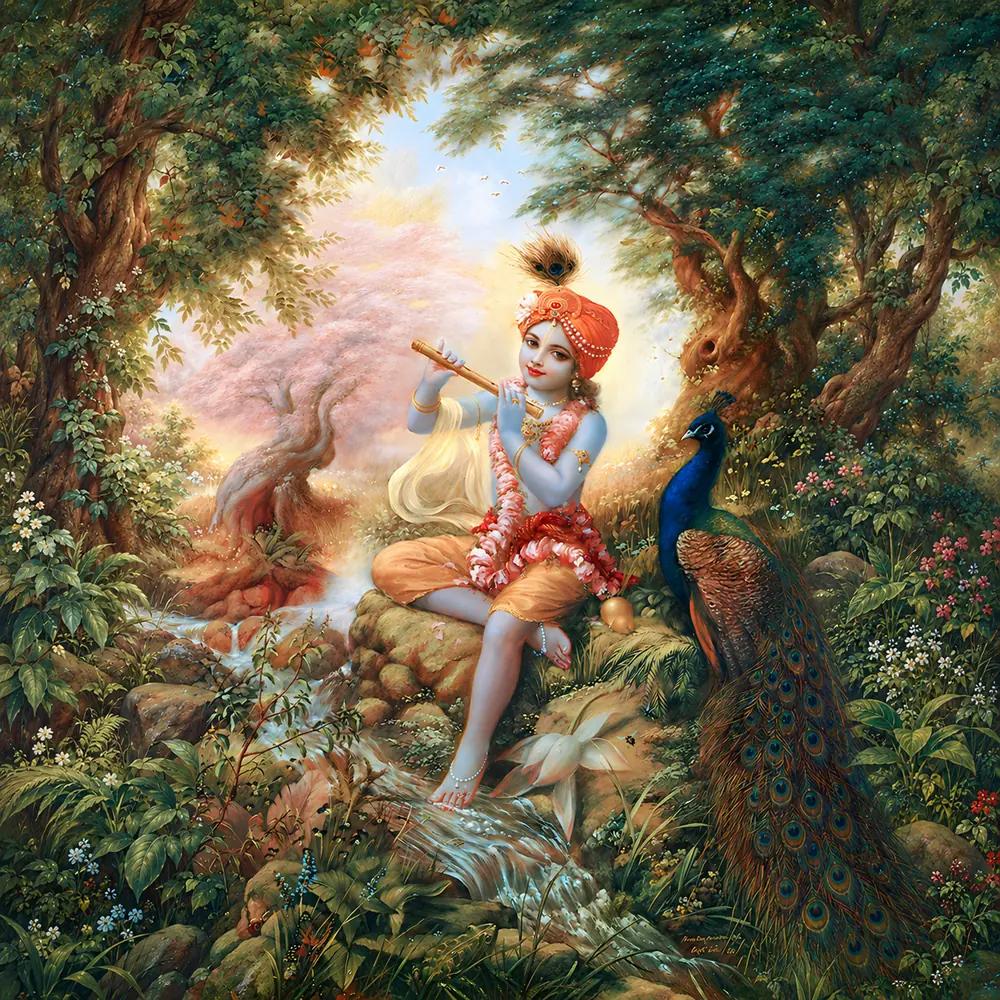
Lord Brahmā said: My dear Lord, You are the only worshipable Lord, the Supreme Personality of Godhead, and therefore I offer my humble obeisances and prayers just to please You. O son of the king of the cowherds, Your transcendental body is dark blue like a new cloud, Your garment is brilliant like lightning, and the beauty of Your face is enhanced by Your guñjā earrings and the peacock feather on Your head. Wearing garlands of various forest flowers and leaves, and equipped with a herding stick, a buffalo horn and a flute, You stand beautifully with a morsel of food in Your hand.
Verse 2
My dear Lord, neither I nor anyone else can estimate the potency of this transcendental body of Yours, which has shown such mercy to me and which appears just to fulfill the desires of Your pure devotees. Although my mind is completely withdrawn from material affairs, I cannot understand Your personal form. How, then, could I possibly understand the happiness You experience within Yourself?
Verse 3
Those who, even while remaining situated in their established social positions, throw away the process of speculative knowledge and with their body, words and mind offer all respects to descriptions of Your personality and activities, dedicating their lives to these narrations, which are vibrated by You personally and by Your pure devotees, certainly conquer Your Lordship, although You are otherwise unconquerable by anyone within the three worlds.
Verse 4
My dear Lord, devotional service unto You is the best path for self-realization. If someone gives up that path and engages in the cultivation of speculative knowledge, he will simply undergo a troublesome process and will not achieve his desired result. As a person who beats an empty husk of wheat cannot get grain, one who simply speculates cannot achieve self-realization. His only gain is trouble.
Verse 5
O almighty Lord, in the past many yogīs in this world achieved the platform of devotional service by offering all their endeavors unto You and faithfully carrying out their prescribed duties. Through such devotional service, perfected by the processes of hearing and chanting about You, they came to understand You, O infallible one, and could easily surrender to You and achieve Your supreme abode.
Verse 6
Nondevotees, however, cannot realize You in Your full personal feature. Nevertheless, it may be possible for them to realize Your expansion as the impersonal Supreme by cultivating direct perception of the Self within the heart. But they can do this only by purifying their mind and senses of all conceptions of material distinctions and all attachment to material sense objects. Only in this way will Your impersonal feature manifest itself to them.
Verse 7
In time, learned philosophers or scientists might be able to count all the atoms of the earth, the particles of snow, or perhaps even the shining molecules radiating from the sun, the stars and other luminaries. But among these learned men, who could possibly count the unlimited transcendental qualities possessed by You, the Supreme Personality of Godhead, who have descended onto the surface of the earth for the benefit of all living entities?
Verse 8
My dear Lord, one who earnestly waits for You to bestow Your causeless mercy upon him, all the while patiently suffering the reactions of his past misdeeds and offering You respectful obeisances with his heart, words and body, is surely eligible for liberation, for it has become his rightful claim.
Verse 9
My Lord, just see my uncivilized impudence! To test Your power I tried to extend my illusory potency to cover You, the unlimited and primeval Supersoul, who bewilder even the masters of illusion. What am I compared to You? I am just like a small spark in the presence of a great fire.
Verse 10
Therefore, O infallible Lord, kindly excuse my offenses. I have taken birth in the mode of passion and am therefore simply foolish, presuming myself a controller independent of Your Lordship. My eyes are blinded by the darkness of ignorance, which causes me to think of myself as the unborn creator of the universe. But please consider that I am Your servant and therefore worthy of Your compassion.
Verse 11
What am I, a small creature measuring seven spans of my own hand? I am enclosed in a potlike universe composed of material nature, the total material energy, false ego, ether, air, water and earth. And what is Your glory? Unlimited universes pass through the pores of Your body just as particles of dust pass through the openings of a screened window.
Verse 12
O Lord Adhokṣaja, does a mother take offense when the child within her womb kicks with his legs? And is there anything in existence — whether designated by various philosophers as real or as unreal — that is actually outside Your abdomen?
Verse 13
My dear Lord, it is said that when the three planetary systems are merged into the water at the time of dissolution, Your plenary portion, Nārāyaṇa, lies down on the water, gradually a lotus flower grows from His navel, and Brahmā takes birth upon that lotus flower. Certainly, these words are not false. Thus am I not born from You?
Verse 14
Are You not the original Nārāyaṇa, O supreme controller, since You are the Soul of every embodied being and the eternal witness of all created realms? Indeed, Lord Nārāyaṇa is Your expansion, and He is called Nārāyaṇa because He is the generating source of the primeval water of the universe. He is real, not a product of Your illusory Māyā.
Verse 15
My dear Lord, if Your transcendental body, which shelters the entire universe, is actually lying upon the water, then why were You not seen by me when I searched for You? And why, though I could not envision You properly within my heart, did You then suddenly reveal Yourself?
Verse 16
My dear Lord, in this incarnation You have proved that You are the supreme controller of Māyā. Although You are now within this universe, the whole universal creation is within Your transcendental body — a fact You demonstrated by exhibiting the universe within Your abdomen before Your mother, Yaśodā.
Verse 17
Just as this entire universe, including You, was exhibited within Your abdomen, so it is now manifested here externally in the same exact form. How could such things happen unless arranged by Your inconceivable energy?
Verse 18
Have You not shown me today that both You Yourself and everything within this creation are manifestations of Your inconceivable potency? First You appeared alone, and then You manifested Yourself as all of Vṛndāvana’s calves and cowherd boys, Your friends. Next You appeared as an equal number of four-handed Viṣṇu forms, who were worshiped by all living beings, including me, and after that You appeared as an equal number of complete universes. Finally, You have now returned to Your unlimited form as the Supreme Absolute Truth, one without a second.
Verse 19
To persons ignorant of Your actual transcendental position, You appear as part of the material world, manifesting Yourself by the expansion of Your inconceivable energy. Thus for the creation of the universe You appear as me [Brahmā], for its maintenance You appear as Yourself [Viṣṇu], and for its annihilation You appear as Lord Trinetra [Śiva].
Verse 20
O Lord, O supreme creator and master, You have no material birth, yet to defeat the false pride of the faithless demons and show mercy to Your saintly devotees, You take birth among the demigods, sages, human beings, animals and even the aquatics.
Verse 21
O supreme great one! O Supreme Personality of Godhead! O Supersoul, master of all mystic power! Your pastimes are taking place continuously in these three worlds, but who can estimate where, how and when You are employing Your spiritual energy and performing these innumerable pastimes? No one can understand the mystery of how Your spiritual energy acts.
Verse 22
Therefore this entire universe, which like a dream is by nature unreal, nevertheless appears real, and thus it covers one’s consciousness and assails one with repeated miseries. This universe appears real because it is manifested by the potency of illusion emanating from You, whose unlimited transcendental forms are full of eternal happiness and knowledge.
Verse 23
You are the one Supreme Soul, the primeval Supreme Personality, the Absolute Truth — self-manifested, endless and beginningless. You are eternal and infallible, perfect and complete, without any rival and free from all material designations. Your happiness can never be obstructed, nor have You any connection with material contamination. Indeed, You are the indestructible nectar of immortality.
Verse 24
Those who have received the clear vision of knowledge from the sunlike spiritual master can see You in this way, as the very Soul of all souls, the Supersoul of everyone’s own self. Thus understanding Your original personality, they are able to cross over the ocean of illusory material existence.
Verse 25
A person who mistakes a rope for a snake becomes fearful, but he then gives up his fear upon realizing that the so-called snake does not exist. Similarly, for those who fail to recognize You as the Supreme Soul of all souls, the expansive illusory material existence arises, but knowledge of You at once causes it to subside.
Verse 26
The conception of material bondage and the conception of liberation are both manifestations of ignorance. Being outside the scope of true knowledge, they cease to exist when one correctly understands that the pure spirit soul is distinct from matter and always fully conscious. At that time bondage and liberation no longer have any significance, just as day and night have no significance from the perspective of the sun.
Verse 27
Just see the foolishness of those ignorant persons who consider You to be some separated manifestation of illusion and who consider the self, which is actually You, to be something else, the material body. Such fools conclude that the supreme soul is to be searched for somewhere outside Your supreme personality.
Verse 28
O unlimited Lord, the saintly devotees seek You out within their own bodies by rejecting everything separate from You. Indeed, how can discriminating persons appreciate the real nature of a rope lying before them until they refute the illusion that it is a snake?
Verse 29
My Lord, if one is favored by even a slight trace of the mercy of Your lotus feet, he can understand the greatness of Your personality. But those who speculate to understand the Supreme Personality of Godhead are unable to know You, even though they continue to study the Vedas for many years.
Verse 30
My dear Lord, I therefore pray to be so fortunate that in this life as Lord Brahmā or in another life, wherever I take my birth, I may be counted as one of Your devotees. I pray that wherever I may be, even among the animal species, I can engage in devotional service to Your lotus feet.
Verse 31
O almighty Lord, how greatly fortunate are the cows and ladies of Vṛndāvana, the nectar of whose breast milk You have happily drunk to Your full satisfaction, taking the form of their calves and children! All the Vedic sacrifices performed from time immemorial up to the present day have not given You as much satisfaction.
Verse 32
How greatly fortunate are Nanda Mahārāja, the cowherd men and all the other inhabitants of Vrajabhūmi! There is no limit to their good fortune, because the Absolute Truth, the source of transcendental bliss, the eternal Supreme Brahman, has become their friend.
Verse 33
Yet even though the extent of the good fortune of these residents of Vṛndāvana is inconceivable, we eleven presiding deities of the various senses, headed by Lord Śiva, are also most fortunate, because the senses of these devotees of Vṛndāvana are the cups through which we repeatedly drink the nectarean, intoxicating beverage of the honey of Your lotus feet.
Verse 34
My greatest possible good fortune would be to take any birth whatever in this forest of Gokula and have my head bathed by the dust falling from the lotus feet of any of its residents. Their entire life and soul is the Supreme Personality of Godhead, Mukunda, the dust of whose lotus feet is still being searched for in the Vedic mantras.
Verse 35
My mind becomes bewildered just trying to think of what reward other than You could be found anywhere. You are the embodiment of all benedictions, which You bestow upon these residents of the cowherd community of Vṛndāvana. You have already arranged to give Yourself to Pūtanā and her family members in exchange for her disguising herself as a devotee. So what is left for You to give these devotees of Vṛndāvana, whose homes, wealth, friends, dear relations, bodies, children and very lives and hearts are all dedicated only to You?
Verse 36
My dear Lord Kṛṣṇa, until people become Your devotees, their material attachments and desires remain thieves, their homes remain prisons, and their affectionate feelings for their family members remain foot-shackles.
Verse 37
My dear master, although You have nothing to do with material existence, You come to this earth and imitate material life just to expand the varieties of ecstatic enjoyment for Your surrendered devotees.
Verse 38
There are people who say, “I know everything about Kṛṣṇa.” Let them think that way. As far as I am concerned, I do not wish to speak very much about this matter. O my Lord, let me say this much: As far as Your opulences are concerned, they are all beyond the reach of my mind, body and words.
Verse 39
My dear Kṛṣṇa, I now humbly request permission to leave. Actually, You are the knower and seer of all things. Indeed, You are the Lord of all the universes, and yet I offer this one universe unto You.
Verse 40
My dear Śrī Kṛṣṇa, You bestow happiness upon the lotuslike Vṛṣṇi dynasty and expand the great oceans consisting of the earth, the demigods, the brāhmaṇas and the cows. You dispel the dense darkness of irreligion and oppose the demons who have appeared on this earth. O Supreme Personality of Godhead, as long as this universe exists and as long as the sun shines, I will offer my obeisances unto You.
Verse 1
śrī-brahmovāca
naumīḍya te 'bhra-vapuṣe taḍid-ambarāya
guñjāvataṁsa-paripiccha-lasan-mukhāya
vanya-sraje kavala-vetra-viṣāṇa-veṇu-
lakṣma-śriye mṛdu-pade paśupāṅgajāya
Verse 2
asyāpi deva vapuṣo mad-anugrahasya
svecchā-mayasya na tu bhūta-mayasya ko 'pi
neśe mahi tv avasituṁ manasāntareṇa
sākṣāt tavaiva kim utātma-sukhānubhūteḥ
Verse 3
jñāne prayāsam udapāsya namanta eva
jīvanti san-mukharitāṁ bhavadīya-vārtām
sthāne sthitāḥ śruti-gatāṁ tanu-vāṅ-manobhir
ye prāyaśo 'jita jito 'py asi tais tri-lokyām
Verse 4
śreyaḥ-sṛtiṁ bhaktim udasya te vibho
kliśyanti ye kevala-bodha-labdhaye
teṣām asau kleśala eva śiṣyate
nānyad yathā sthūla-tuṣāvaghātinām
Verse 5
pureha bhūman bahavo 'pi yoginas
tvad-arpitehā nija-karma-labdhayā
vibudhya bhaktyaiva kathopanītayā
prapedire 'ñjo 'cyuta te gatiṁ parām
Verse 6
tathāpi bhūman mahimāguṇasya te
viboddhum arhaty amalāntar-ātmabhiḥ
avikriyāt svānubhavād arūpato
hy ananya-bodhyātmatayā na cānyathā
Verse 7
guṇātmanas te 'pi guṇān vimātuṁ
hitāvatīṛnasya ka īśire 'sya
kālena yair vā vimitāḥ su-kalpair
bhū-pāṁśavaḥ khe mihikā dyu-bhāsaḥ
Verse 8
tat te 'nukampāṁ su-samīkṣamāṇo
bhuñjāna evātma-kṛtaṁ vipākam
hṛd-vāg-vapurbhir vidadhan namas te
jīveta yo mukti-pade sa dāya-bhāk
Verse 9
paśyeśa me 'nāryam ananta ādye
parātmani tvayy api māyi-māyini
māyāṁ vitatyekṣitum ātma-vaibhavaṁ
hy ahaṁ kiyān aiccham ivārcir agnau
Verse 10
ataḥ kṣamasvācyuta me rajo-bhuvo
hy ajānatas tvat-pṛthag-īśa-māninaḥ
ajāvalepāndha-tamo-'ndha-cakṣuṣa
eṣo 'nukampyo mayi nāthavān iti
Verse 11
kvāhaṁ tamo-mahad-ahaṁ-kha-carāgni-vār-bhū-
saṁveṣṭitāṇḍa-ghaṭa-sapta-vitasti-kāyaḥ
kvedṛg-vidhāvigaṇitāṇḍa-parāṇu-caryā-
vātādhva-roma-vivarasya ca te mahitvam
Verse 12
utkṣepaṇaṁ garbha-gatasya pādayoḥ
kiṁ kalpate mātur adhokṣajāgase
kim asti-nāsti-vyapadeśa-bhūṣitaṁ
tavāsti kukṣeḥ kiyad apy anantaḥ
Verse 13
jagat-trayāntodadhi-samplavode
nārāyaṇasyodara-nābhi-nālāt
vinirgato 'jas tv iti vāṅ na vai mṛṣā
kintv īśvara tvan na vinirgato 'smi
Verse 14
nārāyaṇas tvaṁ na hi sarva-dehinām
ātmāsy adhīśākhila-loka-sākṣī
nārāyaṇo 'ṅgaṁ nara-bhū-jalāyanāt
tac cāpi satyaṁ na tavaiva māyā
Verse 15
tac cej jala-sthaṁ tava saj jagad-vapuḥ
kiṁ me na dṛṣṭaṁ bhagavaṁs tadaiva
kiṁ vā su-dṛṣṭaṁ hṛdi me tadaiva
kiṁ no sapady eva punar vyadarśi
Verse 16
atraiva māyā-dhamanāvatāre
hy asya prapañcasya bahiḥ sphuṭasya
kṛtsnasya cāntar jaṭhare jananyā
māyātvam eva prakaṭī-kṛtaṁ te
Verse 17
yasya kukṣāv idaṁ sarvaṁ
sātmaṁ bhāti yathā tathā
tat tvayy apīha tat sarvaṁ
kim idaṁ māyayā vinā
Verse 18
adyaiva tvad ṛte 'sya kiṁ mama na te māyātvam ādarśitam
eko 'si prathamaṁ tato vraja-suhṛd-vatsāḥ samastā api
tāvanto 'si catur-bhujās tad akhilaiḥ sākaṁ mayopāsitās
tāvanty eva jaganty abhūs tad amitaṁ brahmādvayaṁ śiṣyate
Verse 19
ajānatāṁ tvat-padavīm anātmany
ātmātmanā bhāsi vitatya māyām
sṛṣṭāv ivāhaṁ jagato vidhāna
iva tvam eṣo 'nta iva trinetraḥ
Verse 20
sureṣv ṛṣiṣv īśa tathaiva nṛṣv api
tiryakṣu yādaḥsv api te 'janasya
janmāsatāṁ durmada-nigrahāya
prabho vidhātaḥ sad-anugrahāya ca
Verse 21
ko vetti bhūman bhagavan parātman
yogeśvarotīr bhavatas tri-lokyām
kva vā kathaṁ vā kati vā kadeti
vistārayan krīḍasi yoga-māyām
Verse 22
tasmād idaṁ jagad aśeṣam asat-svarūpaṁ
svapnābham asta-dhiṣaṇaṁ puru-duḥkha-duḥkham
tvayy eva nitya-sukha-bodha-tanāv anante
māyāta udyad api yat sad ivāvabhāti
Verse 23
ekas tvam ātmā puruṣaḥ purāṇaḥ
satyaḥ svayaṁ-jyotir ananta ādyaḥ
nityo 'kṣaro 'jasra-sukho nirañjanaḥ
pūrṇādvayo mukta upādhito 'mṛtaḥ
Verse 24
evaṁ-vidhaṁ tvāṁ sakalātmanām api
svātmānam ātmātmatayā vicakṣate
gurv-arka-labdhopaniṣat-sucakṣuṣā
ye te tarantīva bhavānṛtāmbudhim
Verse 25
ātmānam evātmatayāvijānatāṁ
tenaiva jātaṁ nikhilaṁ prapañcitam
jñānena bhūyo 'pi ca tat pralīyate
rajjvām aher bhoga-bhavābhavau yathā
Verse 26
ajñāna-saṁjñau bhava-bandha-mokṣau
dvau nāma nānyau sta ṛta-jña-bhāvāt
ajasra-city ātmani kevale pare
vicāryamāṇe taraṇāv ivāhanī
Verse 27
tvām ātmānaṁ paraṁ matvā
param ātmānam eva ca
ātmā punar bahir mṛgya
aho 'jña-janatājñatā
Verse 28
antar-bhave 'nanta bhavantam eva
hy atat tyajanto mṛgayanti santaḥ
asantam apy anty ahim antareṇa
santaṁ guṇaṁ taṁ kim u yanti santaḥ
Verse 29
athāpi te deva padāmbuja-dvaya-
prasāda-leśānugṛhīta eva hi
jānāti tattvaṁ bhagavan-mahimno
na cānya eko 'pi ciraṁ vicinvan
Verse 30
tad astu me nātha sa bhūri-bhāgo
bhave 'tra vānyatra tu vā tiraścām
yenāham eko 'pi bhavaj-janānāṁ
bhūtvā niṣeve tava pāda-pallavam
Verse 31
aho 'ti-dhanyā vraja-go-ramaṇyaḥ
stanyāmṛtaṁ pītam atīva te mudā
yāsāṁ vibho vatsatarātmajātmanā
yat-tṛptaye 'dyāpi na cālam adhvarāḥ
Verse 32
aho bhāgyam aho bhāgyaṁ
nanda-gopa-vrajaukasām
yan-mitraṁ paramānandaṁ
pūrṇaṁ brahma sanātanam
Verse 33
eṣāṁ tu bhāgya-mahimācyuta tāvad āstām
ekādaśaiva hi vayaṁ bata bhūri-bhāgāḥ
etad-dhṛṣīka-caṣakair asakṛt pibāmaḥ
śarvādayo 'ṅghry-udaja-madhv-amṛtāsavaṁ te
Verse 34
tad bhūri-bhāgyam iha janma kim apy aṭavyāṁ
yad gokule 'pi katamāṅghri-rajo-'bhiṣekam
yaj-jīvitaṁ tu nikhilaṁ bhagavān mukundas
tv adyāpi yat-pada-rajaḥ śruti-mṛgyam eva
Verse 35
eṣāṁ ghoṣa-nivāsinām uta bhavān kiṁ deva rāteti naś
ceto viśva-phalāt phalaṁ tvad-aparaṁ kutrāpy ayan muhyati
sad-veṣād iva pūtanāpi sa-kulā tvām eva devāpitā
yad-dhāmārtha-suhṛt-priyātma-tanaya-prāṇāśayās tvat-kṛte
Verse 36
tāvad rāgādayaḥ stenās
tāvat kārā-gṛhaṁ gṛham
tāvan moho 'ṅghri-nigaḍo
yāvat kṛṣṇa na te janāḥ
Verse 37
prapañcaṁ niṣprapañco 'pi
viḍambayasi bhū-tale
prapanna-janatānanda-
sandohaṁ prathituṁ prabho
Verse 38
jānanta eva jānantu
kiṁ bahūktyā na me prabho
manaso vapuṣo vāco
vaibhavaṁ tava go-caraḥ
Verse 39
anujānīhi māṁ kṛṣṇa
sarvaṁ tvaṁ vetsi sarva-dṛk
tvam eva jagatāṁ nātho
jagad etat tavārpitam
Verse 40
śrī-kṛṣṇa vṛṣṇi-kula-puṣkara-joṣa-dāyin
kṣmā-nirjara-dvija-paśūdadhi-vṛddhi-kārin
uddharma-śārvara-hara kṣiti-rākṣasa-dhrug
ā-kalpam ārkam arhan bhagavan namas te
Verse 1
Lord Brahmā said: My dear Lord, You are the only worshipable Lord, the Supreme Personality of Godhead, and therefore I offer my humble obeisances and prayers just to please You. O son of the king of the cowherds, Your transcendental body is dark blue like a new cloud, Your garment is brilliant like lightning, and the beauty of Your face is enhanced by Your guñjā earrings and the peacock feather on Your head. Wearing garlands of various forest flowers and leaves, and equipped with a herding stick, a buffalo horn and a flute, You stand beautifully with a morsel of food in Your hand.
Verse 2
My dear Lord, neither I nor anyone else can estimate the potency of this transcendental body of Yours, which has shown such mercy to me and which appears just to fulfill the desires of Your pure devotees. Although my mind is completely withdrawn from material affairs, I cannot understand Your personal form. How, then, could I possibly understand the happiness You experience within Yourself?
Verse 3
Those who, even while remaining situated in their established social positions, throw away the process of speculative knowledge and with their body, words and mind offer all respects to descriptions of Your personality and activities, dedicating their lives to these narrations, which are vibrated by You personally and by Your pure devotees, certainly conquer Your Lordship, although You are otherwise unconquerable by anyone within the three worlds.
Verse 4
My dear Lord, devotional service unto You is the best path for self-realization. If someone gives up that path and engages in the cultivation of speculative knowledge, he will simply undergo a troublesome process and will not achieve his desired result. As a person who beats an empty husk of wheat cannot get grain, one who simply speculates cannot achieve self-realization. His only gain is trouble.
Verse 5
O almighty Lord, in the past many yogīs in this world achieved the platform of devotional service by offering all their endeavors unto You and faithfully carrying out their prescribed duties. Through such devotional service, perfected by the processes of hearing and chanting about You, they came to understand You, O infallible one, and could easily surrender to You and achieve Your supreme abode.
Verse 6
Nondevotees, however, cannot realize You in Your full personal feature. Nevertheless, it may be possible for them to realize Your expansion as the impersonal Supreme by cultivating direct perception of the Self within the heart. But they can do this only by purifying their mind and senses of all conceptions of material distinctions and all attachment to material sense objects. Only in this way will Your impersonal feature manifest itself to them.
Verse 7
In time, learned philosophers or scientists might be able to count all the atoms of the earth, the particles of snow, or perhaps even the shining molecules radiating from the sun, the stars and other luminaries. But among these learned men, who could possibly count the unlimited transcendental qualities possessed by You, the Supreme Personality of Godhead, who have descended onto the surface of the earth for the benefit of all living entities?
Verse 8
My dear Lord, one who earnestly waits for You to bestow Your causeless mercy upon him, all the while patiently suffering the reactions of his past misdeeds and offering You respectful obeisances with his heart, words and body, is surely eligible for liberation, for it has become his rightful claim.
Verse 9
My Lord, just see my uncivilized impudence! To test Your power I tried to extend my illusory potency to cover You, the unlimited and primeval Supersoul, who bewilder even the masters of illusion. What am I compared to You? I am just like a small spark in the presence of a great fire.
Verse 10
Therefore, O infallible Lord, kindly excuse my offenses. I have taken birth in the mode of passion and am therefore simply foolish, presuming myself a controller independent of Your Lordship. My eyes are blinded by the darkness of ignorance, which causes me to think of myself as the unborn creator of the universe. But please consider that I am Your servant and therefore worthy of Your compassion.
Verse 11
What am I, a small creature measuring seven spans of my own hand? I am enclosed in a potlike universe composed of material nature, the total material energy, false ego, ether, air, water and earth. And what is Your glory? Unlimited universes pass through the pores of Your body just as particles of dust pass through the openings of a screened window.
Verse 12
O Lord Adhokṣaja, does a mother take offense when the child within her womb kicks with his legs? And is there anything in existence — whether designated by various philosophers as real or as unreal — that is actually outside Your abdomen?
Verse 13
My dear Lord, it is said that when the three planetary systems are merged into the water at the time of dissolution, Your plenary portion, Nārāyaṇa, lies down on the water, gradually a lotus flower grows from His navel, and Brahmā takes birth upon that lotus flower. Certainly, these words are not false. Thus am I not born from You?
Verse 14
Are You not the original Nārāyaṇa, O supreme controller, since You are the Soul of every embodied being and the eternal witness of all created realms? Indeed, Lord Nārāyaṇa is Your expansion, and He is called Nārāyaṇa because He is the generating source of the primeval water of the universe. He is real, not a product of Your illusory Māyā.
Verse 15
My dear Lord, if Your transcendental body, which shelters the entire universe, is actually lying upon the water, then why were You not seen by me when I searched for You? And why, though I could not envision You properly within my heart, did You then suddenly reveal Yourself?
Verse 16
My dear Lord, in this incarnation You have proved that You are the supreme controller of Māyā. Although You are now within this universe, the whole universal creation is within Your transcendental body — a fact You demonstrated by exhibiting the universe within Your abdomen before Your mother, Yaśodā.
Verse 17
Just as this entire universe, including You, was exhibited within Your abdomen, so it is now manifested here externally in the same exact form. How could such things happen unless arranged by Your inconceivable energy?
Verse 18
Have You not shown me today that both You Yourself and everything within this creation are manifestations of Your inconceivable potency? First You appeared alone, and then You manifested Yourself as all of Vṛndāvana’s calves and cowherd boys, Your friends. Next You appeared as an equal number of four-handed Viṣṇu forms, who were worshiped by all living beings, including me, and after that You appeared as an equal number of complete universes. Finally, You have now returned to Your unlimited form as the Supreme Absolute Truth, one without a second.
Verse 19
To persons ignorant of Your actual transcendental position, You appear as part of the material world, manifesting Yourself by the expansion of Your inconceivable energy. Thus for the creation of the universe You appear as me [Brahmā], for its maintenance You appear as Yourself [Viṣṇu], and for its annihilation You appear as Lord Trinetra [Śiva].
Verse 20
O Lord, O supreme creator and master, You have no material birth, yet to defeat the false pride of the faithless demons and show mercy to Your saintly devotees, You take birth among the demigods, sages, human beings, animals and even the aquatics.
Verse 21
O supreme great one! O Supreme Personality of Godhead! O Supersoul, master of all mystic power! Your pastimes are taking place continuously in these three worlds, but who can estimate where, how and when You are employing Your spiritual energy and performing these innumerable pastimes? No one can understand the mystery of how Your spiritual energy acts.
Verse 22
Therefore this entire universe, which like a dream is by nature unreal, nevertheless appears real, and thus it covers one’s consciousness and assails one with repeated miseries. This universe appears real because it is manifested by the potency of illusion emanating from You, whose unlimited transcendental forms are full of eternal happiness and knowledge.
Verse 23
You are the one Supreme Soul, the primeval Supreme Personality, the Absolute Truth — self-manifested, endless and beginningless. You are eternal and infallible, perfect and complete, without any rival and free from all material designations. Your happiness can never be obstructed, nor have You any connection with material contamination. Indeed, You are the indestructible nectar of immortality.
Verse 24
Those who have received the clear vision of knowledge from the sunlike spiritual master can see You in this way, as the very Soul of all souls, the Supersoul of everyone’s own self. Thus understanding Your original personality, they are able to cross over the ocean of illusory material existence.
Verse 25
A person who mistakes a rope for a snake becomes fearful, but he then gives up his fear upon realizing that the so-called snake does not exist. Similarly, for those who fail to recognize You as the Supreme Soul of all souls, the expansive illusory material existence arises, but knowledge of You at once causes it to subside.
Verse 26
The conception of material bondage and the conception of liberation are both manifestations of ignorance. Being outside the scope of true knowledge, they cease to exist when one correctly understands that the pure spirit soul is distinct from matter and always fully conscious. At that time bondage and liberation no longer have any significance, just as day and night have no significance from the perspective of the sun.
Verse 27
Just see the foolishness of those ignorant persons who consider You to be some separated manifestation of illusion and who consider the self, which is actually You, to be something else, the material body. Such fools conclude that the supreme soul is to be searched for somewhere outside Your supreme personality.
Verse 28
O unlimited Lord, the saintly devotees seek You out within their own bodies by rejecting everything separate from You. Indeed, how can discriminating persons appreciate the real nature of a rope lying before them until they refute the illusion that it is a snake?
Verse 29
My Lord, if one is favored by even a slight trace of the mercy of Your lotus feet, he can understand the greatness of Your personality. But those who speculate to understand the Supreme Personality of Godhead are unable to know You, even though they continue to study the Vedas for many years.
Verse 30
My dear Lord, I therefore pray to be so fortunate that in this life as Lord Brahmā or in another life, wherever I take my birth, I may be counted as one of Your devotees. I pray that wherever I may be, even among the animal species, I can engage in devotional service to Your lotus feet.
Verse 31
O almighty Lord, how greatly fortunate are the cows and ladies of Vṛndāvana, the nectar of whose breast milk You have happily drunk to Your full satisfaction, taking the form of their calves and children! All the Vedic sacrifices performed from time immemorial up to the present day have not given You as much satisfaction.
Verse 32
How greatly fortunate are Nanda Mahārāja, the cowherd men and all the other inhabitants of Vrajabhūmi! There is no limit to their good fortune, because the Absolute Truth, the source of transcendental bliss, the eternal Supreme Brahman, has become their friend.
Verse 33
Yet even though the extent of the good fortune of these residents of Vṛndāvana is inconceivable, we eleven presiding deities of the various senses, headed by Lord Śiva, are also most fortunate, because the senses of these devotees of Vṛndāvana are the cups through which we repeatedly drink the nectarean, intoxicating beverage of the honey of Your lotus feet.
Verse 34
My greatest possible good fortune would be to take any birth whatever in this forest of Gokula and have my head bathed by the dust falling from the lotus feet of any of its residents. Their entire life and soul is the Supreme Personality of Godhead, Mukunda, the dust of whose lotus feet is still being searched for in the Vedic mantras.
Verse 35
My mind becomes bewildered just trying to think of what reward other than You could be found anywhere. You are the embodiment of all benedictions, which You bestow upon these residents of the cowherd community of Vṛndāvana. You have already arranged to give Yourself to Pūtanā and her family members in exchange for her disguising herself as a devotee. So what is left for You to give these devotees of Vṛndāvana, whose homes, wealth, friends, dear relations, bodies, children and very lives and hearts are all dedicated only to You?
Verse 36
My dear Lord Kṛṣṇa, until people become Your devotees, their material attachments and desires remain thieves, their homes remain prisons, and their affectionate feelings for their family members remain foot-shackles.
Verse 37
My dear master, although You have nothing to do with material existence, You come to this earth and imitate material life just to expand the varieties of ecstatic enjoyment for Your surrendered devotees.
Verse 38
There are people who say, “I know everything about Kṛṣṇa.” Let them think that way. As far as I am concerned, I do not wish to speak very much about this matter. O my Lord, let me say this much: As far as Your opulences are concerned, they are all beyond the reach of my mind, body and words.
Verse 39
My dear Kṛṣṇa, I now humbly request permission to leave. Actually, You are the knower and seer of all things. Indeed, You are the Lord of all the universes, and yet I offer this one universe unto You.
Verse 40
My dear Śrī Kṛṣṇa, You bestow happiness upon the lotuslike Vṛṣṇi dynasty and expand the great oceans consisting of the earth, the demigods, the brāhmaṇas and the cows. You dispel the dense darkness of irreligion and oppose the demons who have appeared on this earth. O Supreme Personality of Godhead, as long as this universe exists and as long as the sun shines, I will offer my obeisances unto You.
STAY CONNECTED
Subscribe to get updates on new songs, mantras, and devotional Content.
Explore More Categories
Find more bhajans grouped by devotional theme.
Dependency
253 Songs
Glories of the Holy Name
184 Songs
Prayer for Mercy
149 Songs
Other
366 Songs

Shri Chaitanya Mahaprabhu
323 Songs
Stotram & Ashtakam
216 Songs
Tulasi Songs
5 Songs
Pranam Mantras
54 Songs
Spiritual Master
61 Songs
Shri Nityananada Prabhu
34 Songs
Lord Shri Krishna
575 Songs
Shrimati Radharani
107 Songs
Narasimha Prayers
10 Songs

Be a Part of Building Gupt Vrindavan Dham
Your support helps strengthen temple construction, Gau Seva, Annadaan Seva, cultural education, and devotional programs. Participate in Square Feet Seva, Mandir Nirman Seva, Annadaan, Gau Seva, and other sacred initiatives.