

 Donate Now
Narasimha Kavacam Vaksye
Bhajan | Prahalad Maharaj
Verse 1
nṛsiṁha-kavacaṁ vakṣye
prahlādenoditaṁ purā
sarva-rakṣā-karaṁ puṇyaṁ
sarvopadrava-nāśanam
Verse 2
sarva-sampat-karaṁ caiva
svarga-mokṣa-pradāyakam
dhyātvā nṛsiṁhaṁ deveśaṁ
hema-siṁhāsana-sthitam
Verse 3
vivṛtāsyaṁ tri-nayanaṁ
śarad-indu-sama-prabham
lakṣmy-āliṅgita-vāmāṅgaṁ
vibhūtibhir upāśritam
Verse 4
catur-bhujaṁ komalāṅgaṁ
svarṇa-kuṇḍala-śobhitam
saroja-śobhitoraskaṁ
ratna-keyūra-mudritam
Verse 5
tapta-kāñcana-saṅkāśaṁ
pīta-nirmala-vāsasam
indrādi-sura-mauliṣṭhaḥ
sphuran māṇikya-dīptibhiḥ
Verse 6
virājita-pada-dvandvaṁ
śaṅkha-cakrādi-hetibhiḥ
garutmatā ca vinayāt
stūyamānaṁ mudānvitam
Verse 7
sva-hṛt-kamala-saṁvāsaṁ
kṛtvā tu kavacaṁ paṭhet
nṛsiṁho me śiraḥ pātu
loka-rakṣārtha-sambhavaḥ
Verse 8
sarvago ’pi stambha-vāsaḥ
phālaṁ me rakṣatu dhvanim
nṛsiṁho me dṛśau pātu
soma-sūryāgni-locanaḥ
Verse 9
smṛtiṁ me pātu nṛhariḥ
muni-varya-stuti-priyaḥ
nāsāṁ me siṁha-nāsas tu
mukhaṁ lakṣmī-mukha-priyaḥ
Verse 10
sarva-vidyādhipaḥ pātu
nṛsiṁho rasanāṁ mama
vaktraṁ pātv indu-vadanaṁ
sadā prahlāda-vanditaḥ
Verse 11
nṛsiṁhaḥ pātu me kaṇṭhaṁ
skandhau bhū-bharaṇānta-kṛt
divyāstra-śobhita-bhujaḥ
nṛsiṁhaḥ pātu me bhujau
Verse 12
karau me deva-varado
nṛsiṁhaḥ pātu sarvataḥ
hṛdayaṁ yogi-sādhyaś ca
nivāsaṁ pātu me hariḥ
Verse 13
madhyaṁ pātu hiraṇyākṣa-
vakṣaḥ-kukṣi-vidāraṇaḥ
nābhiṁ me pātu nṛhariḥ
sva-nābhi-brahma-saṁstutaḥ
Verse 14
brahmāṇḍa-koṭayaḥ kaṭyāṁ
yasyāsau pātu me kaṭim
guhyaṁ me pātu guhyānāṁ
mantrāṇāṁ guhya-rūpa-dhṛk
Verse 15
ūrū manobhavaḥ pātu
jānunī nara-rūpa-dhṛk
jaṅghe pātu dharā-bhāra-
hartā yo ’sau nṛ-keśarī
Verse 16
sura-rājya-pradaḥ pātu
pādau me nṛharīśvaraḥ
sahasra-śīrṣā-puruṣaḥ
pātu me sarvaśas tanum
Verse 17
mahograḥ pūrvataḥ pātu
mahā-vīrāgrajo ’gnitaḥ
mahā-viṣṇur dakṣiṇe tu
mahā-jvālas tu nairṛtau
Verse 18
paścime pātu sarveśo
diśi me sarvato-mukhaḥ
nṛsiṁhaḥ pātu vāyavyāṁ
saumyāṁ bhūṣaṇa-vigrahaḥ
Verse 19
īśānyāṁ pātu bhadro me
sarva-maṅgala-dāyakaḥ
saṁsāra-bhayataḥ pātu
mṛtyor mṛtyur nṛ-keśarī
Verse 20
idaṁ nṛsiṁha-kavacaṁ
prahlāda-mukha-maṇḍitam
bhaktimān yaḥ paṭhen nityaṁ
sarva-pāpaiḥ pramucyate
Verse 21
putravān dhanavān loke
dīrghāyur upajāyate
yaṁ yaṁ kāmayate kāmaṁ
taṁ taṁ prāpnoty asaṁśayam
Verse 22
sarvatra jayam āpnoti
sarvatra vijayī bhavet
bhūmy-antarīkṣa-divyānāṁ
grahāṇāṁ vinivāraṇam
Verse 23
vṛścikoraga-sambhūta-
viṣāpaharaṇaṁ param
brahma-rākṣasa-yakṣāṇāṁ
dūrotsāraṇa-kāraṇam
Verse 24
bhūrje vā tāla-patre vā
kavacaṁ likhitaṁ śubham
kara-mūle dhṛtaṁ yena
sidhyeyuḥ karma-siddhayaḥ
Verse 25
devāsura-manuṣyeṣu
svaṁ svam eva jayaṁ labhet
eka-sandhyaṁ tri-sandhyaṁ vā
yaḥ paṭhen niyato naraḥ
Verse 26
sarva-maṅgala-māṅgalyaṁ
bhuktiṁ muktiṁ ca vindati
dvā-triṁśati-sahasrāṇi
paṭhec chuddhātmanāṁ nṛṇām
Verse 27
kavacasyāsya mantrasya
mantra-siddhiḥ prajāyate
anena mantra-rājena
kṛtvā bhasmābhimantraṇam
Verse 28
tilakaṁ vinyased yas tu
tasya graha-bhayaṁ haret
tri-vāraṁ japamānas tu
dattaṁ vāry abhimantrya ca
Verse 29
prāśayed yo naro mantraṁ
nṛsiṁha-dhyānam ācaret
tasya rogāḥ praṇaśyanti
ye ca syuḥ kukṣi-sambhavāḥ
Verse 30
kim atra bahunoktena
nṛsiṁha-sadṛśo bhavet
manasā cintitaṁ yat tu
sa tac cāpnoty asaṁśayam
Verse 31
garjantaṁ garjayantaṁ nija-bhuja-paṭalaṁ sphoṭayantaṁ haṭhantaṁ
rūpyantaṁ tāpayantaṁ divi bhuvi ditijaṁ kṣepayantaṁ kṣipantam
krandantaṁ roṣayantaṁ diśi diśi satataṁ saṁharantaṁ bharantaṁ
vīkṣantaṁ ghūrṇayantaṁ śara-nikara-śatair divya-siṁhaṁ namāmi
iti śrī-brahmāṇḍa-purāṇe prahlādoktaṁ śrī-nṛsiṁha-kavacaṁ sampūrṇam
Verse 1
I shall now recite the Nrsimha-kavaca, formerly spoken by Prahlada Maharaja. It is most pious, vanquishes all kinds of impediments, and provides one all protection.
Verse 2
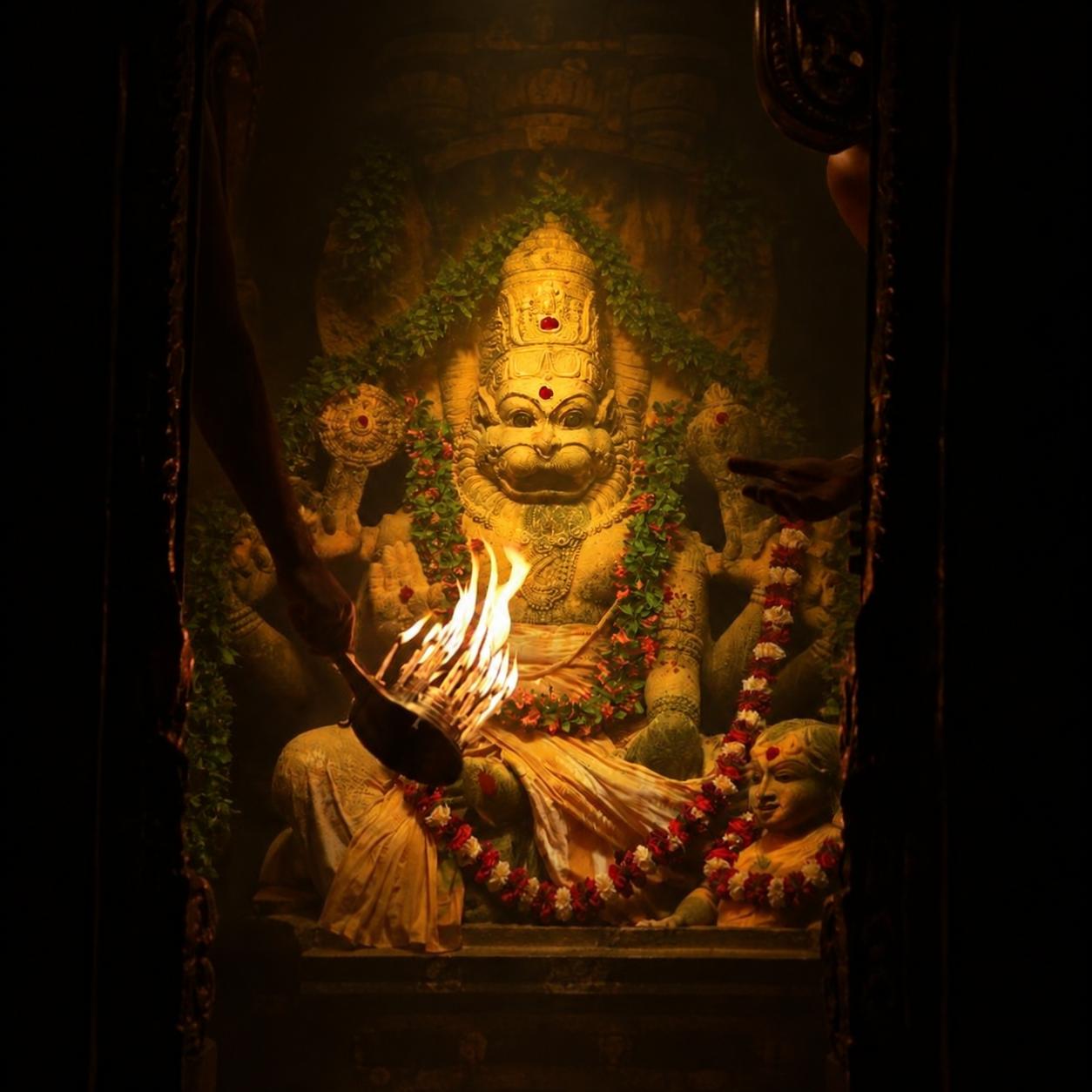
It bestows upon one all opulences and can give one elevation to the heavenly planets or liberation. One should meditate on Lord Nrsimha, Lord of the universe, seated upon a golden throne.
Verse 3
His mouth is wide open, He has three eyes, and He is as radiant as the autumn moon. He is embraced by Laksmidevi on his left side, and His form is the shelter of all opulences, both material and spiritual.
Verse 4
The Lord has four arms, and His limbs are very soft. He is decorated with golden earrings. His chest is resplendent like the lotus flower, and His arms are decorated with jewel-studded ornaments.
Verse 5
He is dressed in a spotless yellow garment, which exactly resembles molten gold. He is the original cause of existence, beyond the mundane sphere, for the great demigods headed by Indra. He appears bedecked with rubies which are blazingly effulgent.
Verse 6
His two feet are very attractive, and He is armed with various weapons such as the conch, disc, etc. Garuda joyfully offers prayers with great reverence.
Verse 7
Having seated Lord Nrsimhadeva upon the lotus of one's heart, one should recite the following mantra: May Lord Nrsimha, who protects all the planetary systems, protect my head.
Verse 8
Although the Lord is all-pervading, He hid Himself within a pillar. May He protect my speech and the results of my activities. May Lord Nrsimha, whose eyes are the sun, and fire, protect my eyes.
Verse 9
May Lord Nrhari, who is pleased by the prayers offered by the best of sages, protect my memory. May He who has the nose of a lion protect my nose, and may He whose face is very dear to the goddess of fortune protect my mouth.
Verse 10
May Lord Nrsimha, who is the knower of all sciences, protect my sense of taste. May He whose face is beautiful as the full moon and who is offered prayers by Prahlada Maharaja protect my face.
Verse 11
May Lord Nrsimha protect my throat. He is the sustainer of the earth and the performer of unlimitedly wonderful activities. May He protect my shoulders. His arms are resplendent with transcendental weapons. May He protect my shoulders.
Verse 12
May the Lord, who bestows benedictions upon the demigods, protect my hands, and may He protect me from all sides. May He who is achieved by the perfect yogis protect my heart, and may Lord Hari protect my dwelling place.
Verse 13
May He who ripped apart the chest and abdomen of the great demon Hiranyaksa protect my waist, and may Lord Nrhari protect my navel. He is offered prayers by Lord Brahma, who has sprung from his own navel.
Verse 14
May He on whose hips rest all the universes protect my hips. May the Lord protect my private parts. He is the knower of all mantras and all mysteries, but He Himself is not visible.
Verse 15
May He who is the original Cupid protect my thighs. May He who exhibits a human-like form protect my knees. May the remover of the burden of the earth, who appears in a form which is half-man and half-lion, protect my calves.
Verse 16
May the bestower of heavenly opulence protect my feet. He is the Supreme Controller in the form of a man and lion combined. May the thousand-headed Supreme enjoyer protect my body from all sides and in all respects.
Verse 17
May that most ferocious personality protect me from the east. May He who is superior to the greatest heroes protect me from the southeast, which is presided over by Agni. May the Supreme Visnu protect me from the south, and may that person of blazing luster protect me from the southwest.
Verse 18
May the Lord of everything protect me from the west. His faces are everywhere, so please may He protect me from this direction. May Lord Nrsimha protect me from the northwest, which is predominated by Vayu, and may He whose form is in itself the supreme ornament protect me from the north, where Soma resides.
Verse 19
May the all-auspicious Lord, who Himself bestows all-auspiciousness, protect from the northeast, the direction of the sun-god, and may He who is death personified protect me from fear of death and rotation in this material world.
Verse 20
This Nrsimha-kavaca has been ornamented by issuing from the mouth of Prahlada Maharaja. A devotee who reads this becomes freed from all sins.
Verse 21
Whatever one desires in this world he can attain without doubt. One can have wealth, many sons, and a long life.
Verse 22
He becomes victorious who desires victory, and indeed becomes a conqueror. He wards off the influence of all planets, earthly, heavenly, and everything in between.
Verse 23
This is the supreme remedy for the poisonous effects of serpents and scorpions, and Brahma-raksasa ghosts and Yaksas are driven away.
Verse 24
One may write this most auspicious prayer on his arm, or inscribe it on a palm-leaf and attach it to his wrist, and all his activities will become perfect.
Verse 25
One who regularly chants this prayer, whether once or thrice (daily), he becomes victorious whether among demigods, demons, or human beings.
Verse 26
One who with purified heart recites this prayer 32,000 times attains the most auspicious of all auspicious things, and material enjoyment and liberation are already understood to be available to such a person.
Verse 27
This Kavaca-mantra is the king of all mantras. One attains by it what would be attained by anointing oneself with ashes and chanting all other mantras.
Verse 28
Having marked one’s body with tilaka, taking acamana with water, and reciting this mantra three times, one will find that the fear of all inauspicious planets is removed.
Verse 29
That person who recites this mantra, meditating upon Lord Nrsimhadeva, has all of his diseases vanquished, including those of the abdomen.
Verse 30
Why should more be said? One acquires qualitative oneness with Narasimha Himself. There is no doubt that the desires in the mind of one who meditates will be granted.
Verse 31
Lord Nrsimha roars loudly and causes others to roar. With His multitudes of arms He tears the demons asunder and kills them in this way. He is always seeking out and tormenting the demoniac descendants of Diti, both on this earth planet and in the higher planets, and He throws them down and scatters them. He cries with great anger as He destroys the demons in all directions, yet with His unlimited hands He sustains, protects, and nourishes the cosmic manifestation. I offer my respectful obeisances to the Lord, who has assumed the form of a transcendental lion.
Verse 1
nṛsiṁha-kavacaṁ vakṣye
prahlādenoditaṁ purā
sarva-rakṣā-karaṁ puṇyaṁ
sarvopadrava-nāśanam
Verse 2
sarva-sampat-karaṁ caiva
svarga-mokṣa-pradāyakam
dhyātvā nṛsiṁhaṁ deveśaṁ
hema-siṁhāsana-sthitam
Verse 3
vivṛtāsyaṁ tri-nayanaṁ
śarad-indu-sama-prabham
lakṣmy-āliṅgita-vāmāṅgaṁ
vibhūtibhir upāśritam
Verse 4
catur-bhujaṁ komalāṅgaṁ
svarṇa-kuṇḍala-śobhitam
saroja-śobhitoraskaṁ
ratna-keyūra-mudritam
Verse 5
tapta-kāñcana-saṅkāśaṁ
pīta-nirmala-vāsasam
indrādi-sura-mauliṣṭhaḥ
sphuran māṇikya-dīptibhiḥ
Verse 6
virājita-pada-dvandvaṁ
śaṅkha-cakrādi-hetibhiḥ
garutmatā ca vinayāt
stūyamānaṁ mudānvitam
Verse 7
sva-hṛt-kamala-saṁvāsaṁ
kṛtvā tu kavacaṁ paṭhet
nṛsiṁho me śiraḥ pātu
loka-rakṣārtha-sambhavaḥ
Verse 8
sarvago ’pi stambha-vāsaḥ
phālaṁ me rakṣatu dhvanim
nṛsiṁho me dṛśau pātu
soma-sūryāgni-locanaḥ
Verse 9
smṛtiṁ me pātu nṛhariḥ
muni-varya-stuti-priyaḥ
nāsāṁ me siṁha-nāsas tu
mukhaṁ lakṣmī-mukha-priyaḥ
Verse 10
sarva-vidyādhipaḥ pātu
nṛsiṁho rasanāṁ mama
vaktraṁ pātv indu-vadanaṁ
sadā prahlāda-vanditaḥ
Verse 11
nṛsiṁhaḥ pātu me kaṇṭhaṁ
skandhau bhū-bharaṇānta-kṛt
divyāstra-śobhita-bhujaḥ
nṛsiṁhaḥ pātu me bhujau
Verse 12
karau me deva-varado
nṛsiṁhaḥ pātu sarvataḥ
hṛdayaṁ yogi-sādhyaś ca
nivāsaṁ pātu me hariḥ
Verse 13
madhyaṁ pātu hiraṇyākṣa-
vakṣaḥ-kukṣi-vidāraṇaḥ
nābhiṁ me pātu nṛhariḥ
sva-nābhi-brahma-saṁstutaḥ
Verse 14
brahmāṇḍa-koṭayaḥ kaṭyāṁ
yasyāsau pātu me kaṭim
guhyaṁ me pātu guhyānāṁ
mantrāṇāṁ guhya-rūpa-dhṛk
Verse 15
ūrū manobhavaḥ pātu
jānunī nara-rūpa-dhṛk
jaṅghe pātu dharā-bhāra-
hartā yo ’sau nṛ-keśarī
Verse 16
sura-rājya-pradaḥ pātu
pādau me nṛharīśvaraḥ
sahasra-śīrṣā-puruṣaḥ
pātu me sarvaśas tanum
Verse 17
mahograḥ pūrvataḥ pātu
mahā-vīrāgrajo ’gnitaḥ
mahā-viṣṇur dakṣiṇe tu
mahā-jvālas tu nairṛtau
Verse 18
paścime pātu sarveśo
diśi me sarvato-mukhaḥ
nṛsiṁhaḥ pātu vāyavyāṁ
saumyāṁ bhūṣaṇa-vigrahaḥ
Verse 19
īśānyāṁ pātu bhadro me
sarva-maṅgala-dāyakaḥ
saṁsāra-bhayataḥ pātu
mṛtyor mṛtyur nṛ-keśarī
Verse 20
idaṁ nṛsiṁha-kavacaṁ
prahlāda-mukha-maṇḍitam
bhaktimān yaḥ paṭhen nityaṁ
sarva-pāpaiḥ pramucyate
Verse 21
putravān dhanavān loke
dīrghāyur upajāyate
yaṁ yaṁ kāmayate kāmaṁ
taṁ taṁ prāpnoty asaṁśayam
Verse 22
sarvatra jayam āpnoti
sarvatra vijayī bhavet
bhūmy-antarīkṣa-divyānāṁ
grahāṇāṁ vinivāraṇam
Verse 23
vṛścikoraga-sambhūta-
viṣāpaharaṇaṁ param
brahma-rākṣasa-yakṣāṇāṁ
dūrotsāraṇa-kāraṇam
Verse 24
bhūrje vā tāla-patre vā
kavacaṁ likhitaṁ śubham
kara-mūle dhṛtaṁ yena
sidhyeyuḥ karma-siddhayaḥ
Verse 25
devāsura-manuṣyeṣu
svaṁ svam eva jayaṁ labhet
eka-sandhyaṁ tri-sandhyaṁ vā
yaḥ paṭhen niyato naraḥ
Verse 26
sarva-maṅgala-māṅgalyaṁ
bhuktiṁ muktiṁ ca vindati
dvā-triṁśati-sahasrāṇi
paṭhec chuddhātmanāṁ nṛṇām
Verse 27
kavacasyāsya mantrasya
mantra-siddhiḥ prajāyate
anena mantra-rājena
kṛtvā bhasmābhimantraṇam
Verse 28
tilakaṁ vinyased yas tu
tasya graha-bhayaṁ haret
tri-vāraṁ japamānas tu
dattaṁ vāry abhimantrya ca
Verse 29
prāśayed yo naro mantraṁ
nṛsiṁha-dhyānam ācaret
tasya rogāḥ praṇaśyanti
ye ca syuḥ kukṣi-sambhavāḥ
Verse 30
kim atra bahunoktena
nṛsiṁha-sadṛśo bhavet
manasā cintitaṁ yat tu
sa tac cāpnoty asaṁśayam
Verse 31
garjantaṁ garjayantaṁ nija-bhuja-paṭalaṁ sphoṭayantaṁ haṭhantaṁ
rūpyantaṁ tāpayantaṁ divi bhuvi ditijaṁ kṣepayantaṁ kṣipantam
krandantaṁ roṣayantaṁ diśi diśi satataṁ saṁharantaṁ bharantaṁ
vīkṣantaṁ ghūrṇayantaṁ śara-nikara-śatair divya-siṁhaṁ namāmi
iti śrī-brahmāṇḍa-purāṇe prahlādoktaṁ śrī-nṛsiṁha-kavacaṁ sampūrṇam
Verse 1
I shall now recite the Nrsimha-kavaca, formerly spoken by Prahlada Maharaja. It is most pious, vanquishes all kinds of impediments, and provides one all protection.
Verse 2
It bestows upon one all opulences and can give one elevation to the heavenly planets or liberation. One should meditate on Lord Nrsimha, Lord of the universe, seated upon a golden throne.
Verse 3
His mouth is wide open, He has three eyes, and He is as radiant as the autumn moon. He is embraced by Laksmidevi on his left side, and His form is the shelter of all opulences, both material and spiritual.
Verse 4
The Lord has four arms, and His limbs are very soft. He is decorated with golden earrings. His chest is resplendent like the lotus flower, and His arms are decorated with jewel-studded ornaments.
Verse 5
He is dressed in a spotless yellow garment, which exactly resembles molten gold. He is the original cause of existence, beyond the mundane sphere, for the great demigods headed by Indra. He appears bedecked with rubies which are blazingly effulgent.
Verse 6
His two feet are very attractive, and He is armed with various weapons such as the conch, disc, etc. Garuda joyfully offers prayers with great reverence.
Verse 7
Having seated Lord Nrsimhadeva upon the lotus of one's heart, one should recite the following mantra: May Lord Nrsimha, who protects all the planetary systems, protect my head.
Verse 8
Although the Lord is all-pervading, He hid Himself within a pillar. May He protect my speech and the results of my activities. May Lord Nrsimha, whose eyes are the sun, and fire, protect my eyes.
Verse 9
May Lord Nrhari, who is pleased by the prayers offered by the best of sages, protect my memory. May He who has the nose of a lion protect my nose, and may He whose face is very dear to the goddess of fortune protect my mouth.
Verse 10
May Lord Nrsimha, who is the knower of all sciences, protect my sense of taste. May He whose face is beautiful as the full moon and who is offered prayers by Prahlada Maharaja protect my face.
Verse 11
May Lord Nrsimha protect my throat. He is the sustainer of the earth and the performer of unlimitedly wonderful activities. May He protect my shoulders. His arms are resplendent with transcendental weapons. May He protect my shoulders.
Verse 12
May the Lord, who bestows benedictions upon the demigods, protect my hands, and may He protect me from all sides. May He who is achieved by the perfect yogis protect my heart, and may Lord Hari protect my dwelling place.
Verse 13
May He who ripped apart the chest and abdomen of the great demon Hiranyaksa protect my waist, and may Lord Nrhari protect my navel. He is offered prayers by Lord Brahma, who has sprung from his own navel.
Verse 14
May He on whose hips rest all the universes protect my hips. May the Lord protect my private parts. He is the knower of all mantras and all mysteries, but He Himself is not visible.
Verse 15
May He who is the original Cupid protect my thighs. May He who exhibits a human-like form protect my knees. May the remover of the burden of the earth, who appears in a form which is half-man and half-lion, protect my calves.
Verse 16
May the bestower of heavenly opulence protect my feet. He is the Supreme Controller in the form of a man and lion combined. May the thousand-headed Supreme enjoyer protect my body from all sides and in all respects.
Verse 17
May that most ferocious personality protect me from the east. May He who is superior to the greatest heroes protect me from the southeast, which is presided over by Agni. May the Supreme Visnu protect me from the south, and may that person of blazing luster protect me from the southwest.
Verse 18
May the Lord of everything protect me from the west. His faces are everywhere, so please may He protect me from this direction. May Lord Nrsimha protect me from the northwest, which is predominated by Vayu, and may He whose form is in itself the supreme ornament protect me from the north, where Soma resides.
Verse 19
May the all-auspicious Lord, who Himself bestows all-auspiciousness, protect from the northeast, the direction of the sun-god, and may He who is death personified protect me from fear of death and rotation in this material world.
Verse 20
This Nrsimha-kavaca has been ornamented by issuing from the mouth of Prahlada Maharaja. A devotee who reads this becomes freed from all sins.
Verse 21
Whatever one desires in this world he can attain without doubt. One can have wealth, many sons, and a long life.
Verse 22
He becomes victorious who desires victory, and indeed becomes a conqueror. He wards off the influence of all planets, earthly, heavenly, and everything in between.
Verse 23
This is the supreme remedy for the poisonous effects of serpents and scorpions, and Brahma-raksasa ghosts and Yaksas are driven away.
Verse 24
One may write this most auspicious prayer on his arm, or inscribe it on a palm-leaf and attach it to his wrist, and all his activities will become perfect.
Verse 25
One who regularly chants this prayer, whether once or thrice (daily), he becomes victorious whether among demigods, demons, or human beings.
Verse 26
One who with purified heart recites this prayer 32,000 times attains the most auspicious of all auspicious things, and material enjoyment and liberation are already understood to be available to such a person.
Verse 27
This Kavaca-mantra is the king of all mantras. One attains by it what would be attained by anointing oneself with ashes and chanting all other mantras.
Verse 28
Having marked one’s body with tilaka, taking acamana with water, and reciting this mantra three times, one will find that the fear of all inauspicious planets is removed.
Verse 29
That person who recites this mantra, meditating upon Lord Nrsimhadeva, has all of his diseases vanquished, including those of the abdomen.
Verse 30
Why should more be said? One acquires qualitative oneness with Narasimha Himself. There is no doubt that the desires in the mind of one who meditates will be granted.
Verse 31
Lord Nrsimha roars loudly and causes others to roar. With His multitudes of arms He tears the demons asunder and kills them in this way. He is always seeking out and tormenting the demoniac descendants of Diti, both on this earth planet and in the higher planets, and He throws them down and scatters them. He cries with great anger as He destroys the demons in all directions, yet with His unlimited hands He sustains, protects, and nourishes the cosmic manifestation. I offer my respectful obeisances to the Lord, who has assumed the form of a transcendental lion.
STAY CONNECTED
Subscribe to get updates on new songs, mantras, and devotional Content.
Explore More Categories
Find more bhajans grouped by devotional theme.
Dependency
28 Songs
Glories of the Holy Name
126 Songs
Prayer for Mercy
22 Songs
Other
21 Songs

Shri Chaitanya Mahaprabhu
17 Songs
Stotram & Ashtakam
14 Songs
Tulasi Songs
2 Songs
Pranam Mantras
17 Songs
Spiritual Master
8 Songs
Shri Nityananada Prabhu
9 Songs
Lord Shri Krishna
20 Songs
Shrimati Radharani
7 Songs
Narasimha Prayers
7 Songs
Be a Part of Building Gupt Vrindavan Dham
Your support helps strengthen temple construction, Gau Seva, Annadaan Seva, cultural education, and devotional programs. Participate in Square Feet Seva, Mandir Nirman Seva, Annadaan, Gau Seva, and other sacred initiatives.